
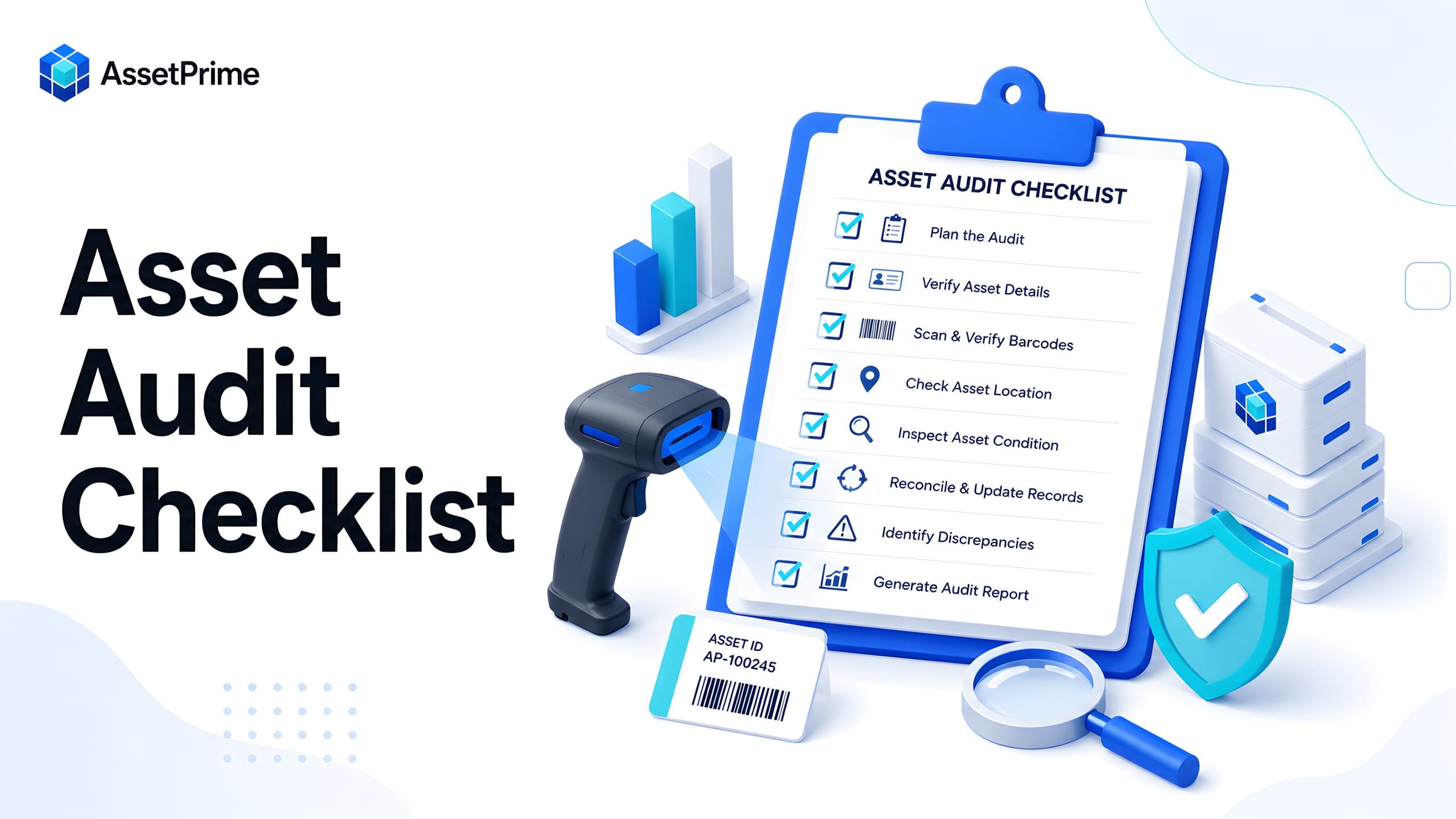
What is an asset audit?
An asset audit is a structured comparison between the organization’s physical assets and its recorded asset data. It verifies that assets exist, are correctly identified, are held at the expected location, are assigned to the correct custodian, and have an accurate condition and lifecycle status.
A complete audit does more than count items. It checks barcodes, serial numbers, categories, branches, rooms, departments, ownership, assignments, maintenance state, warranty, AMC, insurance, supporting documents, and disposal evidence.
The goal is to establish whether the asset register can be trusted. The process identifies missing assets, unrecorded assets, duplicate records, incorrect locations, damaged equipment, inactive assignments, unauthorized movements, and records that should have been retired or disposed.
Asset audits may be conducted by internal teams, external auditors, finance, IT, facilities, engineering, biomedical teams, stores, or a combined cross-functional group depending on the organization and asset type.
Need the actionable checklist?
Follow the step-by-step physical asset audit checklist
This article explains the complete audit process, controls, exceptions, and reporting. Use the dedicated checklist for a concise before, during, and after-audit action list.
View the asset audit checklist →“You cannot control assets clearly when ownership, location, maintenance, and audit history live in separate files.”
Why organizations need a formal audit checklist
Assets change continuously after purchase. They are received, installed, assigned, transferred, loaned, repaired, returned, stored, replaced, retired, sold, scrapped, or lost. When those events are not recorded consistently, the register gradually diverges from reality.
A checklist ensures that every audit team follows the same scope, evidence standards, exception categories, and approval process. Without it, one branch may perform only a count while another checks serial numbers, condition, and custody, making results difficult to compare.
The checklist also protects audit quality when the work is distributed among several people. Each person knows what to verify, what evidence to collect, which issues require escalation, and how completed locations are signed off.
A repeatable process makes future audits faster because the organization can compare findings, measure closure rates, and identify departments or asset categories with recurring control failures.
What strong asset control should make visible
- ✓Where each asset is located today.
- ✓Who is responsible for the asset.
- ✓When it was purchased, moved, maintained, or disposed.
- ✓Which records are ready for audit, reporting, and decision-making.
Define the audit objective and scope
Before scanning or counting, define why the audit is being performed. The objective may be annual financial verification, internal control testing, insurance validation, handover, compliance, branch closure, merger integration, loss investigation, or data cleanup.
Define the population clearly: all assets, capitalized assets, IT equipment, medical devices, tools, vehicles, leased assets, assets above a value threshold, or assets within selected branches and departments.
Establish the audit period, cutoff date, included locations, excluded records, treatment of assets under repair or in transit, and whether bulk quantities will be counted separately from serialized units.
Documenting scope prevents disagreements later about whether an asset should have been inspected and helps the reconciliation team understand expected exceptions such as newly received or recently transferred items.
Assign roles and responsibilities
Appoint an audit owner who is accountable for planning, progress, escalation, reconciliation, and final sign-off. The owner should coordinate with finance, procurement, stores, IT, facilities, maintenance, department heads, and local custodians.
Separate the verifier from the person solely responsible for the assets where independence is important. A custodian can assist in locating assets, but the verifier should confirm the evidence.
Define who can update records, approve location changes, classify missing assets, confirm disposals, and close exceptions. Audit teams should not silently alter master data to make the physical result match the register.
Provide each verifier with assigned locations or asset groups and track completion. Large audits benefit from branch coordinators who manage access, local communication, and unresolved items.
Freeze the baseline and control transactions
Create an audit baseline from the asset register at a defined cutoff date. The baseline should contain unique identifiers, expected location, custodian, status, condition, serial number, barcode, quantity, and relevant financial or coverage details.
Operations may need to continue during the audit, so completely freezing asset movement is not always practical. Instead, record movements after the cutoff separately and reconcile them against the baseline.
Avoid exporting a spreadsheet and then allowing uncontrolled edits in several copies. Maintain one approved baseline and record audit observations and approved corrections separately.
For long audits, use timestamps and transaction references so the team can distinguish a genuine discrepancy from an asset that was legitimately transferred after the baseline was created.
Prepare the asset data before fieldwork
Review the register for obvious data-quality problems before physical verification. Identify duplicate asset codes, duplicate serial numbers, missing locations, blank custodians, invalid statuses, assets assigned to former employees, and disposed assets still shown as active.
Normalize branch and location names, confirm the hierarchy, and make sure closed rooms or departments are mapped correctly. Poor location data can waste substantial time during fieldwork.
Segment the population by location, category, value, portability, and risk. This helps determine the order of verification and highlights assets that require photographs, calibration evidence, or additional documentation.
Prepare exception categories in advance, such as found as expected, found elsewhere, wrong custodian, damaged, barcode missing, serial mismatch, unrecorded asset, duplicate record, missing, service out, in transit, retired, or disposed.
Communicate with branches and departments
Notify branch managers, department heads, and custodians about the audit dates, scope, responsibilities, and access requirements. Ask them not to move assets unnecessarily during the verification window.
Request that desks, storage rooms, server rooms, workshops, warehouses, rooftops, vehicles, and restricted areas be accessible. Assets hidden in locked cabinets or offsite rooms are common reasons for incomplete audits.
Ask departments to provide lists of assets sent for repair, issued temporarily, transferred recently, held by remote employees, or awaiting disposal. These lists should support verification but should not replace independent evidence.
Clear communication reduces disruption and prevents staff from interpreting the audit as a fault-finding exercise. The purpose is to establish reliable records and accountability.
Prepare audit tools and evidence standards
Verifiers may use barcode scanners, smartphones, tablets, printed location lists, label printers, tamper-resistant tags, cameras, and portable chargers. Test devices and user access before fieldwork begins.
Define what qualifies as sufficient evidence. For a serialized asset, this may include barcode scan, serial number match, location, condition, custodian confirmation, and photograph for selected high-risk units.
For bulk assets, define the counting method, unit of measure, handling of sealed boxes, and tolerance rules. Record damaged and unusable quantities separately rather than including them in available stock.
Offline procedures should be planned for locations with weak connectivity. Any offline files or paper sheets should be controlled, numbered, and imported or reconciled promptly to avoid duplicate work.
Physical verification checklist for each asset
Confirm the asset code or barcode and compare the serial number, make, model, and description with the register. Never assume an asset is correct only because it looks similar to the expected item.
Confirm the branch, building, floor, room, department, and custodian. Record whether the asset is installed, in storage, temporarily loaned, assigned, under maintenance, service out, or awaiting disposal.
Assess condition using standard values such as new, good, fair, damaged, or unusable. Add notes for visible defects, missing accessories, safety concerns, or evidence that the asset is no longer operational.
Check whether the label is readable and securely attached. Replace damaged labels through a controlled process that preserves the same asset identity instead of creating a duplicate record.
Barcode and serial-number verification
Barcode scanning reduces manual entry and helps connect the physical item directly to its digital record. The scan should display enough information for the verifier to confirm that the correct asset has been selected.
Compare the manufacturer serial number for serialized assets. A barcode can be attached to the wrong device, and a serial-number check helps detect swapped labels or duplicate records.
When a label is missing, search using serial number, model, prior location, custodian, or other identifiers before creating a new record. Many duplicate assets are created during audits because an existing record was not found.
Record label exceptions separately: missing, damaged, unreadable, duplicated, wrong asset, or placed in an inaccessible location. Label replacement should be reviewed and logged.
Location and custody verification
An asset found in a different room or branch is not automatically missing, but it is an exception that requires explanation and correction. Record the observed location and identify whether a movement was omitted.
Confirm employee assignments with both the physical asset and the custodian where possible. Remote, traveling, or offsite assets may require photographs, live video verification, signed declarations, endpoint records, or return-to-office checks according to policy.
Check shared assets differently from assigned assets. A conference-room display may have a location owner rather than an individual custodian, while a laptop should usually have a named assignee.
Assets held by repair vendors, contractors, or customers should have service-out, loan, or custody documentation showing destination, dispatch date, expected return, and responsible internal owner.
Condition, maintenance, and safety checks
Physical verification is an opportunity to identify damaged, unsafe, inactive, or underutilized assets. Use a standardized condition scale so results can be compared across locations.
Check whether preventive maintenance, calibration, certification, or inspection is overdue. For critical equipment, verify service labels and supporting records in addition to the asset register.
Record assets repeatedly repaired, cannibalized for parts, or no longer economical to maintain. These findings can support replacement planning and disposal decisions.
Do not allow an audit observation to replace a maintenance work order or safety escalation. Critical defects should be routed immediately to the responsible team.
Warranty, AMC, insurance, and document review
For selected high-value or critical assets, verify warranty, AMC, insurance, calibration, ownership, and statutory documents. Confirm that policy or contract references match the asset and that coverage dates are current.
Check whether newly purchased assets were added to insurance schedules and whether disposed assets were removed. Differences between the register and insurance list can create financial exposure.
Verify invoices, purchase orders, goods-receipt records, installation certificates, service reports, and disposal approvals on a sample or risk basis.
Document gaps should be classified and assigned for closure. The physical existence of an asset does not prove ownership, value, or coverage.
How to handle common audit exceptions
Use predefined statuses for exceptions so the results can be summarized consistently. Typical categories include missing, found in another location, wrong custodian, untagged, duplicate, serial mismatch, damaged, inactive, unrecorded, disposed without documentation, and record exists but asset was never received.
Do not immediately write off a missing asset. Search previous locations, assigned users, repair records, movement history, disposal stores, and recently closed departments. Establish a follow-up deadline and escalation path.
For an unrecorded asset, collect evidence and confirm ownership before adding it. It may belong to an employee, contractor, customer, donor, lessor, or another group company.
Every correction should retain the original observation, reviewer, decision, and supporting evidence. An audit trail is more valuable than simply changing the register until all rows appear correct.
Reconciliation and root-cause analysis
After fieldwork, compare observed results with the baseline and transactions recorded after the cutoff. Resolve timing differences before classifying control failures.
Reconciliation should identify not only the final status of each exception but also the root cause. Examples include delayed receiving, unauthorized transfer, missed assignment return, incomplete disposal, duplicate import, poor label placement, or weak handover procedures.
Group findings by branch, department, category, custodian, value, and exception type. Patterns are more actionable than a long list of unrelated discrepancies.
Assign corrective actions with owners and deadlines. Examples include updating location hierarchies, improving receiving controls, enforcing movement approval, retrieving assets from former employees, replacing labels, or completing disposal documentation.
Asset audit reporting checklist
The final report should state the objective, scope, cutoff date, locations, population, methodology, limitations, team, and evidence standards. It should distinguish serialized units from bulk quantities.
Include total assets expected, verified as expected, verified with exceptions, not found, newly discovered, damaged, untagged, and pending follow-up. Financial exposure may be reported using acquisition cost, book value, or replacement value according to purpose.
Summarize root causes, high-risk findings, repeated issues, and unresolved exceptions. Management should be able to see where control weaknesses are concentrated.
The report should also include corrective actions, owners, target dates, approval, and final closure status. A report without remediation tracking does not complete the audit process.
Continuous and cycle-count auditing
Organizations do not always need to wait for one large annual audit. Cycle counts verify selected assets throughout the year based on value, risk, portability, movement frequency, or regulatory importance.
High-risk laptops, tools, medical devices, vehicles, and portable equipment may be verified quarterly or semi-annually, while fixed low-risk furniture may be checked less frequently.
Continuous verification at receiving, assignment, transfer, maintenance, and return also improves the register. Each controlled scan becomes evidence that the asset existed at a specific place and time.
A risk-based schedule reduces disruption, identifies problems earlier, and makes year-end verification more manageable.
Common asset audit mistakes to avoid
Common mistakes include starting without a defined baseline, relying only on asset descriptions, allowing uncontrolled spreadsheet edits, counting without checking serial numbers, and changing records during verification without preserving evidence.
Other failures include ignoring remote and service-out assets, treating all missing items as losses, creating duplicates for untagged assets, failing to verify bulk quantities, and closing exceptions without management approval.
Audit teams also lose value when they focus only on financial assets and ignore operational equipment that creates safety, service, or accountability risk.
Finally, repeating the same audit every year without fixing root causes produces recurring discrepancies. The audit should lead to stronger receiving, movement, assignment, maintenance, and disposal processes.
How AssetPrime supports asset audits
AssetPrime centralizes serialized and bulk asset records across branches and hierarchical locations. Barcode identification helps teams verify assets, locations, conditions, and custodians with less manual entry.
Movement, assignment, maintenance, warranty, AMC, insurance, procurement, depreciation, disposal, document, and audit histories provide context when an asset is not found where expected.
Role-based and location-based access controls help distribute verification work without exposing unrelated data. Reports can highlight assigned assets, location stock, recent movements, open maintenance, expiring coverage, and lifecycle exceptions.
By connecting physical verification to operational workflows, AssetPrime helps organizations maintain a reliable register between audits rather than correcting the data only once a year.
Final thoughts
An effective asset audit is a controlled process of preparation, physical verification, evidence collection, reconciliation, approval, and corrective action. The checklist should be consistent enough to produce comparable results across every branch and department.
Barcode scanning can make verification faster, but audit quality still depends on clear scope, accurate baseline data, independent checks, exception handling, and ownership of corrective actions.
Organizations that combine regular verification with controlled receiving, movements, assignments, maintenance, and disposal will experience fewer missing assets and far more reliable operational and financial records.
Related AssetPrime Pages
Continue with related pages
Explore connected features, guides, solutions, and industry pages that support this topic.
FAQ
Frequently asked questions
What is an asset audit checklist?
An asset audit checklist is a standardized list of planning, verification, evidence, reconciliation, reporting, and follow-up steps used to compare physical assets with the asset register.
How often should physical asset verification be performed?
Many organizations perform a full audit annually and use quarterly or semi-annual cycle counts for high-value, portable, critical, or frequently moved assets. The frequency should reflect risk, policy, and regulatory requirements.
What should be checked during an asset audit?
Verify asset code, barcode, serial number, description, branch, location, custodian, status, condition, quantity, maintenance, coverage, documents, and evidence for assets that are assigned, offsite, under repair, retired, or disposed.
How are missing assets handled during an audit?
Search movement, assignment, maintenance, service-out, storage, and disposal records; contact custodians; set a follow-up deadline; and escalate unresolved cases. Do not immediately delete or write off the record.
Can smartphones be used for barcode asset audits?
Yes. Smartphones can scan many one-dimensional barcodes and QR codes and are practical for distributed teams, provided the software, camera quality, label design, connectivity, and security controls are suitable.
What is the difference between an asset audit and inventory count?
An asset audit typically verifies individual identity, serial number, location, custodian, condition, lifecycle, and documentation. An inventory count often focuses primarily on quantities of stock items.
How should remote employee assets be verified?
Organizations may use live video checks, time-stamped photographs, signed declarations, endpoint-management evidence, courier collection, or scheduled physical inspection according to risk and policy.
Should auditors update the asset register directly?
Observed results should normally be recorded separately and corrections should follow review and approval. This preserves the original baseline, evidence, and audit trail.
What should an asset audit report include?
Include objective, scope, cutoff date, population, methodology, verified totals, exception categories, financial exposure, root causes, limitations, corrective actions, owners, deadlines, approvals, and closure status.
How does AssetPrime support physical asset verification?
AssetPrime supports barcode-based identification, serialized and bulk assets, multi-branch locations, assignments, movements, maintenance, coverage, disposal, documents, audit history, access controls, and reports that help investigate and reconcile exceptions.
Continue Reading
Related articles
Asset Management
What Is Asset Management Software? A Complete Guide for Modern Organizations
Read Article →
Asset Tracking
Asset Tracking vs Inventory Management: Key Differences for Modern Businesses
Read Article →
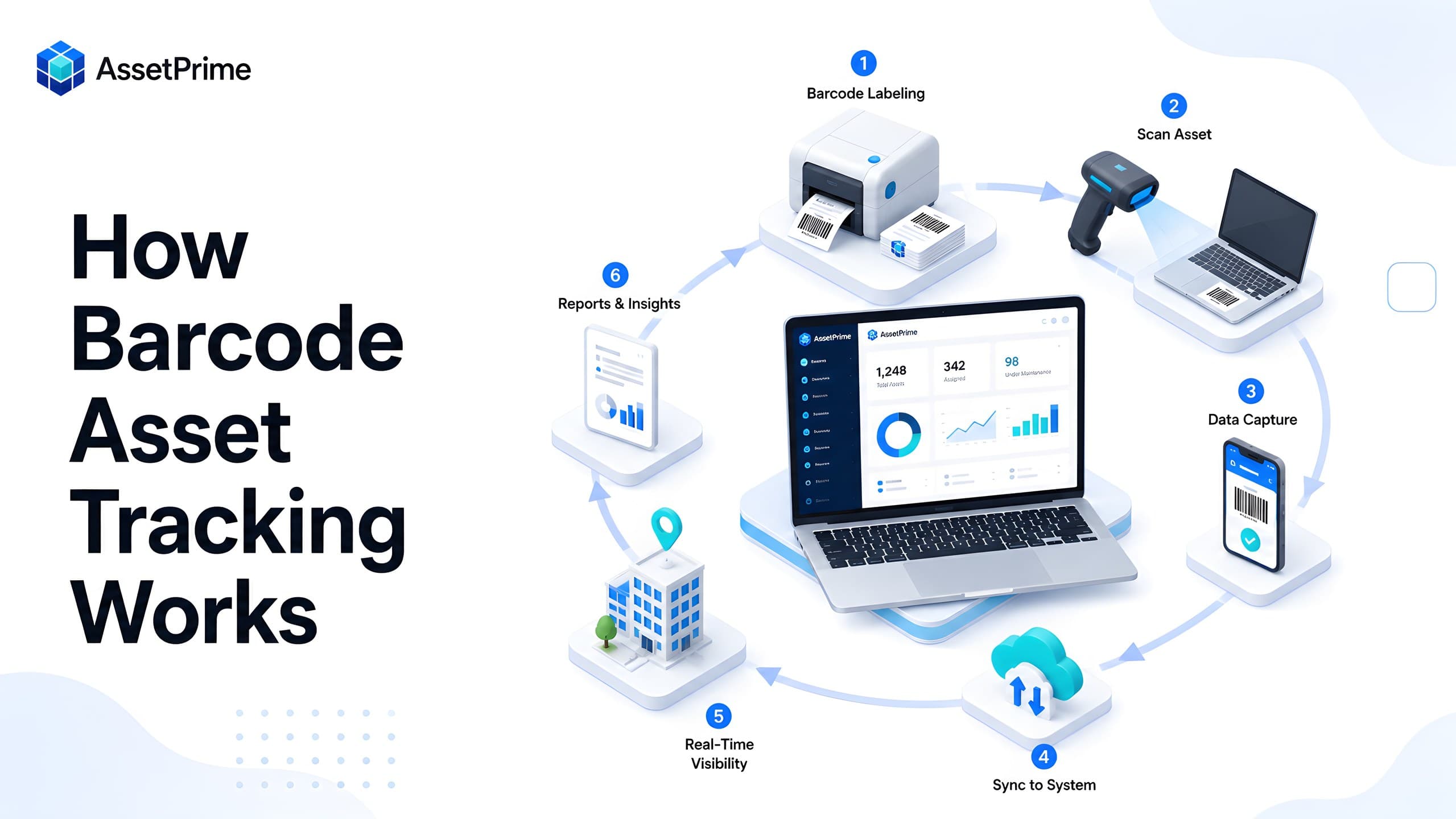
Barcode Tracking
How Barcode Asset Tracking Works: A Complete Guide for Modern Asset Operations
Read Article →