
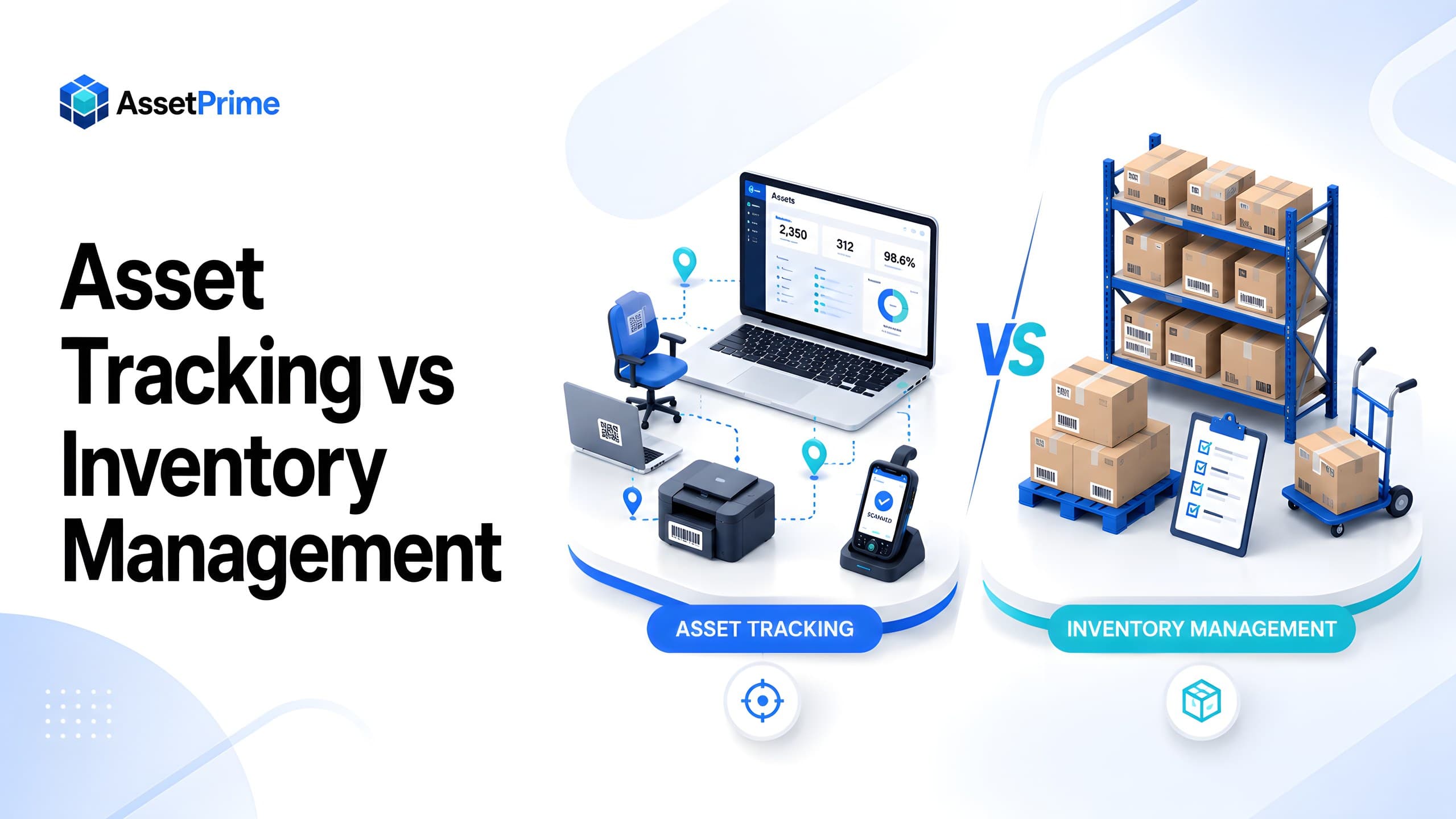
Asset tracking and inventory management are related, but they are not the same
Asset tracking and inventory management are often used together in business conversations, but they are not the same discipline. Both help organizations control physical items, reduce loss, and improve visibility. The difference is in the type of item being managed, the questions the business needs to answer, and the level of history required for each item.
Asset tracking focuses on long-term assets used by the organization to operate. These assets usually remain in use for months or years and often require ownership, assignment, movement history, maintenance, warranty, depreciation, audit evidence, and disposal records. Laptops, medical equipment, machinery, tools, vehicles, furniture, printers, scanners, and facility equipment are common examples.
Inventory management focuses on stock quantity, availability, replenishment, receipt, issue, consumption, transfer, or sale. Consumables, spare parts, raw materials, packaging materials, saleable goods, medicines, office supplies, and warehouse stock are common inventory examples. The primary question is usually how many units are available and where they are held.
The confusion happens because many organizations start by putting everything into one spreadsheet. Assets, inventory, serial numbers, purchase values, departments, quantities, users, locations, and notes are all mixed together. This may work temporarily, but it becomes unreliable when some items need lifecycle history while others need quantity control.
Modern organizations need a clear distinction. Asset tracking tells the life story of a specific asset. Inventory management tells the quantity and availability story of stock. When both are handled correctly, finance, operations, IT, administration, warehouse, maintenance, and audit teams can work from cleaner data.
“You cannot control assets clearly when ownership, location, maintenance, and audit history live in separate files.”
What asset tracking focuses on
Asset tracking is the process of identifying, recording, locating, assigning, maintaining, auditing, and retiring physical assets across their useful life. It is designed for items that need identity, accountability, history, and governance rather than only quantity tracking.
A strong asset tracking process answers practical questions. Where is this asset now? Which branch, building, floor, department, room, store, or employee is responsible for it? When was it purchased? What is its current condition? Has it moved before? Is it under maintenance? Is it covered by warranty, AMC, or insurance? What documents are attached? When should it be replaced, retired, or disposed?
Asset tracking is usually item-specific. A laptop assigned to an employee needs its own identity. A hospital monitor in a department needs its own service history and coverage details. A production machine in a plant needs lifecycle visibility, maintenance cost, and audit history. These details cannot be managed reliably with only a quantity balance.
Good asset tracking also preserves history. If an asset moves from one room to another, from one branch to another, from stock to an employee, or from operations to a service center, the movement should be recorded. If an asset is repaired, returned, lost, retired, or disposed, that activity should remain connected to the asset record.
This is why asset tracking is closely connected with asset lifecycle management, asset assignment, barcode tracking, movement tracking, maintenance, warranty, AMC, insurance, depreciation, audit logs, and reporting. It is not just about knowing that an asset exists. It is about knowing what happened to it from purchase to disposal.
What strong asset control should make visible
- ✓Where each asset is located today.
- ✓Who is responsible for the asset.
- ✓When it was purchased, moved, maintained, or disposed.
- ✓Which records are ready for audit, reporting, and decision-making.
What inventory management focuses on
Inventory management focuses on quantity, availability, stock movement, purchase, receipt, issue, consumption, transfer, replenishment, and stock value. Its main goal is to make sure the right quantity of items is available in the right place at the right time, without excessive stock or shortage.
Inventory management answers questions such as: How many units are available? Which warehouse, branch, store, or department holds the stock? What was received? What was issued? What is the reorder requirement? Which items are fast moving? Which items are low? What is the current stock value?
Inventory items do not always need individual lifecycle records. If an organization has 500 identical consumables, it may only need quantity by location. Recording maintenance, warranty, assignment, and depreciation for every unit may create unnecessary work. In many cases, quantity-level control is more practical.
However, some inventory can become assets. A batch of laptops may arrive as stock in a store. Once individual laptops are issued to employees, each unit may become a serialized asset with an assignment record, barcode, warranty, and lifecycle history. The process changes when the business needs individual accountability.
This is where many standalone systems become limited. Some inventory tools are strong at stock quantity but weak at asset lifecycle. Some fixed asset registers are good at asset records but cannot handle stock rooms, bulk quantities, or receiving workflows. Growing organizations often need both models connected.
Fixed assets, inventory, bulk stock, and serialized assets
A practical way to avoid confusion is to separate items into four groups: fixed assets, inventory items, bulk stock, and serialized assets. Fixed assets are long-term resources used by the organization. Inventory items are items held for sale, consumption, production, support, or operational use. Bulk stock is tracked mainly by quantity. Serialized assets are tracked individually with unique identifiers.
A desktop computer assigned to an employee is usually a fixed asset. It should have an asset code, barcode, serial number, assignment history, warranty details, condition, and movement records. A box of printer cartridges is usually inventory or consumable stock because the business mostly needs quantity, issue, and reorder visibility.
Ten identical office chairs may start as bulk stock in a store. If the organization only needs to know that five chairs are in Branch A and five are in Branch B, bulk tracking may be enough. If each chair must be tagged, audited, assigned to rooms, moved, repaired, or disposed individually, serialized tracking may be better.
Serialized tracking is important when every physical unit has value, risk, maintenance needs, warranty, insurance, or audit importance. Bulk tracking is useful when the exact identity of each unit is less important than quantity and location. A flexible platform should support both because real operations rarely fit into one simple model.
AssetPrime supports this hybrid approach by allowing organizations to manage bulk stock and serialized assets together. Teams can track quantity where quantity matters and track individual asset history where accountability, lifecycle, movement, and maintenance matter.
Why the difference matters for finance, operations, and audits
The difference between asset tracking and inventory management is not just terminology. It affects financial control, operational accountability, audit readiness, purchasing decisions, maintenance planning, and reporting accuracy.
For finance teams, fixed assets may require purchase value, depreciation, capitalization, asset register reports, disposal records, and audit evidence. Inventory may require stock valuation, consumption reporting, cost of goods, replenishment planning, and quantity adjustments. Mixing both without clear structure can create inaccurate reports and manual reconciliation work.
For operations teams, asset tracking focuses on where assets are located, who is responsible, whether they are usable, and what action is needed next. Inventory management focuses on what quantity is available, what was received, what was issued, and whether the stock level is sufficient for operations.
For audit teams, assets need identity and evidence. Auditors may want to verify asset existence, ownership, condition, location, custodian, purchase details, movement history, and disposal records. Inventory audits may focus on physical count, stock balance, shortage, excess, slow-moving items, and valuation differences.
Using the wrong model creates risk. Treating a laptop as only stock hides ownership and lifecycle history. Treating every consumable as a full asset creates unnecessary data entry. The better approach is to define rules by item category, value, usage, risk, and audit requirement.
Asset tracking vs inventory management comparison
Asset tracking is primarily identity-driven. Inventory management is primarily quantity-driven. Asset tracking is best when the business needs to know the exact item, its owner, its condition, and its history. Inventory management is best when the business needs to know available quantity, movement, consumption, and replenishment.
A useful comparison is this: asset tracking manages the asset lifecycle, while inventory management manages stock flow. Asset tracking asks who owns this item, where it is, what happened to it, and whether it is ready for audit. Inventory management asks how many are available, where the stock is held, and whether more should be purchased or issued.
Asset tracking usually includes asset code, barcode, serial number, branch, location, custodian, assignment, movement history, maintenance, warranty, AMC, insurance, depreciation, documents, audit logs, and disposal. Inventory management usually includes item code, SKU, quantity, unit, branch, store, receipt, issue, transfer, adjustment, reorder level, and stock value.
Asset tracking reports often include asset register, assignment report, movement report, maintenance report, depreciation report, warranty report, AMC report, insurance report, disposal report, and audit trail. Inventory reports often include stock position, stock ledger, stock movement, low stock, purchase receiving, issue summary, and warehouse balance.
Both are valuable. The goal is not to choose one and ignore the other. The goal is to use asset tracking where lifecycle control is needed and inventory management where stock quantity control is needed.
Common mistakes businesses make when they mix both processes
The most common mistake is using one spreadsheet for everything. When fixed assets, stock items, consumables, serial numbers, quantities, assignment details, maintenance notes, and purchase values are mixed in the same file, the data quickly becomes hard to maintain and harder to trust.
Another mistake is overwriting current location without keeping movement history. This may show where an asset is today, but it removes evidence of where it came from, who approved the transfer, and when the change happened. During audits, this creates uncertainty.
A third mistake is treating quantity as enough for high-value assets. If a business only knows that it has 20 laptops, but does not know which laptop is assigned to which user, which one is under warranty, which one is damaged, or which one was returned, the organization still lacks control.
The opposite mistake is also common. Some teams try to serialize every low-value item, including consumables that do not need individual history. This creates unnecessary work and reduces user adoption because the process feels heavier than the benefit.
Businesses also lose control when procurement, receiving, stock, asset registration, assignment, maintenance, and disposal are disconnected. A modern system should make it possible to receive items, classify them correctly, assign or move them, track lifecycle history, and report on them without repeatedly re-entering the same data.
Where barcode tracking fits in
Barcode or QR code tracking can support both asset tracking and inventory management, but it plays different roles in each process. For assets, a barcode usually identifies a specific physical item. Scanning the code should open the asset record, location, assignment, condition, maintenance history, warranty details, and audit information.
For inventory, barcode scanning usually helps identify an item or SKU during receipt, issue, transfer, stock count, or adjustment. It reduces manual typing and improves speed when teams are working with quantities in stores, warehouses, stock rooms, or branch locations.
In asset audits, barcode scanning helps confirm that the right asset exists in the expected place. In movements, scanning helps verify that the correct asset is transferred. In maintenance, scanning helps connect service activity to the right equipment. In inventory operations, scanning helps improve receiving, issue, and verification accuracy.
Barcode tracking becomes especially useful when teams operate across multiple branches, departments, warehouses, hospitals, campuses, plants, or remote locations. Combined with mobile-friendly access or a PWA, users can verify assets and stock closer to where work actually happens.
How modern software should support both models
A modern platform should not force every item into a single structure. It should support bulk stock for quantity-based control and serialized assets for item-level lifecycle control. This is important because many organizations manage both high-value assets and operational stock at the same time.
The system should allow teams to record purchase and receiving details, store items by branch and location, create asset records where needed, assign assets to employees or departments, move assets between locations, track maintenance and coverage, and generate reports for finance, operations, and audits.
For multi-branch businesses, location structure is especially important. Branches, buildings, floors, departments, rooms, stores, and operational areas should be represented clearly so users can see where assets and stock are held. Permissions should also support location-based access so users see only what they are allowed to manage.
Reporting should be separated but connected. Asset teams need asset register, lifecycle, assignment, maintenance, depreciation, warranty, AMC, insurance, disposal, and audit reports. Operations teams need stock position, movement, purchase, receiving, and location-wise visibility. Decision-makers need both views without manually combining files.
The best software creates a connected operating model: stock can be received, assets can be registered, serialized units can be assigned, bulk quantities can be monitored, movements can be tracked, and audit evidence can be retained.
How AssetPrime handles asset tracking and inventory visibility
AssetPrime is built for organizations that need both asset lifecycle control and stock visibility. It supports bulk assets, serialized assets, multi-branch operations, hierarchical locations, barcode tracking, asset assignment, asset movement tracking, procurement, maintenance, warranty, AMC, insurance, depreciation, audit logs, and enterprise reports.
For serialized assets, AssetPrime helps track individual identity, barcode, serial number, condition, branch, location, assignment, movement history, maintenance, coverage, depreciation, documents, and audit activity. This is useful for IT assets, medical equipment, machinery, tools, high-value office equipment, and assets that need accountability.
For bulk stock, AssetPrime helps teams understand quantity by branch and location. This is useful when items are better managed by stock position instead of individual lifecycle. Organizations can monitor where stock is held, how it supports operations, and when it should move or be converted into individually tracked assets.
The Asset Intelligence Console brings the asset story together. Instead of checking separate screens or files, teams can view stock or instance data, movement history, purchase and receiving records, assignment, maintenance, warranty, AMC, insurance, depreciation, documents, and audit history from one place.
This hybrid model helps organizations avoid the common mistake of forcing every item into one tracking style. It gives teams practical flexibility while maintaining governance, role-based access, reporting, and accountability.
Industry examples
In healthcare, asset tracking is used for biomedical equipment, monitors, pumps, diagnostic devices, beds, IT devices, and facility equipment. Inventory management may be used for consumables, spare parts, and stock items. Hospitals benefit when equipment history and stock availability are visible without mixing both into one uncontrolled file.
In manufacturing, asset tracking is used for machinery, tools, production equipment, molds, inspection devices, and maintenance-heavy assets. Inventory management is used for raw materials, spare parts, consumables, and warehouse stock. Clear separation supports maintenance planning, procurement control, and production reliability.
In IT operations, asset tracking is used for laptops, desktops, servers, printers, networking devices, and accessories assigned to employees. Inventory management may be used for spare devices, cables, peripherals, and unopened procurement stock. The same item can move from stock to assigned asset during its lifecycle.
In education, asset tracking covers classroom equipment, laboratory devices, furniture, library assets, IT devices, and campus equipment. Inventory management covers consumables and stores. Multi-location visibility matters because assets and stock are spread across rooms, labs, departments, stores, and campuses.
In warehouses and corporate offices, asset tracking helps manage scanners, racks, computers, forklifts, office equipment, facility assets, and shared devices. Inventory management helps control stock items, supplies, spare parts, and operational materials. Both are needed, but they should not be treated as the same process.
How to decide which tracking model to use
Use asset tracking when an item has long-term value, needs accountability, requires maintenance, carries warranty or insurance, is assigned to a person or department, moves between locations, requires depreciation, or must be audited individually. These items need history, not just quantity.
Use inventory management when the main concern is quantity, availability, receipt, issue, consumption, replenishment, transfer, or sale. These items may not need a full lifecycle profile for each physical unit, especially when they are low-value, interchangeable, or consumed quickly.
Use serialized tracking when every physical unit needs its own identity. Use bulk tracking when quantity by branch, store, warehouse, or location is enough. Use both when items start as stock and later become assigned assets. This is common in IT, healthcare, education, corporate offices, warehouses, and multi-branch operations.
A simple decision rule is this: if the business needs to ask who has this item, where has it moved, when was it serviced, and what is its lifecycle status, use asset tracking. If the business needs to ask how many are available and whether stock is enough, use inventory management.
The best approach is not to treat asset tracking and inventory management as competitors. The best approach is to define clear item-category rules and use a platform that supports both models without manual workarounds.
Final thoughts
Asset tracking and inventory management both improve visibility, but they solve different problems. Asset tracking controls the lifecycle of long-term business assets. Inventory management controls quantity, availability, and movement of stock items. Understanding the difference helps organizations choose the right process for each item type.
For small teams, a spreadsheet may be enough for a short time. For growing organizations with branches, departments, users, stock rooms, audits, maintenance, warranty, and reporting requirements, a structured platform becomes much safer and more scalable.
AssetPrime helps organizations manage both sides of the problem by supporting bulk stock, serialized assets, barcode tracking, asset assignment, movements, maintenance, coverage, procurement, audit logs, and reporting from one platform. That gives teams the flexibility to manage real-world operations without losing control.
Related AssetPrime Pages
Continue with related pages
Explore connected features, guides, solutions, and industry pages that support this topic.
FAQ
Frequently asked questions
What is the main difference between asset tracking and inventory management?
Asset tracking focuses on long-term business assets and their lifecycle, including identity, location, ownership, assignment, movement, maintenance, warranty, audit history, and disposal. Inventory management focuses on stock quantity, availability, receipt, issue, transfer, consumption, replenishment, and stock value.
Is a laptop an asset or inventory?
A laptop assigned to an employee is usually treated as a fixed or IT asset because it needs individual tracking, assignment history, warranty, condition, and lifecycle visibility. Unassigned laptops waiting in a store may temporarily be managed as stock before assignment.
Can one system manage both assets and inventory?
Yes. A modern platform can support both if it handles bulk stock, serialized assets, location-wise stock, assignments, movements, maintenance, procurement, barcode tracking, audit logs, and reports in one connected system.
When should I use serialized asset tracking?
Use serialized tracking when each physical item needs its own identity, barcode, serial number, condition, assignment history, maintenance record, warranty, insurance, depreciation, or audit trail. This is common for IT assets, medical equipment, machinery, tools, and high-value equipment.
When is bulk inventory tracking enough?
Bulk tracking is usually enough when the main requirement is quantity by branch, store, warehouse, or location and individual unit history is not necessary. Consumables, spare stock, low-value supplies, and interchangeable items are often managed this way.
How does barcode tracking help asset and inventory control?
Barcode or QR code tracking helps users identify assets and stock faster during audits, receipts, issues, transfers, assignments, and maintenance. It reduces manual entry errors and improves physical verification accuracy.
Why do spreadsheets become difficult for asset and inventory tracking?
Spreadsheets become difficult because they lack controlled workflows, audit logs, barcode scanning, role-based access, movement history, assignment records, automated reports, and reliable multi-user updates across branches and locations.
What is the difference between bulk stock and serialized assets?
Bulk stock is tracked mainly by quantity and location. Serialized assets are tracked individually with unique identifiers, barcodes, serial numbers, lifecycle history, assignment records, maintenance records, and audit trails.
Should fixed assets be managed inside inventory software?
Basic inventory software may record quantity, but fixed assets usually need lifecycle controls such as ownership, movement history, maintenance, warranty, depreciation, audit logs, and disposal. For serious control, fixed assets should be managed in an asset management system or a platform that supports both asset and stock workflows.
How does AssetPrime support asset tracking and inventory management?
AssetPrime supports bulk stock, serialized assets, barcode tracking, multi-branch locations, hierarchical locations, assignments, movements, procurement, maintenance, warranty, AMC, insurance, depreciation, audit logs, and enterprise reports from one platform.
Continue Reading
Related articles
Asset Management
What Is Asset Management Software? A Complete Guide for Modern Organizations
Read Article →
Barcode Tracking
How Barcode Asset Tracking Works: A Complete Guide for Modern Asset Operations
Read Article →
Asset Management
Asset Management Software vs Excel: Complete Comparison for Growing Organizations
Read Article →