
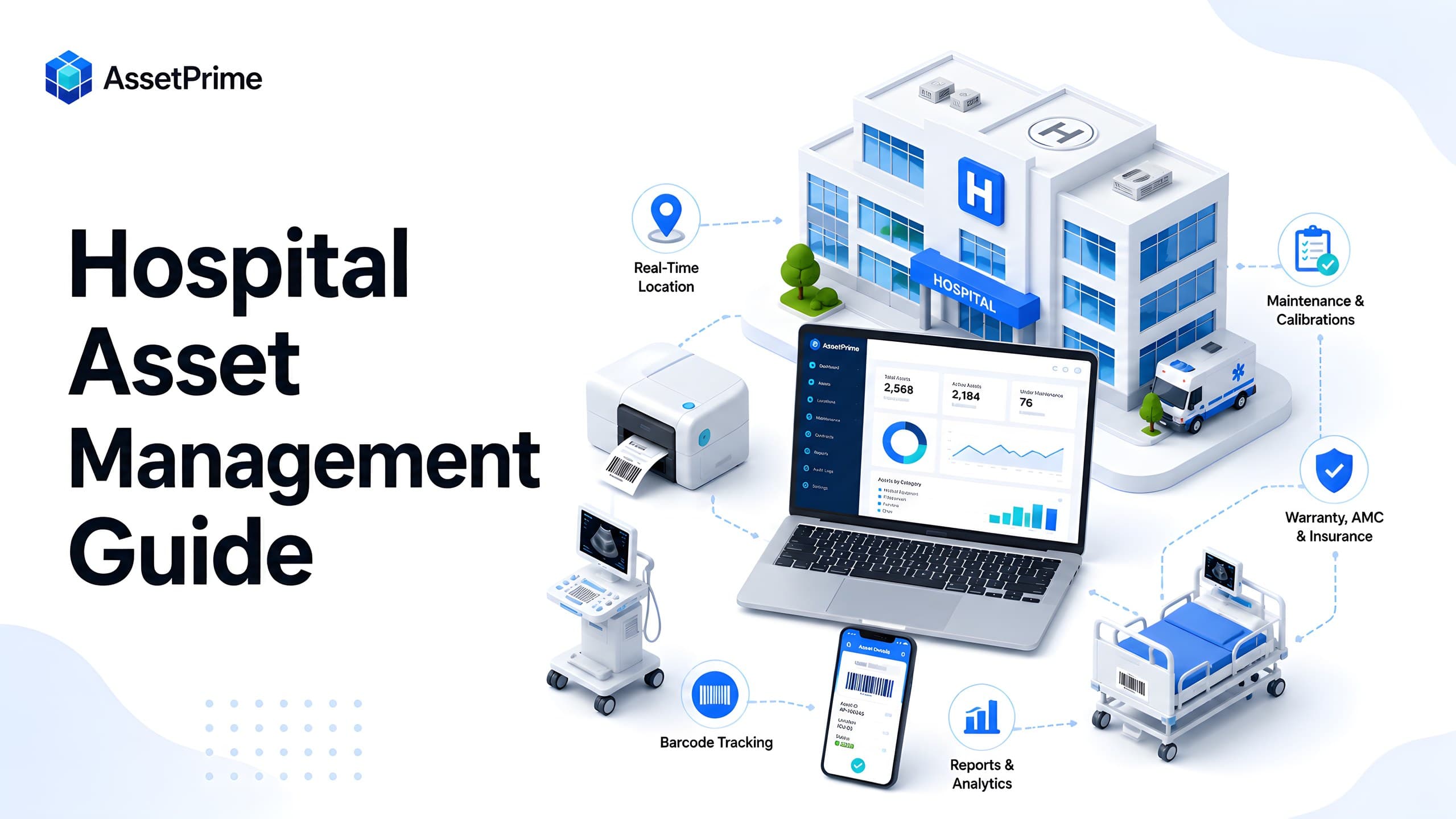
What is hospital asset management?
Hospital asset management is the structured process of identifying, locating, assigning, maintaining, auditing, and reporting on medical, IT, facility, and operational assets throughout their lifecycle. It helps hospitals know what equipment they have, where it is, who is responsible, whether it is available, and what service or compliance action is due.
A hospital may manage patient monitors, infusion pumps, ventilators, imaging equipment, laboratory devices, defibrillators, beds, wheelchairs, sterilization equipment, computers, network devices, HVAC systems, generators, furniture, and many other asset types. Each category has different value, mobility, maintenance, risk, and documentation needs.
The objective is not merely to maintain an equipment list. A reliable system connects procurement, receiving, registration, location, custody, movement, preventive maintenance, breakdown service, warranty, AMC, insurance, calibration, audit, depreciation, documents, and disposal.
“You cannot control assets clearly when ownership, location, maintenance, and audit history live in separate files.”
Why hospitals need stronger asset visibility
Hospital equipment moves frequently between wards, departments, procedure rooms, stores, biomedical workshops, and service providers. When these transfers are not recorded, staff may spend critical time searching for equipment that is available elsewhere.
Poor visibility can also cause unnecessary purchases, rental costs, delayed procedures, low utilization, missed maintenance, and weak audit evidence. The impact is operational and financial, and for certain equipment it may also affect patient-service readiness.
A centralized hospital asset register gives clinical engineering, biomedical, nursing, IT, finance, procurement, administration, and facilities teams a shared view while maintaining role-based access.
What strong asset control should make visible
- ✓Where each asset is located today.
- ✓Who is responsible for the asset.
- ✓When it was purchased, moved, maintained, or disposed.
- ✓Which records are ready for audit, reporting, and decision-making.
Medical equipment, fixed assets, and consumable inventory
Hospitals manage both long-life assets and consumable inventory. Medical devices, computers, beds, machinery, and facility equipment usually require lifecycle tracking. Medicines, disposables, reagents, and routine supplies are generally managed as inventory based on stock, batch, expiry, and consumption.
Some categories sit between these models. Reusable instruments, portable devices, and low-value equipment may need quantity tracking in one hospital but unique serialization in another.
The tracking approach should be based on clinical importance, value, mobility, maintenance, calibration, infection-control considerations, compliance, and expected useful life rather than using one method for every item.
Building the hospital asset register
The asset register should begin with consistent categories and ownership. Typical fields include asset code, equipment name, manufacturer, model, serial number, category, biomedical classification, purchase details, vendor, cost, commissioning date, branch, building, floor, department, ward, room, custodian, condition, and status.
Coverage fields may include warranty, AMC, comprehensive maintenance contract, insurance, and provider details. Service fields may include preventive maintenance frequency, last service, next due date, breakdown history, calibration requirements, downtime, and service cost.
Documents such as invoices, manuals, certificates, contracts, installation reports, calibration certificates, and disposal approvals should be connected to the relevant asset record.
Creating a hospital location hierarchy
Hospital locations are more complex than a simple branch and room list. A useful hierarchy may include hospital or campus, building, floor, department, ward, unit, room, store, biomedical workshop, quarantine area, and external service location.
Consistent location masters help staff find equipment and allow management to report by clinical or administrative area. Free-text locations should be minimized because variations such as ICU, I.C.U., and Intensive Care Unit create fragmented reports.
Temporary and external locations should also be controlled so equipment sent for repair, calibration, loan, or vendor demonstration does not disappear from operational visibility.
Using barcode or QR labels in hospitals
Barcode or QR labels give each serialized asset a scannable identity. Staff can scan equipment during receiving, placement, transfer, service, audit, or disposal instead of manually searching by name or serial number.
Label material and placement must suit the environment. Cleaning chemicals, disinfectants, abrasion, heat, moisture, curved surfaces, and frequent handling can damage ordinary labels. Placement should remain visible and scannable without obstructing clinical use, safety information, vents, or manufacturer labels.
The label should point to a controlled system record. Storing sensitive operational or patient data directly in the barcode is unnecessary and should be avoided.
Tracking equipment movement between wards and departments
Portable equipment may move several times in a day. If every small movement requires a complicated process, staff may bypass the system. If no movement is recorded, location data becomes useless.
Hospitals should define which movements require formal transactions, which can use quick scan-based updates, and which assets need strict custody or approval. High-value, scarce, regulated, or clinically critical devices generally need tighter control.
Movement records should preserve source, destination, date, user, reason, and condition. Service out and service return should be distinct from internal clinical transfers.
Managing assignment and custody
Not all hospital assets are assigned to individuals. Many are assigned to wards, departments, rooms, biomedical teams, or responsible custodians. The assignment model should reflect how responsibility works in practice.
Portable IT devices, tools, communication devices, and certain clinical equipment may require individual custody and return records. Shared equipment may need a departmental owner with location-based verification.
Clear custody supports handovers, employee exits, damage review, loss investigation, and accountability without interfering with clinical operations.
Preventive maintenance and breakdown management
Hospital equipment maintenance should connect the exact asset with preventive schedules, breakdown complaints, service providers, technicians, parts, costs, downtime, condition, and completion evidence.
Before service, teams should be able to review warranty or contract coverage and previous repair history. Repeated failures, rising costs, and long downtime may indicate that replacement is more appropriate than continued repair.
Open, overdue, and upcoming maintenance should be visible by department, equipment class, risk level, and responsible team so clinical engineering can prioritize work.
Warranty, AMC, CMC, and insurance control
Hospitals often maintain multiple coverage arrangements across vendors and equipment groups. Missing an expiry date can lead to uncovered service, delayed renewals, and unexpected cost.
Coverage records should identify the provider, contract period, covered assets, service scope, exclusions, response terms, document references, and renewal owner. Assets may need individual coverage or group coverage depending on the agreement.
Expiry dashboards and reports should support action well before the end date, not only notify users after coverage has lapsed.
Calibration and compliance documentation
Certain medical and laboratory devices require calibration, performance verification, safety testing, or certification according to internal policy, manufacturer guidance, accreditation needs, or applicable regulations.
The asset record should show whether calibration is required, the interval, last completion, next due date, provider, result, and certificate. Overdue items should be easy to identify and remove from use when policy requires it.
Requirements differ by country, device, and institution. Hospitals should configure the system around their approved biomedical and compliance procedures rather than relying on generic assumptions.
Managing equipment availability and utilization
Knowing that an asset exists is not the same as knowing whether it is available. Equipment may be assigned, in use, under maintenance, awaiting parts, quarantined, loaned, or reserved.
Status and location data help departments distinguish unavailable equipment from genuinely missing equipment. Utilization analysis can identify overburdened devices in one ward and underused devices elsewhere.
This supports redistribution, rental reduction, capacity planning, and more evidence-based procurement decisions.
Hospital asset audits and physical verification
A hospital audit should compare physical equipment with the register by location, department, category, and custodian. Barcode scanning can speed up verification and reduce manual transcription.
Findings should be classified as verified, missing, misplaced, unregistered, duplicate, damaged, inactive, or disposed but still active. Each exception needs an owner, investigation, corrective action, and closure evidence.
High-risk and movable equipment may benefit from cycle audits throughout the year, while broader fixed-asset verification can follow the hospital audit calendar.
Procurement, receiving, and commissioning
Asset control should start before equipment enters service. Procurement records should capture the vendor, order, invoice, cost, quantity, expected serial numbers, warranty, and contract terms.
At receiving, staff should verify quantity, model, serial number, physical condition, accessories, documents, and coverage. The asset should then be registered, labeled, placed, and commissioned through the approved process.
Connecting procurement and receiving to the asset register prevents equipment from entering clinical use without identity, ownership, and service information.
Depreciation, valuation, and financial reconciliation
Finance teams need cost, capitalization date, useful life, depreciation method, accumulated depreciation, and current book value. Operational teams need location, condition, availability, maintenance, and custody.
A hospital asset platform should connect these perspectives without allowing operational updates to compromise controlled financial data. Periodic reconciliation between the fixed-asset register and general ledger remains important.
Disposals, transfers, additions, and value adjustments should follow documented approval and accounting procedures.
Safe disposal and retirement of hospital assets
Equipment may be retired because it is obsolete, unsafe, uneconomical to repair, beyond support, damaged, lost, sold, donated, or replaced. Disposal should not be handled as a simple deletion from the register.
The process may require technical evaluation, data sanitization for IT-enabled equipment, infection-control handling, environmental or e-waste procedures, finance approval, and documented transfer or destruction.
The final record should preserve reason, date, approval, financial outcome, documents, and historical lifecycle information.
Data security and role-based access
Hospital asset systems should manage equipment information without collecting patient data unless a separately governed integration genuinely requires it. Asset identification and lifecycle control generally do not need patient details.
Role-based access should separate biomedical, nursing, IT, finance, procurement, administration, facilities, and audit responsibilities. Location scope can restrict users to their hospital, branch, department, or operational area.
Audit logs, secure authentication, backups, controlled exports, and documented access reviews strengthen governance.
Hospital asset tracking software vs inventory and maintenance systems
Hospital asset tracking software focuses on the identity, location, custody, movement, condition, service history, coverage, audit status, and lifecycle of long-lived equipment. Inventory systems are generally designed around quantities, batches, stock movement, consumption, and replenishment, while maintenance systems concentrate on work orders and service activity.
Hospitals often need these functions to connect rather than exist as isolated records. A medical device may need a unique asset identity, a current ward or department, a preventive maintenance schedule, warranty or AMC coverage, calibration evidence, movement history, and an eventual disposal record.
When evaluating software, hospitals should therefore test the complete equipment lifecycle instead of selecting a system only because it can store an equipment list or create maintenance tasks.
What to look for in medical equipment asset management software
Medical equipment asset management software should support unique equipment identification, manufacturer and serial details, hospital and department hierarchy, barcode or QR labels, current location, movement history, custody, condition, documents, maintenance, calibration, warranty, AMC, audits, and lifecycle status.
For multi-hospital groups, evaluate branch-level visibility and location-based permissions. Biomedical, finance, procurement, IT, facilities, and audit teams may need different access to the same underlying equipment records.
The strongest evaluation method is to use real hospital examples. Register a device, place it in a ward, transfer it, record service and calibration, verify coverage, audit it, and review the resulting history and reports before choosing a platform.
Hospital asset management implementation roadmap
Start with governance: define owners, asset classes, location hierarchy, coding, mandatory fields, serialized and bulk rules, movement types, maintenance responsibilities, and audit frequency.
Clean existing data and pilot the process in one department or asset group. Validate labels, scanning, movement, maintenance, reports, and user roles before expanding across the hospital.
Roll out in phases, train users by responsibility, monitor adoption, and review exceptions. The goal is a sustainable operational process, not a one-time data-entry exercise.
How AssetPrime supports hospital asset management
AssetPrime supports hospital and multi-branch asset operations through a centralized register, serialized instances, bulk stock, hierarchical locations, assignments, movements, maintenance, warranty, AMC, insurance, depreciation, procurement, audits, documents, and disposal. For a commercial overview of these capabilities, see AssetPrime's Hospital Asset Management Software page at /industries/hospital-asset-management.
Barcode labels and scan-oriented workflows help identify equipment and verify location. Role-based menu access and location scope allow different teams to work within controlled responsibilities.
The Asset Intelligence Console connects purchase, stock, movement, service, coverage, depreciation, documents, and audit history, giving authorized users a complete view of each asset.
Final thoughts
Hospital asset management improves equipment visibility, service readiness, financial control, auditability, and accountability. Its value comes from connecting physical equipment with reliable lifecycle information.
Implementation should respect clinical workflows and avoid adding unnecessary administrative burden. Fast scanning, clear ownership, practical movement rules, and role-specific interfaces increase adoption.
With clean data, durable labels, structured maintenance, controlled access, and continuous audits, hospitals can reduce search time, improve utilization, and make better equipment decisions.
Related AssetPrime Pages
Continue with related pages
Explore connected features, guides, solutions, and industry pages that support this topic.
FAQ
Frequently asked questions
What is hospital asset management?
Hospital asset management is the lifecycle control of medical, IT, facility, and operational equipment, including registration, location, custody, movement, maintenance, coverage, audit, valuation, and disposal.
What types of assets should hospitals track?
Hospitals commonly track medical devices, laboratory equipment, beds, wheelchairs, IT equipment, communication devices, tools, generators, HVAC equipment, furniture, and other long-life operational assets.
How do hospitals track movable medical equipment?
They can use unique asset codes, barcode or QR labels, defined location hierarchies, scan-based transfers, custody records, and periodic cycle audits.
Can barcode labels be used on medical equipment?
Yes, but label material and placement should withstand cleaning, moisture, chemicals, abrasion, and handling without obstructing safety information or clinical operation.
How often should hospital equipment be audited?
Frequency should depend on value, mobility, clinical importance, risk, compliance, and discrepancy history. High-risk movable equipment may need frequent cycle audits, while broader verification may be annual.
How should preventive maintenance be tracked?
Link schedules and work records to the exact equipment item, including due dates, complaint, technician, provider, parts, cost, downtime, status, notes, and completion evidence.
What is the difference between hospital assets and inventory?
Assets are generally used over a longer period and require lifecycle, maintenance, custody, and valuation control. Inventory is usually stocked, issued, consumed, or sold and managed mainly by quantity, batch, and expiry.
Does hospital asset management software need patient data?
Usually no. Equipment lifecycle management can normally operate without patient information. Any integration involving patient data requires separate governance, security, and legal review.
How should hospitals manage equipment sent outside for service?
Record a service-out movement with vendor or service location, date, reason, condition, expected return, and responsible user, followed by a separate service-return transaction.
How does AssetPrime support hospitals?
AssetPrime connects hospital assets with branches, hierarchical locations, barcodes, assignments, movements, maintenance, warranty, AMC, insurance, depreciation, procurement, audits, documents, and disposal under role-based access.
Continue Reading
Related articles
Asset Management
What Is Asset Management Software? A Complete Guide for Modern Organizations
Read Article →
Asset Tracking
Asset Tracking vs Inventory Management: Key Differences for Modern Businesses
Read Article →
Barcode Tracking
How Barcode Asset Tracking Works: A Complete Guide for Modern Asset Operations
Read Article →