
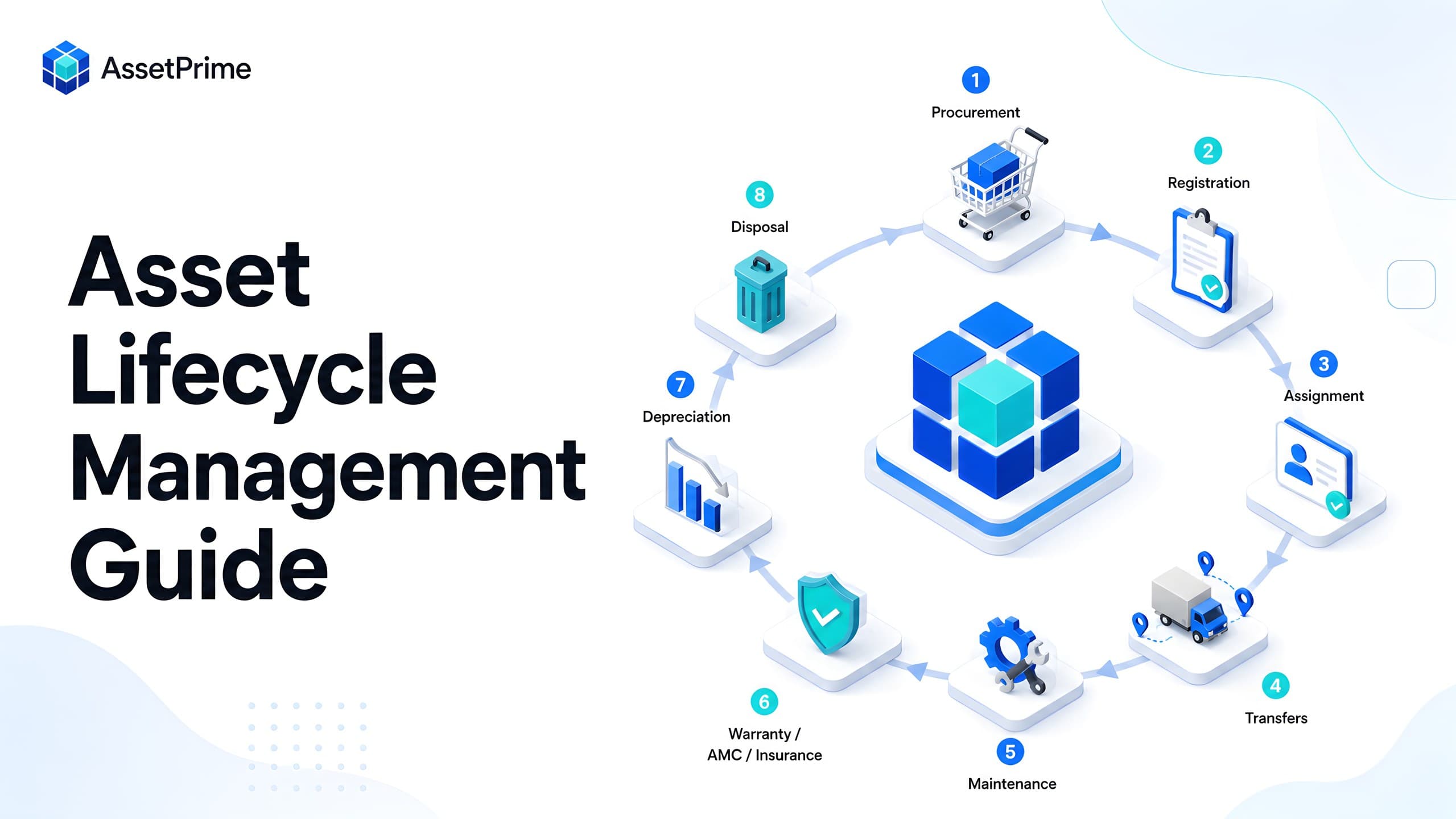
What is asset lifecycle management?
Asset lifecycle management is the structured process of managing a physical asset from the moment a business identifies the need for it until the asset is sold, scrapped, retired, lost, destroyed, or otherwise removed from service. It connects planning, procurement, receiving, registration, deployment, assignment, movement, maintenance, coverage, depreciation, audit, and disposal into one continuous operational record.
A simple asset register may tell an organization that a laptop, machine, medical device, vehicle, tool, or piece of furniture exists. Asset lifecycle management explains the complete story: why the asset was acquired, how much it cost, where it was received, where it is located, who is responsible for it, how it has moved, what maintenance it has received, what coverage remains, how its value has changed, and how it eventually leaves the organization.
This lifecycle view matters because assets are rarely static. They move between branches, buildings, departments, rooms, warehouses, employees, service centres, and project sites. They may be repaired, reassigned, upgraded, insured, depreciated, audited, and replaced several times during their useful life.
An effective lifecycle process gives finance, operations, IT, administration, maintenance, facilities, procurement, and management teams a shared source of truth. Instead of maintaining disconnected spreadsheets and files, each team can work from the same controlled asset history.
“You cannot control assets clearly when ownership, location, maintenance, and audit history live in separate files.”
Why asset lifecycle management matters
Assets represent both financial investment and operational capability. A hospital depends on medical devices, a manufacturer depends on machines and tools, an IT team depends on laptops and network equipment, a school depends on classroom and laboratory assets, and a warehouse depends on handling and scanning equipment. When these assets are not managed well, productivity, service quality, compliance, and cost control can all suffer.
Poor lifecycle control commonly leads to duplicate purchases, missing assets, unclear ownership, unexpected downtime, expired warranties, missed AMC renewals, incomplete insurance records, inaccurate depreciation, weak audit evidence, and delayed replacement decisions. Each problem may begin as a small data gap, but the impact grows as asset volume and location complexity increase.
Lifecycle management reduces these risks by keeping operational, financial, and historical information connected. Purchase details remain linked to receiving records. Asset records remain linked to assignments and movements. Maintenance history remains linked to coverage information. Depreciation, audit, and disposal records remain connected to the same asset identity.
The result is better accountability and better decisions. Teams can determine whether an asset should be repaired or replaced, whether an unused asset can be redeployed, whether coverage should be renewed, and whether an asset has reached the end of its useful life.
What strong asset control should make visible
- ✓Where each asset is located today.
- ✓Who is responsible for the asset.
- ✓When it was purchased, moved, maintained, or disposed.
- ✓Which records are ready for audit, reporting, and decision-making.
The 10 stages of the asset lifecycle
Although organizations may use different terminology, the asset lifecycle can be understood through ten connected stages: planning, procurement, receiving, registration, deployment, movement, maintenance, coverage management, financial and audit control, and final disposal or retirement.
These stages should not be managed as isolated activities. Decisions made in one stage affect every stage that follows. Incomplete purchase data can weaken warranty tracking. Poor registration can make assignments and audits unreliable. Missing movement records can create ownership disputes. Weak maintenance history can lead to poor replacement decisions.
A strong asset management process therefore treats the lifecycle as one controlled workflow. The following sections explain what should happen at each stage and what information should be retained.
Stage 1: Planning and requirement assessment
The lifecycle begins before an asset is purchased. Planning starts when a department, branch, project, or employee identifies a business need. The organization should clarify why the asset is required, where it will be used, who will be responsible for it, what performance is expected, and what budget is available.
A good planning process checks whether an existing asset can be reused, transferred, repaired, or upgraded before a new purchase is approved. Visibility across branches and locations is especially valuable here because another department may already have an idle or underutilized asset that can meet the requirement.
Planning should consider total cost of ownership rather than purchase price alone. Maintenance, consumables, accessories, calibration, warranty extensions, AMC, insurance, energy use, downtime, depreciation, and disposal can all affect the long-term cost of an asset.
Organizations should also define expected useful life, risk level, criticality, replacement criteria, and approval responsibility. This creates a stronger basis for procurement and reduces impulsive or duplicate purchases.
Stage 2: Procurement and vendor selection
Once the requirement is approved, procurement begins. Depending on the organization, this stage may include purchase requests, quotation comparison, vendor evaluation, approvals, purchase orders, delivery terms, payment terms, and expected warranty or service coverage.
Procurement data should be captured in a structured way because it becomes the financial foundation of the asset record. Important details include vendor name, purchase order, invoice reference, acquisition date, quantity, unit cost, taxes, freight, installation cost, expected delivery date, warranty terms, and supporting documents.
A common lifecycle failure occurs when procurement records remain separate from asset records. Finance may know what was purchased, while operations may know what was received, but neither team has a complete picture. Connecting procurement with receiving and registration prevents repeated data entry and reduces mismatches.
Vendor performance should also be reviewed over time. Delivery delays, recurring defects, service responsiveness, warranty support, and maintenance costs can inform future purchasing decisions.
Stage 3: Receiving, inspection, and acceptance
Receiving is the point where the organization confirms that purchased items have physically arrived. The receiving team should compare the delivery against the purchase order and invoice, verify quantity, inspect condition, confirm specifications, and capture serial numbers or manufacturer identifiers where applicable.
Damaged, incomplete, incorrect, or non-compliant deliveries should be recorded before acceptance. This is also the right time to collect warranty documents, service agreements, calibration certificates, manuals, and installation records.
For serialized assets, every physical unit should be identified individually. For bulk items, the organization may record quantity at the relevant branch, store, or location. Supporting both approaches is important because organizations often manage high-value individual assets and quantity-based operational assets at the same time.
A controlled receiving process ensures that only accepted assets become active records. It also creates traceability between what was ordered, what was delivered, and what was finally registered for use.
Stage 4: Asset registration and identification
Registration creates the official asset record. Each record should include a unique asset code, category, description, branch, location, department, acquisition date, purchase value, vendor, condition, status, and relevant technical or financial details.
Serialized assets such as laptops, scanners, machines, medical equipment, vehicles, and specialised tools should normally have a unique instance record. This allows each unit to retain its own serial number, barcode, assignment, movement, maintenance, warranty, and disposal history.
Bulk assets or stock-controlled items may be managed primarily by quantity and location. A mature asset management platform should support both bulk and serialized tracking without forcing every item into the same model.
Barcode or QR code labels should be generated during registration whenever practical. A scannable identity helps teams verify assets quickly during receiving, assignment, movement, maintenance, audit, and disposal. Standard label formats and clear placement rules improve long-term scanning reliability.
Data quality at this stage is critical. Incorrect categories, duplicate codes, inconsistent location names, and missing values can weaken every report and workflow that follows. Standardized masters and validation rules help keep the asset register trustworthy.
Stage 5: Deployment, assignment, and ownership
After registration, the asset is deployed to a branch, department, room, work area, employee, project, or custodian. Deployment establishes where the asset is being used, while assignment establishes who is responsible for it.
For IT assets, assignment may involve issuing a laptop or mobile device to an employee. In hospitals, a device may be placed in a ward or diagnostic department. In manufacturing, a machine or tool may be deployed to a production line. In offices, furniture and equipment may be placed in a floor, room, or department.
A strong assignment record includes the assigned user or department, assignment date, expected return date where relevant, condition at issue, acknowledgement, and return history. When an employee changes role, exits the organization, or returns equipment, the system should preserve the previous assignment rather than overwrite it.
Clear ownership reduces disputes and makes audits faster. It also helps managers follow up on missing, damaged, overdue, or unreturned assets.
Stage 6: Movement and operational control
Assets often move during their useful life. They may be transferred between branches, departments, buildings, rooms, employees, warehouses, service centres, or project sites. These movements should be recorded as transactions rather than handled by simply changing the current location field.
A movement transaction should capture the source, destination, date, reason, responsible users, approval reference, and affected assets or quantities. For serialized assets, each instance should retain its own movement history. For bulk assets, quantities should be adjusted accurately at both source and destination locations.
Different movement types may require different controls. Internal transfers, service-out movements, service returns, assignments, disposals, losses, and retirements should not all be treated as the same event. Clear movement types make reports and audit trails easier to understand.
Preserving movement history is essential for accountability. When an asset cannot be found, teams should be able to review where it was previously located, when it moved, and who handled the transfer.
Stage 7: Maintenance, service, and condition management
Maintenance keeps assets safe, reliable, and productive. Depending on the asset type, maintenance may be preventive, corrective, predictive, condition-based, scheduled, or emergency-driven.
A maintenance record should capture the reported issue, maintenance type, service date, status, technician or vendor, parts used, service cost, downtime, findings, resolution, and next planned action. For recurring failures, the history should make patterns visible.
Maintenance history supports repair-versus-replace decisions. An older asset with frequent breakdowns and rising service costs may be more expensive to retain than replace. Without a connected history, organizations often make this decision based on incomplete information.
Condition should be updated after inspections, movements, maintenance, and audits. Clear condition values such as good, needs attention, under service, damaged, or retired help teams prioritize action and prevent unsafe or unreliable assets from remaining in use.
For critical assets, maintenance records may also need calibration details, safety checks, service-level commitments, or regulatory evidence. These requirements should be configured according to the industry and asset type.
Stage 8: Warranty, AMC, insurance, and coverage management
Coverage is a major part of lifecycle control because it determines who bears the cost or risk when an asset fails, is damaged, or requires service. Warranty, annual maintenance contracts, and insurance serve different purposes and should be tracked separately.
Warranty records may include provider, start date, expiry date, covered components, exclusions, claim references, and supporting documents. AMC records may include vendor, contract period, service frequency, covered assets, renewal value, and service commitments. Insurance records may include policy number, insurer, insured value, premium, expiry date, and claim history.
Expiry visibility is essential. Missed warranty or AMC renewals can lead to avoidable repair costs and downtime. Expired insurance can expose the organization to financial risk. Alerts and expiry reports help responsible teams act before coverage lapses.
Coverage information should be linked directly to the asset or asset instance wherever possible. This makes it easier to verify eligibility during maintenance, claims, audits, and replacement decisions.
Stage 9: Depreciation, audit, and performance review
As assets age, their financial value changes. Depreciation helps finance teams account for this change over the expected useful life of the asset. Common methods include straight-line and written-down value, although the correct method depends on accounting policy and local requirements.
Depreciation should be viewed alongside operational information. Purchase value alone does not show whether an asset remains productive. Age, current condition, maintenance cost, downtime, utilization, coverage, and remaining book value together provide a better basis for replacement planning.
Physical audits verify whether assets exist, whether they are in the correct location, whether assignments are accurate, and whether system records match reality. Barcode scanning can make verification faster by connecting the physical label to the asset record.
Audit readiness is created through daily discipline, not last-minute spreadsheet cleanup. When movements, assignments, maintenance, coverage, and disposals are recorded consistently, auditors can trace the asset history with less manual effort.
Management should also review lifecycle KPIs such as asset utilization, maintenance cost, downtime, overdue maintenance, expiring coverage, missing assets, disposal value, and replacement needs. These indicators turn asset records into operational intelligence.
Stage 10: Retirement, disposal, sale, loss, and replacement
The lifecycle ends when an asset is no longer active. Possible outcomes include retirement, disposal, sale, scrap, donation, loss, destruction, write-off, or replacement. Each outcome should follow an approved process because the asset may still carry financial, legal, environmental, or security obligations.
Disposal records should include the disposal date, method, reason, approving authority, disposal location, buyer or vendor where relevant, sale or scrap value, profit or loss, certificate references, and supporting documents. For IT equipment, secure data wiping or destruction evidence may also be necessary before the asset leaves the organization.
Disposed assets should no longer appear as active stock or available for assignment. However, their complete history should remain available for finance, audit, compliance, warranty, insurance, and management review.
End-of-life data supports future planning. If many assets of the same category are being retired because of age, failure, or obsolescence, procurement and finance teams can forecast replacement budgets more accurately.
A practical asset lifecycle example
Consider a laptop purchased for a new employee in a multi-branch organization. The lifecycle begins when the requirement is approved and procurement selects the device and vendor. When the laptop arrives, receiving verifies the delivery, captures the serial number, and connects the invoice and warranty information.
The laptop is then registered with a unique asset code and barcode, placed at the correct branch and location, and assigned to the employee. If the employee transfers to another branch, the movement and assignment should be recorded rather than simply changing the current location.
During use, the laptop may require repair, warranty service, accessories, insurance, or preventive checks. Its depreciation continues in parallel with its operational history. Periodic audits confirm that the physical device, custodian, and recorded location still match.
When the laptop becomes obsolete or uneconomical to repair, the organization can approve replacement, securely remove company data, record the disposal or sale, and retain the complete history for finance and audit. This example shows why lifecycle management is more useful than maintaining only a current asset list.
Asset lifecycle management KPIs to monitor
Lifecycle data becomes more valuable when organizations use it to monitor performance and exceptions. Useful indicators include asset utilization, average asset age, maintenance cost by asset or category, downtime, overdue maintenance, expiring warranty or AMC coverage, missing assets, assets without assigned locations, and assets approaching replacement.
Finance and management may also review acquisition cost, accumulated depreciation, current book value, disposal value, repair-versus-replacement trends, and total cost of ownership. Procurement teams can use vendor and failure history to improve future purchasing decisions.
The objective is not to create a dashboard full of metrics. The most useful KPIs are those that lead to action: service an overdue machine, renew valuable coverage, redeploy an idle asset, investigate a missing item, or replace equipment whose operating cost has become unreasonable.
Asset lifecycle management versus asset tracking
Asset tracking is one part of lifecycle management. It focuses mainly on identification, location, custody, and movement. Lifecycle management includes these controls but also covers planning, procurement, receiving, maintenance, warranty, AMC, insurance, depreciation, audit, disposal, and total cost of ownership.
A barcode scanner may confirm that an asset is physically present, but lifecycle management explains whether the asset is assigned correctly, under coverage, due for service, financially depreciated, or ready for replacement.
Organizations that only track location may still struggle with maintenance costs, renewals, ownership changes, audit evidence, and disposal. A lifecycle approach connects these decisions so the asset can be managed as both an operational resource and a financial investment.
Asset lifecycle management versus inventory management
Inventory management generally focuses on quantities of items that are received, stored, issued, consumed, sold, or replenished. Asset lifecycle management focuses on long-term items that remain under organizational control and require individual or category-level history.
Consumables, raw materials, spare parts, medicines, packaging, and saleable goods are typical inventory examples. Laptops, vehicles, medical devices, machinery, furniture, tools, and facility equipment are typical asset examples.
Some organizations need both models. They may track spare parts as inventory while tracking the machine that uses those parts as an asset. They may manage bulk furniture by quantity while managing laptops individually by serial number. A flexible platform should support these different tracking needs without losing location and transaction history.
Common asset lifecycle management challenges
The most common challenge is fragmented data. Procurement records may be held by finance, receiving records by stores, assignments by administration, maintenance by operations, warranty documents in email, and audit results in spreadsheets. This makes the complete asset history difficult to reconstruct.
Inconsistent naming is another problem. Duplicate asset codes, different category names, informal location labels, and incomplete serial numbers reduce reporting accuracy. Standardized masters and controlled data entry are essential before large-scale migration.
Multi-branch organizations face additional complexity because users should not always see or edit every location. Role-based and location-based permissions help protect data integrity while still allowing central reporting.
Process adoption is equally important. Even good software cannot produce reliable data if teams do not record assignments, movements, maintenance, and disposals promptly. Clear responsibilities, training, and periodic review are necessary.
Finally, organizations sometimes try to digitize a weak process without improving it. Before implementation, approval flows, movement rules, maintenance responsibilities, asset categories, and disposal controls should be defined clearly.
Best practices for effective lifecycle management
Define asset categories, ownership rules, branch structures, and location hierarchies before importing data. Consistent structure improves every later report and workflow.
Use unique asset codes and durable barcode or QR labels. Avoid using serial numbers alone because serial formats may be duplicated, missing, or difficult to scan.
Record transactions instead of overwriting history. Assignments, returns, transfers, service movements, and disposals should all create dated records.
Connect procurement, receiving, maintenance, warranty, AMC, insurance, depreciation, and disposal information to the same asset identity. This prevents the lifecycle from becoming fragmented again.
Set responsibilities for each stage. Procurement may own purchase data, stores may own receiving, departments may own custody, maintenance teams may own service updates, and finance may own depreciation and disposal approval.
Review exception reports regularly. Overdue maintenance, expiring coverage, inactive assets, missing assignments, unusual movements, and assets needing action should be visible before they become larger problems.
Perform periodic physical verification and reconcile differences promptly. Audit findings should lead to corrected records, process improvements, and clear accountability.
How to choose asset lifecycle management software
The right software should support the complete lifecycle rather than only asset registration. Evaluate whether the platform can handle procurement, receiving, bulk and serialized assets, assignments, movements, maintenance, coverage, depreciation, audits, and disposal.
Multi-branch and hierarchical location support is important for organizations with offices, plants, hospitals, campuses, warehouses, or project sites. The system should show both current position and historical movement without losing branch-level accountability.
Security should include role-based permissions, location restrictions, controlled actions, and audit logs. Reporting should respect the same access rules so users only see data relevant to their responsibility.
Look for practical workflows, not only feature lists. The software should be easy enough for stores, administration, maintenance, finance, and department users to update consistently. Mobile-friendly access and barcode support can improve adoption during audits and field operations.
Finally, consider implementation support, data migration, scalability, export options, reporting performance, backup practices, and long-term maintenance. Lifecycle management becomes a core operational system, so it should remain reliable as asset volume grows.
How to implement asset lifecycle management step by step
Start by defining which items should be treated as assets and which should remain bulk inventory or consumables. Standardize categories, asset codes, branches, locations, departments, statuses, and ownership rules before migrating historical records.
Next, clean the existing register. Remove duplicates, validate serial numbers, reconcile active and disposed assets, confirm current locations and custodians, and identify missing purchase or coverage information. Migrating unreliable data into new software only preserves old problems.
Define responsibility for each lifecycle event. Procurement should know what information must be captured at purchase, stores should know the receiving process, administrators should understand assignment and movement rules, maintenance teams should update service records, and finance should control depreciation and disposal.
Implement the process in manageable stages. A pilot branch or asset category can validate labels, workflows, permissions, imports, reports, and user responsibilities before organization-wide rollout. After launch, review exception reports and audit samples regularly to make sure lifecycle records remain accurate.
How AssetPrime supports the complete asset lifecycle
AssetPrime brings procurement, receiving, registration, stock, assignments, movements, maintenance, coverage, depreciation, audit, reporting, and disposal into one structured asset management platform.
The platform supports both bulk and serialized assets. Quantity-based assets can be managed through stock records, while serialized instances retain their own barcode, location, assignment, movement, condition, maintenance, warranty, and disposal history.
For multi-branch organizations, AssetPrime supports hierarchical locations and location-based access control. This helps central teams maintain consolidated visibility while allowing users to work only with the branches and locations assigned to them.
The Asset Intelligence Console brings operational and financial information together for each asset. Teams can review stock or instance details, purchase and receiving records, movement history, assignments, maintenance, warranty, AMC, insurance, depreciation, documents, and audit activity from a connected view.
AssetPrime also provides reports for asset registers, stock position, movements, assignments, maintenance, warranty, AMC, insurance, procurement, depreciation, disposal, and audit-related analysis. These reports help organizations identify risks, improve planning, and make lifecycle decisions using current data.
Final thoughts
Asset lifecycle management turns a static asset list into a controlled business process. It helps organizations understand how assets enter the business, where they are used, how they move, what they cost to maintain, what coverage protects them, how their value changes, and how they eventually leave service.
The strongest lifecycle processes combine accurate data, clear responsibilities, barcode-based identification, controlled transactions, maintenance discipline, financial visibility, and regular audits.
For growing organizations, especially those operating across multiple branches, departments, users, and asset types, lifecycle management improves accountability, reduces avoidable cost, supports audit readiness, and creates a better foundation for replacement and investment decisions.
Related AssetPrime Pages
Continue with related pages
Explore connected features, guides, solutions, and industry pages that support this topic.
FAQ
Frequently asked questions
What is asset lifecycle management?
Asset lifecycle management is the structured process of managing an asset from planning and procurement through receiving, registration, deployment, movement, maintenance, coverage, depreciation, audit, and final disposal or retirement.
What are the main stages of the asset lifecycle?
The main stages are planning, procurement, receiving, registration, deployment and assignment, movement, maintenance, warranty or coverage management, depreciation and audit, and disposal or retirement.
How is asset lifecycle management different from asset tracking?
Asset tracking focuses mainly on identity, location, custody, and movement. Asset lifecycle management includes tracking but also covers procurement, maintenance, warranty, AMC, insurance, depreciation, audit, cost analysis, and disposal.
Why is asset lifecycle management important?
It improves asset visibility, ownership, maintenance planning, renewal control, audit readiness, replacement decisions, and cost management by keeping information connected throughout the asset's useful life.
How does barcode tracking support the asset lifecycle?
Barcode or QR labels provide a reliable identity that can be scanned during receiving, assignment, transfers, maintenance, physical verification, audits, and disposal, reducing manual errors and speeding up updates.
What information should an asset lifecycle record contain?
It should contain asset identity, category, serial number, purchase and vendor details, current and historical locations, assignments, movements, maintenance, warranty, AMC, insurance, depreciation, documents, audit activity, condition, and disposal details.
How often should physical assets be audited?
The appropriate frequency depends on asset value, mobility, risk, industry, and internal policy. Many organizations perform a full annual audit and verify high-value, mobile, or critical assets more frequently.
Can asset lifecycle management reduce costs?
Yes. Better lifecycle control can reduce duplicate purchases, asset loss, avoidable downtime, missed warranty claims, expired coverage, unnecessary repairs, and poorly timed replacements.
Can one system manage both bulk and serialized assets?
Yes. A flexible asset management platform can manage quantity-based bulk assets alongside individually serialized assets, while maintaining suitable stock, location, assignment, movement, and lifecycle records for each model.
How does AssetPrime support asset lifecycle management?
AssetPrime supports procurement, receiving, bulk and serialized asset registration, barcode tracking, branch and location visibility, assignments, movements, maintenance, warranty, AMC, insurance, depreciation, audits, disposal, and enterprise reporting from one platform.
Continue Reading
Related articles
Asset Management
What Is Asset Management Software? A Complete Guide for Modern Organizations
Read Article →
Asset Tracking
Asset Tracking vs Inventory Management: Key Differences for Modern Businesses
Read Article →
Barcode Tracking
How Barcode Asset Tracking Works: A Complete Guide for Modern Asset Operations
Read Article →