
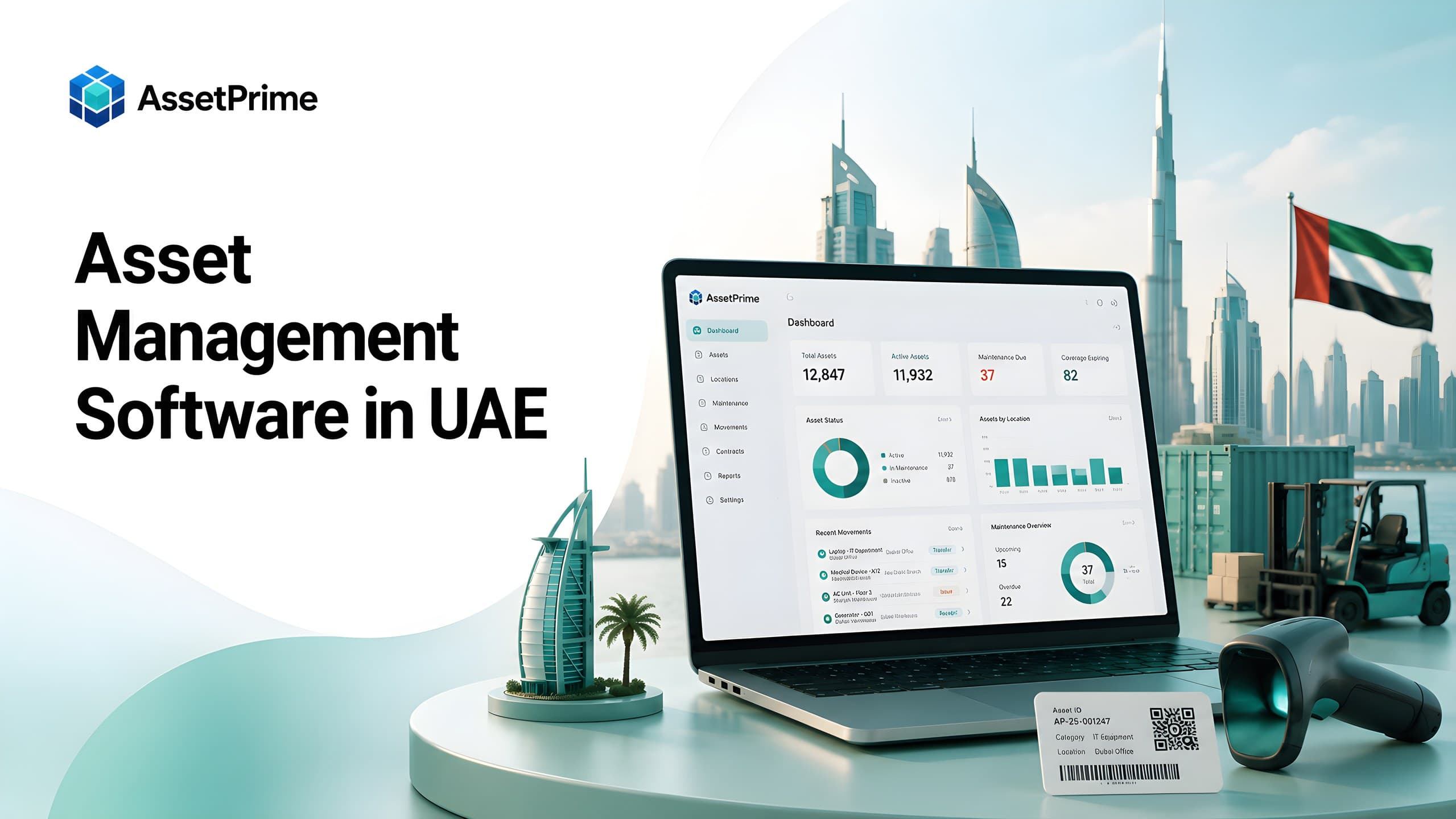
What is asset management software in the UAE?
Asset management software in the UAE is a centralized system that helps organizations record, track, maintain, audit, and control physical assets across their complete lifecycle. It provides a structured asset register for equipment, IT devices, machinery, furniture, tools, medical assets, vehicles, and other business property.
For organizations operating in Dubai, Abu Dhabi, Sharjah, Ajman, Ras Al Khaimah, Fujairah, and Umm Al Quwain, the main challenge is rarely the absence of asset data. The challenge is keeping that data accurate while assets move between branches, departments, warehouses, project sites, employees, service vendors, and storage locations.
A modern platform replaces disconnected spreadsheets and manual registers with one controlled source of truth. It connects asset identity, purchase information, branch and location, assignment, movement, condition, maintenance, warranty, AMC, insurance, depreciation, documents, audits, and disposal history.
The result is better visibility and accountability. Managers can see what the organization owns, where each asset is located, who is responsible, what condition it is in, what coverage applies, and what action is required next.
Explore AssetPrime for the UAE
Asset management software for UAE organizations
See how AssetPrime supports structured asset records, barcode tracking, multi-location visibility, maintenance, audits, and lifecycle control for organizations operating in the UAE.
Explore AssetPrime asset management software in the UAE →“You cannot control assets clearly when ownership, location, maintenance, and audit history live in separate files.”
Why UAE businesses need better asset visibility
The UAE has a highly distributed business environment. Many organizations operate from a head office in one Emirate while maintaining branches, warehouses, clinics, schools, workshops, retail outlets, project sites, or service locations across several Emirates.
When asset records are maintained separately by finance, administration, IT, procurement, maintenance, and branch teams, information quickly becomes fragmented. A purchase file may show what was bought, but not where the asset is today. A maintenance log may show repair history, but not the current custodian. A spreadsheet may list a location that changed months earlier.
This fragmentation creates practical problems: assets cannot be located quickly, duplicate purchases occur, maintenance is missed, warranty claims are lost, audits take longer, and management cannot reliably assess utilization or replacement needs.
Asset management software solves these issues by giving authorized teams a shared, current, and traceable system. Every movement, assignment, service event, and status change can be recorded against the asset rather than communicated informally.
What strong asset control should make visible
- ✓Where each asset is located today.
- ✓Who is responsible for the asset.
- ✓When it was purchased, moved, maintained, or disposed.
- ✓Which records are ready for audit, reporting, and decision-making.
Common asset management challenges in UAE organizations
The most common challenge is inaccurate location data. Assets move between offices, floors, rooms, stores, projects, and service centers, but the central register is not updated at the same time. The recorded location and physical location gradually become different.
A second challenge is unclear custody. Mobile assets such as laptops, tools, testing equipment, medical devices, and portable machinery may be assigned temporarily, shared across teams, or moved without a formal handover record.
A third challenge is fragmented maintenance and coverage information. Warranty, annual maintenance contracts, insurance, repairs, vendor communication, and service costs may be stored in separate emails or files. This makes renewal planning and claim validation difficult.
Other common issues include duplicate asset codes, inconsistent naming, missing serial numbers, no movement history, weak disposal records, branch-wise access problems, and audit reports that require days of manual reconciliation.
Industries in the UAE that benefit from asset management software
Hospitals and healthcare groups use asset management software to track biomedical equipment, diagnostic devices, IT assets, furniture, maintenance schedules, service movement, warranty, and department-wise custody.
Construction, engineering, oil and gas, and facility management companies use it for tools, machinery, safety equipment, project assets, calibration-sensitive equipment, vehicles, and assets that move between sites or vendors.
Warehouses, logistics operators, manufacturers, schools, universities, hotels, corporate groups, government entities, retail chains, and multi-branch businesses also benefit because they manage large asset volumes across distributed locations.
The strongest systems are flexible enough to support both individually serialized assets and quantity-based bulk assets. This matters when one organization manages laptops and medical devices alongside chairs, tools, spare equipment, and stock-like operational assets.
Core features to look for in UAE asset management software
Start with a structured asset register. Each record should support asset code, barcode, category, serial number, description, purchase details, value, vendor, branch, location, department, custodian, condition, lifecycle status, and supporting documents.
The system should also provide barcode or QR-based identification, multi-branch and hierarchical location tracking, asset assignment, movement history, maintenance and AMC management, warranty and insurance tracking, depreciation, disposal, role-based access, dashboards, and exportable reports.
For UAE businesses with several locations, access control is especially important. Head-office users may need consolidated visibility while branch users should see and manage only the assets within their authorized scope.
A serious platform should preserve history rather than simply overwrite fields. Knowing the current location is useful, but knowing how and when the asset moved there is essential for accountability and audits.
Barcode asset tracking for UAE operations
Barcode asset tracking gives each asset a unique machine-readable identity. A barcode label can be scanned during receiving, assignment, transfer, maintenance, physical verification, audit, return, and disposal.
This reduces typing and helps teams update records at the point where work occurs. Instead of searching through a large spreadsheet, a user can scan the label and open the correct asset record immediately.
Barcode tracking is particularly useful in warehouses, hospitals, schools, corporate offices, workshops, and project environments where many similar assets exist. The label helps distinguish one serialized unit from another and supports faster verification.
The barcode itself should identify the record, while detailed information remains in the software. This avoids printing sensitive or frequently changing data on the physical label.
Managing assets across Dubai, Abu Dhabi, Sharjah, and other Emirates
Multi-location asset management requires more than a branch name. Organizations often need a hierarchy such as Emirate, branch, building, floor, department, room, store, project site, or service location.
A structured location model helps users understand exactly where an asset belongs. It also improves branch-wise reports, movement control, physical verification, and responsibility assignment.
When an asset moves from Dubai to Abu Dhabi, the transaction should record the source, destination, date, reason, responsible user, items moved, and approval or reference details. The same principle applies to internal room transfers and temporary service movements.
Centralized visibility allows management to review the whole organization while preserving local accountability. This is significantly more reliable than maintaining separate files for each branch.
Asset lifecycle management from purchase to disposal
Asset lifecycle management begins before an asset is registered. Procurement planning, purchase orders, vendors, quantities, costs, and receiving records establish the commercial origin of the asset.
After receiving, assets are categorized, coded, labeled, placed in a branch and location, and assigned to a department or user where applicable. Each movement and assignment should then become part of the lifecycle history.
During use, the system should track condition, maintenance, repairs, downtime, warranty, AMC, insurance, depreciation, documents, and audits. At the end of useful life, disposal, loss, retirement, or sale should be recorded with authorization and financial details.
This connected lifecycle view helps UAE businesses understand not only where an asset is, but also what it has cost, how reliably it has performed, and whether it should be repaired, redeployed, replaced, or disposed.
Maintenance, AMC, warranty, and insurance control
Maintenance information should be connected directly to the asset record. Teams should be able to record preventive maintenance, breakdowns, service vendors, dates, costs, findings, status, and completion details.
AMC and warranty tracking help organizations monitor coverage periods and avoid paying for work that may still be covered. Expiry alerts support timely renewals and reduce the risk of critical equipment operating without support.
Insurance records should include policy details, coverage dates, values, documents, and relevant notes. This is particularly useful for high-value equipment, vehicles, machinery, medical devices, and assets deployed across several sites.
When maintenance, AMC, warranty, and insurance are managed separately, teams may miss opportunities to claim coverage or coordinate service. A connected platform gives a clearer operational and financial picture.
Audit readiness and physical verification
Asset audits become difficult when the register is outdated or when no reliable movement history exists. Auditors and internal teams then spend time locating assets, checking serial numbers, confirming custodians, and resolving unexplained differences.
A barcode-enabled audit process allows teams to verify physical assets against system records more quickly. Each scan can confirm identity, location, condition, and presence while highlighting exceptions for review.
Useful audit outputs include assets found in the correct location, assets found elsewhere, missing assets, unregistered assets, damaged assets, duplicate labels, and records requiring correction.
Audit readiness is not created only during the audit. It is the result of disciplined receiving, movement, assignment, maintenance, and disposal processes throughout the year.
Role-based access and operational accountability
Not every user should have access to every asset or function. A UAE group with multiple companies, branches, departments, or sites may require different permissions for administrators, finance, procurement, maintenance, auditors, department heads, and local asset custodians.
Role-based access control helps restrict menus and transactions according to responsibility. Location-based scope can further ensure that users see only the branches and locations assigned to them.
Accountability also depends on traceability. Important actions should show who created, updated, moved, assigned, maintained, or disposed of an asset and when the action occurred.
These controls reduce accidental changes, improve data quality, and make internal reviews more reliable.
Cloud, hosted, and on-premise deployment considerations
UAE organizations may choose cloud-hosted, privately hosted, or on-premise deployment depending on IT policy, integration requirements, security controls, data residency preferences, and internal infrastructure.
Cloud deployment can simplify access across Emirates and reduce local server administration. Private hosting or on-premise deployment may be preferred by organizations that require greater infrastructure control or have specific internal security standards.
The right choice depends on the organization, not on a single universal model. Decision-makers should evaluate backup, disaster recovery, encryption, access controls, update responsibility, availability, scalability, and support.
The software should also remain usable on modern browsers and mobile devices so authorized staff can work from offices, stores, warehouses, and operational sites.
Asset management software versus Excel
Excel is useful for small and stable asset lists, but it becomes difficult when several users, branches, transactions, and lifecycle processes are involved. Files can be copied, overwritten, delayed, or updated without a consistent workflow.
A dedicated asset management platform provides controlled records, linked history, permissions, barcode scanning, maintenance workflows, dashboards, alerts, and consistent reports.
The key difference is not merely where data is stored. It is whether the organization can reliably control operational events such as receiving, assignment, movement, maintenance, audit, and disposal.
UAE businesses expanding across locations should consider moving beyond spreadsheets before data fragmentation becomes a major operational problem.
How to choose asset management software in the UAE
Begin by defining the asset types, locations, users, workflows, and reports that matter. A hospital, warehouse, corporate group, and manufacturing company may all need asset management, but their operational details will differ.
Ask vendors to demonstrate real workflows rather than only dashboards. Review how the system receives assets, creates bulk and serialized records, prints barcodes, transfers assets, assigns users, completes maintenance, manages coverage, performs audits, and records disposal.
Evaluate implementation support, data migration, configuration, user training, security, backup, performance, export options, scalability, and ongoing maintenance. The system should remain practical as asset volume and branch count increase.
Also assess whether the product can support UAE-wide operations without forcing each branch to maintain a separate database or disconnected process.
Questions to ask during a software demonstration
Can the system manage both bulk and serialized assets? Can it represent branches, buildings, floors, departments, rooms, warehouses, and service locations? Can users be restricted by menu and location?
Can an asset's complete history be reviewed from one place? Does the platform show procurement, location, assignment, movement, maintenance, warranty, AMC, insurance, depreciation, documents, audit activity, and disposal?
Can barcode labels be generated and scanned? Can reports be filtered and exported? Can large asset volumes be handled without slowing common operations?
Can the vendor explain implementation, migration, support, backup, hosting, security, and future upgrade processes clearly? These questions reveal whether the solution is suitable for real operations rather than only a basic asset list.
Why AssetPrime for UAE businesses
AssetPrime is designed for organizations that need structured control over assets across branches, departments, locations, users, and lifecycle stages. It supports both quantity-based bulk assets and individually serialized assets.
The platform includes asset registration, stock control, barcode tracking, assignments, movements, procurement, maintenance, AMC, warranty, insurance, depreciation, disposal, audit trails, role-based access, location scope, dashboards, and enterprise reports.
For multi-branch UAE organizations, AssetPrime provides consolidated visibility while allowing local teams to work within their authorized branch and location scope. This supports central governance without removing operational ownership.
AssetPrime can support hospitals, corporate groups, warehouses, manufacturers, schools, government teams, IT departments, and other organizations seeking an alternative to fragmented spreadsheets and manual registers.
Implementation roadmap for UAE organizations
A successful implementation begins with asset data preparation. Standardize categories, asset names, branch and location structures, department names, users, vendors, serial numbers, purchase details, and status values before migration.
Next, define responsibilities for receiving, registration, labeling, movement, assignment, maintenance, audit, and disposal. Software cannot improve control if teams continue to bypass agreed processes.
Start with a pilot branch or asset category, verify the workflow, correct data issues, and then expand in controlled phases. Train users according to their responsibilities rather than providing the same generic training to everyone.
After launch, review dashboard exceptions, expired coverage, overdue maintenance, missing location data, unassigned mobile assets, and audit differences regularly. Continuous data discipline is what creates long-term value.
Building a UAE asset management SEO and information hub
Organizations researching asset software often begin with different questions: how asset tracking works, whether software is better than Excel, how to prepare an asset register, how to conduct an audit, or how barcode tracking improves control.
A strong information hub should connect these topics rather than treating them as isolated pages. Readers should be able to move from a broad asset management guide to practical resources on lifecycle management, barcode tracking, audits, locations, maintenance, and pricing.
For AssetPrime, this UAE guide connects local commercial intent with the broader asset management knowledge base. That helps UAE decision-makers evaluate the product while also finding useful operational guidance.
The page should therefore be supported by internal links, UAE-specific examples, clear calls to action, and consistent updates as the product and market evolve.
Asset management for multi-branch organizations across the UAE
Organizations operating across Dubai, Abu Dhabi, Sharjah, Ajman, Ras Al Khaimah, Fujairah, Umm Al Quwain, or multiple sites within the same Emirate can face the same fundamental challenge: the asset register must remain accurate even when equipment is distributed across offices, warehouses, facilities, branches, departments, and employees.
A hierarchical location structure helps central teams organize assets by company, branch, building, floor, department, room, warehouse, or other operational location. Local teams can work with the assets relevant to them while authorized management retains consolidated visibility.
Movement history is particularly important in multi-site operations. When equipment transfers between branches, the system should preserve the previous location, destination, date, and transaction history rather than simply overwriting the current location.
This gives organizations a clearer operational picture when they expand, relocate offices, consolidate facilities, conduct audits, or transfer equipment between UAE locations.
What UAE businesses should evaluate before choosing asset management software
Start with operational requirements rather than a long feature checklist. Document the number of assets, users, branches, locations, departments, asset categories, assignment workflows, movement frequency, maintenance responsibilities, audit process, warranty requirements, and reporting needs.
Evaluate whether the software can manage unique serialized assets, bulk assets where appropriate, barcode identification, hierarchical locations, employee assignment, transfers, maintenance, warranty and AMC, documents, depreciation, lifecycle status, role-based access, audit logs, and exports.
Deployment is another important decision. Some organizations prefer cloud deployment for simpler infrastructure management, while others may require on-premise deployment because of internal IT policies or architecture. The appropriate model depends on the organization's technical and operational requirements.
During a demonstration, test real workflows rather than only viewing dashboards. Register an asset, place it at a UAE branch, assign or transfer it, add warranty information, record maintenance, and review its history and reports.
Asset management software pricing considerations in the UAE
Pricing should be evaluated as a complete commercial structure rather than only as a headline licence or subscription amount. Organizations should understand what is included for users, assets, locations, modules, implementation, migration, training, support, hosting, upgrades, and future expansion.
Compare one-time and recurring charges separately. A perpetual licence may have an upfront software cost followed by annual maintenance or support, while subscription products spread software costs across recurring payments. Cloud hosting can also introduce a separate recurring infrastructure component depending on the vendor and deployment model.
For a meaningful comparison, calculate the expected cost over several years using the same assumptions for each vendor. Include implementation, support, hosting, additional users or locations, and other required services so quotations can be compared on a consistent basis.
Price matters, but the better commercial decision is the system that reliably supports the organization's workflows without creating unnecessary operational complexity.
UAE asset management software evaluation checklist
Confirm that the platform can represent the organization's actual branch and location hierarchy, not just a single flat location field. Verify how assets are identified, assigned, transferred, maintained, audited, depreciated, and eventually retired or disposed of.
Check whether permissions can limit users to the locations and functions they are responsible for while giving central administrators broader visibility. Review audit logs and reporting to understand how important changes can be traced.
Ask how existing asset data will be imported, how documents and images are handled, how reports can be exported, what backup and support arrangements apply, and how the system will scale if the organization adds assets, branches, or users.
Finally, use a representative set of real assets during evaluation. A practical workflow test reveals much more about suitability than a generic feature presentation.
Final thoughts
Asset management software helps UAE organizations replace fragmented records with a controlled operational system. It improves visibility across Emirates, strengthens accountability, supports maintenance and coverage, and makes audits easier to prepare and complete.
The best results come from combining suitable software with disciplined processes. Asset codes, locations, assignments, movements, maintenance, audits, and disposal must be recorded consistently by the teams responsible for them.
For businesses in Dubai, Abu Dhabi, Sharjah, and across the UAE, the right platform can reduce asset loss, avoid unnecessary purchases, improve utilization, and provide management with reliable information for operational and financial decisions.
AssetPrime provides a practical foundation for organizations seeking barcode-enabled, multi-branch, lifecycle-based asset management from one connected platform.
Related AssetPrime Pages
Continue with related pages
Explore connected features, guides, solutions, and industry pages that support this topic.
FAQ
Frequently asked questions
What is the best asset management software for UAE businesses?
The best solution depends on asset types, branch structure, workflows, user access, deployment needs, and reporting requirements. UAE businesses should look for barcode tracking, multi-location control, lifecycle history, maintenance, audits, role-based access, and scalable reporting.
Can asset management software track assets across multiple Emirates?
Yes. A multi-branch system can track assets across Dubai, Abu Dhabi, Sharjah, and other Emirates using branches, buildings, floors, departments, rooms, warehouses, project sites, and service locations.
Does AssetPrime support barcode asset tracking?
Yes. AssetPrime supports barcode-ready records for bulk and serialized assets, helping teams identify, move, assign, maintain, verify, and audit assets more efficiently.
Can UAE companies manage both fixed assets and IT assets in one system?
Yes. A flexible platform can manage fixed assets, IT devices, machinery, medical equipment, furniture, tools, vehicles, and other operational assets using suitable categories and lifecycle workflows.
Is asset management software better than Excel?
It is usually better for growing or multi-location organizations because it provides controlled workflows, permissions, barcode scanning, movement history, maintenance, alerts, audit trails, and consistent reports.
Can asset management software support audits?
Yes. It can provide an accurate register, barcode-based physical verification, location and custodian history, exception reporting, maintenance records, disposal evidence, and exportable audit reports.
Can AssetPrime track warranty, AMC, and insurance?
Yes. AssetPrime supports warranty, annual maintenance contract, insurance, expiry visibility, service history, documents, and related asset reports.
Is AssetPrime suitable for hospitals and warehouses in the UAE?
Yes. AssetPrime supports hospital equipment, warehouse assets, IT devices, tools, machinery, furniture, branches, rooms, maintenance, movements, and audit workflows.
Can UAE branch users be restricted to their own locations?
Yes. AssetPrime supports role-based menu access and location scope so users can work within authorized branches and locations while central teams retain consolidated visibility.
How should a UAE business start implementing asset management software?
Start by cleaning asset data, defining branch and location structures, standardizing categories, assigning process owners, piloting one branch or asset group, training users, and expanding in controlled phases.
Continue Reading
Related articles
Asset Management
Asset Receiving Process and Checklist: From Delivery to Asset Register
Read Article →
Asset Management
What Is Asset Management Software? A Complete Guide for Modern Organizations
Read Article →
Asset Tracking
Asset Tracking vs Inventory Management: Key Differences for Modern Businesses
Read Article →