
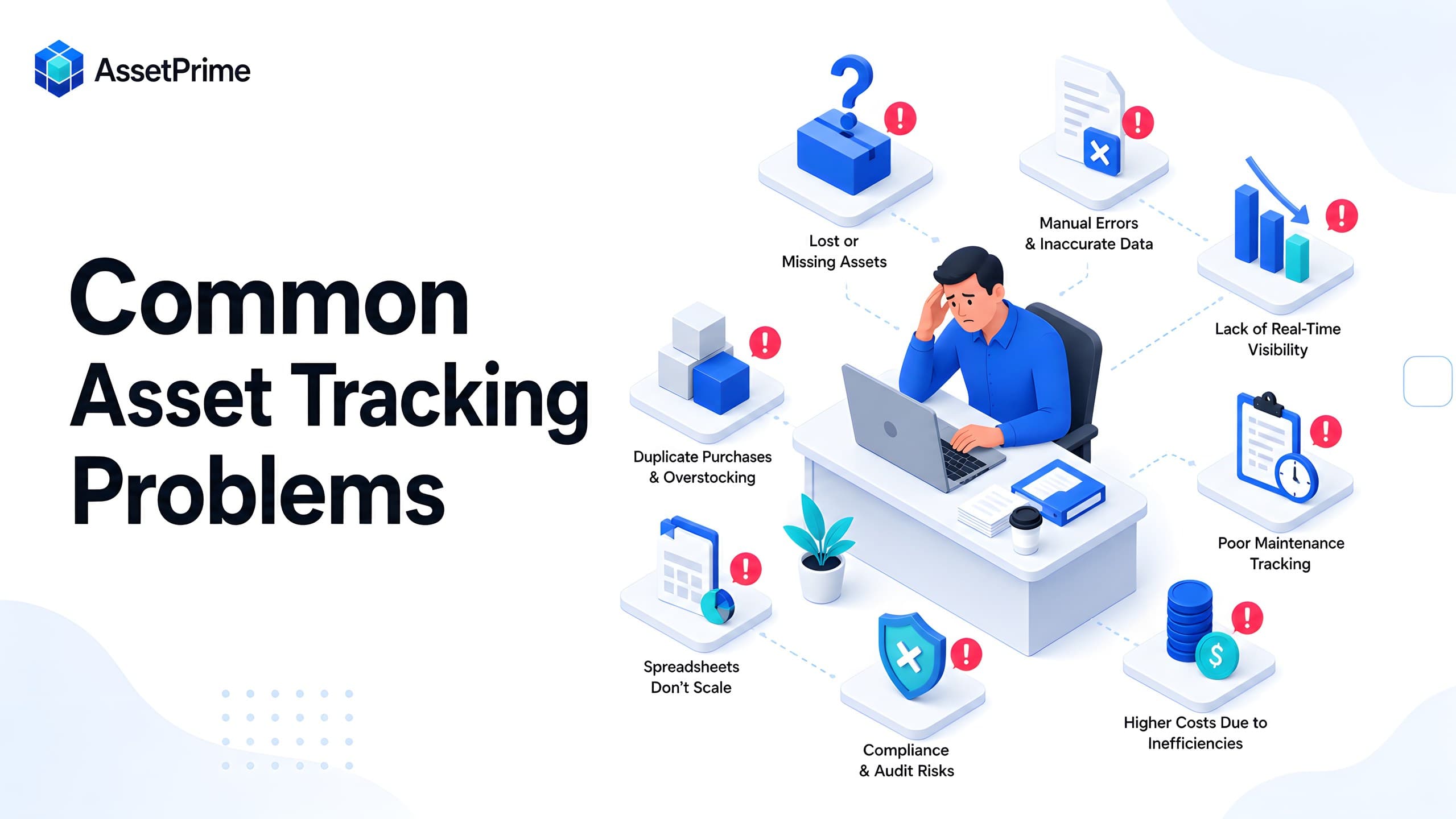
Why asset tracking problems become expensive
Asset tracking problems rarely begin as major failures. They start with a missed update, an unrecorded transfer, an incomplete purchase record, or a spreadsheet copied by another department. Over time, these small gaps create an asset register that no longer reflects physical reality.
When teams cannot trust the register, they spend more time searching, confirming, recounting, reconciling, and asking other departments for information. This affects audits, budgeting, maintenance, procurement, employee exits, insurance claims, and operational continuity.
The first step toward improvement is to identify the root cause of each problem. Missing assets, duplicate records, inaccurate locations, and delayed audits often have different symptoms but share the same underlying weaknesses: fragmented data, unclear ownership, manual workflows, and poor transaction discipline.
“You cannot control assets clearly when ownership, location, maintenance, and audit history live in separate files.”
How to diagnose the real cause of an asset tracking problem
Before changing software or adding more controls, identify where the record stops matching reality. Review a sample of assets from purchase through receiving, registration, deployment, movement, assignment, maintenance, audit, and disposal. The first point where information is missing or delayed usually reveals the process weakness.
Separate data problems from workflow problems. A wrong location may be caused by poor master data, but it may also result from a transfer process that happens physically without a corresponding system transaction. A missing warranty date may be a data-entry issue, or it may indicate that receiving and procurement records are disconnected.
Prioritize problems by business risk. High-value, portable, safety-critical, frequently moved, or maintenance-intensive assets deserve tighter controls than low-value static items. This prevents teams from creating excessive administration around every asset while serious gaps remain unresolved.
What strong asset control should make visible
- ✓Where each asset is located today.
- ✓Who is responsible for the asset.
- ✓When it was purchased, moved, maintained, or disposed.
- ✓Which records are ready for audit, reporting, and decision-making.
Problem 1: Missing or misplaced assets
An asset may still exist inside the organization but appear missing because its current location or custodian was never updated. Movable equipment, laptops, tools, scanners, medical devices, and shared assets are especially vulnerable.
The immediate response should be to review the last confirmed assignment, movement, service transaction, and audit result. A structured search is more effective than sending organization-wide messages without evidence.
The long-term solution is to require recorded movement and assignment transactions, use barcode verification, and perform targeted cycle counts for high-risk assets.
Problem 2: Outdated asset locations
A register becomes unreliable when users edit locations only after audits or when someone notices a discrepancy. Assets may move several times before the central file is updated.
Location changes should be captured at the moment of transfer, with source, destination, date, movement type, responsible user, and notes. The current location should be derived from the latest approved transaction rather than informal messages.
Multi-level location structures also matter. Branch, building, floor, department, room, store, and service locations should be clearly defined so users do not enter inconsistent free-text values.
Problem 3: Duplicate asset records
Duplicates arise when teams import the same purchase twice, create a new record because they cannot find the original, or maintain separate departmental registers. Slight differences in names, codes, and serial numbers make duplicates hard to detect.
Duplicate records inflate quantities and asset values, create conflicting locations, and cause the same physical unit to be verified against more than one row.
Preventive controls include unique asset codes, serial-number validation, controlled imports, standardized naming, duplicate review reports, and centralized creation permissions.
Problem 4: Incomplete asset data
An asset record may exist but still be unusable because key fields are missing. Common gaps include serial number, purchase date, invoice reference, cost, branch, location, department, custodian, condition, warranty, useful life, and supporting documents.
Data requirements should vary by asset type. A high-value medical device needs different controls from office furniture, and a serialized laptop requires more detail than a bulk quantity of low-risk items.
Define mandatory fields by category and lifecycle stage. Receiving teams should capture purchase and identity information, while assignment, maintenance, finance, and audit teams add their relevant data through controlled workflows.
Problem 5: No clear ownership or custody
Organizations often know which department uses an asset but not who is responsible for it. Shared equipment creates even more uncertainty because everyone uses it and no one owns the record.
Assign responsibility at the appropriate level: employee, department, room, branch, project, or custodian role. Record issue, transfer, return, and acknowledgment details where necessary.
Clear custody improves employee offboarding, damage investigation, physical verification, and recovery of portable assets.
Problem 6: Movement history is overwritten
Changing the current location field is not the same as recording a movement. It removes the previous state and leaves no evidence of who moved the asset, why it moved, or whether the transfer was approved.
Every material movement should be preserved as a transaction. Internal transfer, service out, service return, assignment, return, disposal, loss, and retirement should use distinct movement types.
A complete movement trail supports audit, accountability, utilization analysis, service control, and investigation of discrepancies.
Problem 7: Spreadsheet version conflicts
Excel files become difficult to govern when copies are shared by email, stored in different folders, and edited by multiple teams. Users may update an older version or overwrite changes made by someone else.
Even a carefully designed spreadsheet cannot provide reliable real-time transactions, granular permissions, immutable history, and multi-user workflow control at scale.
Move the asset register to a centralized system and use spreadsheets only for controlled imports, exports, or analysis. Define one authoritative source and stop parallel registers after migration.
Problem 8: Slow and disruptive audits
Annual audits become expensive when the asset register is cleaned only shortly before verification. Teams then spend days correcting locations, finding serial numbers, and explaining old discrepancies.
Audit readiness should be continuous. High-risk assets can be checked through cycle audits, while barcode scanning speeds up physical verification and exception recording.
Separate verification from reconciliation. First capture what is physically found, then investigate missing, misplaced, unregistered, damaged, or duplicate assets through a controlled exception workflow.
Problem 9: Poor maintenance visibility
When maintenance records are stored separately, teams cannot easily see open work, repeated failures, service cost, downtime, condition, or the relationship between repairs and warranty or AMC coverage.
Maintenance should be linked to the exact serialized asset or controlled bulk record. The service workflow should preserve complaint, dates, provider, technician, status, cost, notes, and completion evidence.
Combined lifecycle data helps identify assets that should be repaired, replaced, reassigned, or retired.
Problem 10: Missed warranty, AMC, and insurance dates
Coverage information is often trapped in contracts and invoices. Expiry dates may be recorded, but no one is responsible for monitoring or acting on them.
Centralize coverage records, connect them to covered assets, attach supporting documents, and create expiry reports with clear ownership. Alerts are useful only when someone has responsibility to review and act.
Before approving paid service, users should be able to confirm whether the asset is still covered.
Problem 11: Duplicate and unnecessary purchases
Departments may request new assets because existing assets cannot be found or utilization is unknown. This leads to avoidable spending while usable equipment remains idle elsewhere.
Procurement decisions should begin with visibility into available stock, assigned assets, condition, location, and expected returns. Reallocation may solve the need without a new purchase.
Linking procurement with the asset register also ensures that received assets are registered and deployed with complete purchase history.
Problem 12: Confusion between assets and inventory
Assets and inventory require different controls. Assets remain in use and need lifecycle, custody, maintenance, and depreciation visibility. Inventory is usually bought, stored, issued, sold, or consumed and is often managed primarily by quantity.
Organizations create unnecessary complexity when every unit is serialized or when high-value movable assets are tracked only as bulk quantities.
Define tracking rules by value, risk, mobility, maintenance need, compliance importance, and expected life. A hybrid system should support both serialized instances and bulk stock.
Problem 13: Weak barcode and label practices
Barcode projects fail when labels peel off, cannot be scanned, are placed in inaccessible locations, or use inconsistent codes. A poor physical label weakens the digital record.
Select materials based on heat, moisture, chemicals, abrasion, cleaning, and outdoor exposure. Standardize label dimensions, print quality, placement, and replacement procedures.
Labels should be applied during receiving or registration, not months after the asset enters service.
Problem 14: Uncontrolled user access
When every user can edit every asset, errors and unauthorized changes become difficult to trace. On the other hand, overly restrictive access can push teams back to offline files.
Use role-based permissions and location scope. Users should have enough access to complete their work while sensitive financial, disposal, and administrative actions remain controlled.
Audit logs should record important changes and transactions so managers can review who did what and when.
Problem 15: Disposal is not connected to the register
Assets are sometimes sold, scrapped, lost, donated, or retired physically while remaining active in the asset register. This inflates counts and creates audit discrepancies.
Disposal should be a controlled lifecycle event with approval, date, reason, quantity or instance details, financial outcome, supporting documents, and final status.
The asset history should remain available after disposal even though the item is no longer active.
Problem 16: Poor data migration into new software
Organizations may import years of inconsistent spreadsheet data without cleaning it first. Duplicate codes, invalid locations, incomplete serial numbers, and mixed status values then become permanent system problems.
Before migration, profile the data, define masters, map fields, remove duplicates, normalize values, identify mandatory gaps, and separate active from historical records.
Run a pilot import, validate totals and sample records, and document reconciliation before full cutover.
Asset tracking best practices that prevent recurring problems
Use one authoritative asset register and define clear ownership for keeping it accurate. Standardize asset codes, categories, locations, statuses, movement types, and assignment rules so different teams do not describe the same operational event in different ways.
Capture lifecycle events when they happen. Receiving, assignment, return, transfer, maintenance, warranty updates, audit findings, loss, retirement, and disposal should update the asset history as part of the workflow rather than through a later cleanup exercise.
Use barcode or QR identification where it reduces ambiguity and manual entry, but do not treat labels as the complete solution. Reliable tracking also depends on current locations, responsible custodians, transaction history, controlled permissions, and regular exception review.
Review a small set of data-quality indicators regularly: assets without locations, assets without custodians where one is required, duplicate serial numbers, overdue maintenance, expired coverage, unverified high-risk assets, and records that have not been updated for unusually long periods.
When asset tracking software becomes necessary
A spreadsheet may remain sufficient for a small, stable asset list managed by one person. Dedicated software becomes more valuable when the organization has multiple branches, many users, frequent transfers, employee assignments, maintenance activity, warranty or AMC tracking, physical audits, depreciation, or role-based access requirements.
Another warning sign is the amount of reconciliation required. If teams repeatedly compare spreadsheets, emails, service records, purchase files, and physical counts just to answer where an asset is or who has it, the operating model has outgrown a simple register.
Software should not be selected only because it can store more fields. The real benefit comes from connecting the asset record with the transactions that change it throughout its lifecycle and giving authorized teams one reliable source of current and historical information.
A practical asset tracking improvement plan
Start by assessing current records, physical processes, departments, locations, asset types, and reporting needs. Identify the highest-risk gaps rather than attempting to fix every field at once.
Next, define the authoritative asset register, coding rules, serialized and bulk tracking policies, movement types, assignment responsibilities, maintenance processes, audit frequency, and exception ownership.
Finally, implement in phases, train users by workflow, measure adoption, and review data quality regularly. Technology supports control, but governance and consistent usage create lasting improvement.
How AssetPrime solves common asset tracking problems
AssetPrime provides a centralized asset register with support for bulk stock and serialized instances, branches, hierarchical locations, assignments, movement history, maintenance, warranty, AMC, insurance, depreciation, procurement, audits, documents, and disposal.
Role-based access and location scope help organizations control who can view or update records. Barcode printing and scan-oriented workflows improve identification and physical verification.
Reports and the Asset Intelligence Console connect operational, service, financial, coverage, and audit data so teams can resolve problems from one reliable source rather than reconciling disconnected files.
Final thoughts
Common asset tracking problems are symptoms of weak visibility, fragmented records, and inconsistent workflows. Adding more spreadsheet columns may temporarily help, but it does not solve accountability, history, permissions, or real-time control.
The most effective solution combines clean master data, clear responsibilities, structured transactions, barcode verification, regular audits, and a centralized lifecycle platform.
Organizations do not need perfect data before starting. They need a controlled improvement plan that prioritizes high-risk assets, fixes the workflows creating inaccurate records, and builds trust in the register over time.
The strongest asset tracking process is not the one with the most fields or labels. It is the one that consistently answers five operational questions: what is the asset, where is it, who is responsible for it, what has happened to it, and what action is required next.
Related AssetPrime Pages
Continue with related pages
Explore connected features, guides, solutions, and industry pages that support this topic.
FAQ
Frequently asked questions
What is the most common asset tracking problem?
The most common problem is an inaccurate current location or custodian caused by unrecorded movements and assignments. This makes assets appear missing even when they still exist.
Why do asset registers become outdated?
Registers become outdated when updates depend on memory, email, or periodic spreadsheet edits instead of being captured during receiving, movement, assignment, maintenance, audit, and disposal workflows.
How can an organization reduce missing assets?
Use unique asset identification, barcode labels, recorded movements, clear custody, targeted cycle audits, and exception follow-up for high-risk or movable assets.
How can duplicate asset records be prevented?
Use unique asset codes, serial-number validation, standardized master data, controlled imports, limited creation permissions, and regular duplicate review reports.
Is Excel suitable for asset tracking?
Excel can work for a small and stable asset list, but it becomes difficult to control when many users, branches, movements, assignments, maintenance records, and audit requirements are involved.
How often should assets be audited?
Frequency should depend on value, mobility, risk, compliance, and past discrepancies. High-risk assets may require monthly or quarterly cycle audits, while low-risk assets may be verified annually.
What information should an asset movement record contain?
It should include the asset, source, destination, movement type, date, responsible user, approval or reference details, condition, and notes where relevant.
How do barcode labels solve tracking problems?
They speed up identification and verification, reduce manual typing, and connect physical assets to the correct digital record during operational transactions.
What should be done before migrating asset data?
Clean duplicates, standardize categories and locations, validate codes and serial numbers, identify missing mandatory fields, map statuses, and reconcile totals through a pilot import.
How does AssetPrime address asset tracking problems?
AssetPrime centralizes the register and connects identity, branches, locations, custody, movement, maintenance, coverage, procurement, audit, depreciation, documents, and disposal with role-based control and reporting.
Continue Reading
Related articles
Asset Management
What Is Asset Management Software? A Complete Guide for Modern Organizations
Read Article →
Asset Tracking
Asset Tracking vs Inventory Management: Key Differences for Modern Businesses
Read Article →
Barcode Tracking
How Barcode Asset Tracking Works: A Complete Guide for Modern Asset Operations
Read Article →