
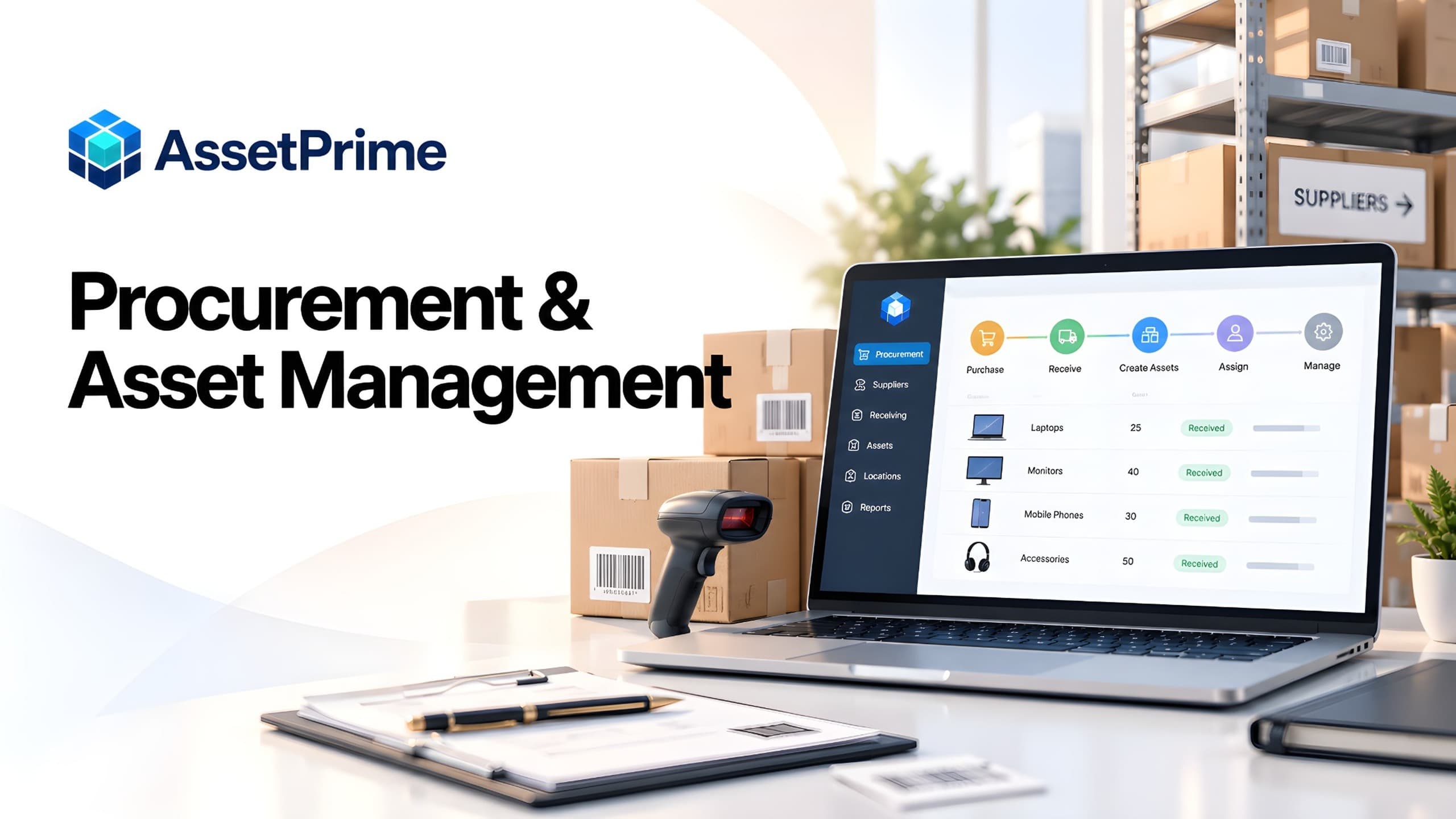
What is procurement and asset management?
Procurement and asset management connects the process of acquiring equipment with the operational records used to control that equipment after it is received. Instead of treating purchasing and asset tracking as separate activities, the organization preserves a continuous path from purchase information to receiving, identification, location, custody, maintenance and eventual retirement or disposal.
This connection is important because an asset's lifecycle does not begin when somebody manually adds it to an asset register. Important information already exists at purchase and receiving, including supplier, invoice, quantity, cost and delivery context.
“You cannot control assets clearly when ownership, location, maintenance, and audit history live in separate files.”
Why procurement and asset management should be connected
When procurement records and the asset register are maintained separately, teams may repeatedly enter the same information and still end up with missing or inconsistent records. Equipment can be purchased but not registered, received into the wrong location or deployed before it receives a reliable identity.
A connected workflow reduces the gap between what the organization bought and what it currently owns, holds and uses. It also gives later maintenance, warranty, depreciation and audit processes better purchase context.
What strong asset control should make visible
- ✓Where each asset is located today.
- ✓Who is responsible for the asset.
- ✓When it was purchased, moved, maintained, or disposed.
- ✓Which records are ready for audit, reporting, and decision-making.
The asset procurement lifecycle from purchase to disposal
A practical lifecycle can be viewed as purchase or procurement, receiving, asset or stock creation, identification, placement, assignment or deployment, movement, maintenance, coverage management, depreciation where applicable, verification and retirement or disposal.
Not every organization uses identical approvals or terminology, but keeping these stages connected makes it easier to understand how an item entered the organization and what happened after acquisition.
Create structured purchase records
A purchase record should capture the commercial context needed by the organization, such as supplier, invoice or reference information, purchase date and the items being acquired.
Purchase items can include description or asset relationship, quantity, unit price and other information required by the organization's process. This creates a source record that can later support receiving and asset creation rather than forcing teams to rebuild purchase context manually.
Manage suppliers and purchase information consistently
Supplier information becomes useful throughout the lifecycle when teams need to check where equipment was purchased, review invoice context, investigate warranty support or understand historical acquisition patterns.
Consistent supplier and purchase records also improve reporting because the organization can analyze asset acquisition using structured data instead of inconsistent names typed across spreadsheets.
Receiving is the bridge between procurement and the asset register
Receiving confirms that purchased items have physically entered the organization. This is the point where quantities, branch, location and the type of tracking required can be translated into operational asset records.
A controlled receiving workflow reduces the risk of treating a purchase order or invoice as proof that every item is already available, deployed or correctly registered.
Practical receiving resource
Use the 12-point asset receiving checklist
This procurement guide explains the broader lifecycle. The receiving checklist covers physical delivery checks, discrepancies, serialized identifiers and location handover at the receiving desk.
Read the asset receiving process and checklist →Bulk assets versus serialized assets at receiving
Different purchases require different tracking. Consumable-like quantities or interchangeable equipment may be managed as bulk stock, while laptops, machines, medical devices, instruments and other individually important equipment may require serialized instance-level tracking.
The receiving workflow should preserve this distinction. Bulk receiving can increase stock quantities and ledger history, while serialized receiving can create individual asset instances that can later be assigned, moved, maintained and audited separately.
Create serialized asset instances from receiving
For serialized equipment, each physical unit needs its own identity even when several identical units were purchased together. Individual instances can carry their own serial number, barcode, location, assignment, condition and lifecycle status.
Creating instances from receiving keeps the quantity purchased connected to the individual equipment that eventually enters service.
Place received assets in the correct branch and location
New equipment should enter the asset system at a known operational location. In multi-branch organizations, that may be a central store, branch store, department, room, warehouse or other hierarchical location.
Correct placement at receiving improves stock visibility and reduces later cleanup caused by assets being registered centrally even though they were delivered elsewhere.
Use barcode identification after receiving
Once serialized equipment is created, barcode or QR labels can connect the physical item to its digital record. Scanning can support lookup, movement, assignment, maintenance and physical verification.
Barcode identification is most useful when it sits on top of accurate procurement, receiving and location data. A label cannot compensate for an asset that was never correctly received or registered.
Move assets from receiving into stock or deployment
After receiving, equipment may remain in stock, move to another location or be deployed directly to an employee or operational area. The system should preserve these transitions instead of replacing the original receiving location.
Movement and stock history help teams distinguish between what was received, what is currently available and what has already been issued or transferred.
Connect procurement with employee asset assignment
Portable equipment such as laptops, phones, tools and field devices may move from receiving or stock into employee custody. Assignment should identify the individual serialized asset and the person responsible for it.
This creates continuity from supplier and purchase information through receiving to the employee who currently holds the equipment, while retaining return and reassignment history.
Connect procurement with maintenance, warranty and AMC
Purchase and receiving information provides useful context when equipment later requires service. Purchase date, supplier, invoice and acquisition value can help teams investigate warranty or maintenance options.
Warranty and AMC records should remain connected to the asset rather than existing only in procurement files. This allows operational teams to check coverage during the period when the equipment is actually being used.
Connect purchase value with depreciation and financial context
Acquisition value is an important input for organizations that maintain depreciation or book-value information for fixed assets. Connecting purchase records with asset records reduces repeated entry and makes financial context easier to trace.
Depreciation methods, capitalization rules and accounting treatment depend on the organization's own policies and applicable requirements. Asset management software can maintain operational and financial data but should not be treated as defining accounting policy.
Track partial and staged receiving carefully
Organizations may not receive every purchased item at the same time. A practical process should distinguish the quantity ordered or recorded in purchasing from the quantity actually received and available.
This is particularly important when deliveries are split across dates or locations. Operational stock and serialized instances should reflect physical receiving rather than assumptions based only on purchase quantities.
Audit the path from purchase to physical asset
During an asset audit, teams may need to trace a physical item back to its acquisition context. A connected system can provide asset identity, current location, custody and lifecycle history alongside purchase and receiving information.
This is more reliable than searching separate procurement files, asset spreadsheets and maintenance records to reconstruct the history of one item.
Reports for procurement and asset management
Useful reports can include purchase and receiving details, asset quantities, serialized instances, current stock, branch and location distribution, assignment, movement, maintenance, warranty, depreciation and disposal context.
Management can use connected reporting to understand not only what was purchased but also where those assets are now and what has happened to them since receiving.
Procurement and asset management versus disconnected spreadsheets
Spreadsheets can work for small purchasing lists or temporary registers, but they become harder to coordinate when purchase items, partial receiving, serialized equipment, multiple locations and lifecycle transactions must remain synchronized.
A dedicated workflow does not eliminate the need for organizational controls, but it can reduce duplicate entry and preserve relationships between procurement events and operational asset records.
How to choose procurement and asset management software
Evaluate whether the platform can connect purchase records, item-level information, receiving, bulk stock and serialized asset instances without forcing separate manual registers.
Also test branch and location placement, barcode creation, movement, employee assignment, maintenance, warranty, depreciation, disposal, documents, permissions and reporting. The strongest evaluation follows a sample asset from purchase through receiving and into active use.
Procurement and asset management implementation checklist
Define supplier and purchase data standards, decide which categories use bulk or serialized tracking, establish receiving locations and determine who is authorized to receive, move and assign equipment.
Clean existing supplier and asset data before migration. Pilot a realistic purchase with multiple items, receive both bulk and serialized equipment, verify stock and instances, apply identification and follow the assets into deployment.
After rollout, reconcile purchases and receiving regularly so missing registrations, incorrect quantities and location errors are identified early.
How AssetPrime connects procurement, receiving and the asset lifecycle
AssetPrime connects purchase and receiving context with the wider physical asset lifecycle. Procurement records can maintain purchase and item information, while receiving can place equipment into stock or create serialized asset instances for individual tracking.
Bulk receiving can update stock and ledger history, while serialized receiving creates individual instances that can carry their own identity, branch, location and later lifecycle transactions.
From there, assets can be identified with barcodes, moved between locations, assigned to Users or Employees, maintained, covered by warranty or AMC, included in depreciation and eventually retired or disposed of while retaining historical context.
This creates a continuous operational record from acquisition to end of life rather than leaving procurement and asset management as disconnected datasets.
Final checklist for procurement-driven asset control
For every important purchase, the organization should be able to answer what was purchased, from whom, at what value, what was actually received, where it entered the organization and how it became stock or an individually tracked asset.
Later, it should also be possible to answer where the asset is now, who is responsible for it, what maintenance or coverage applies and whether it remains active, retired or disposed of.
Connecting these questions is the core value of integrating procurement with asset management.
Related AssetPrime Pages
Continue with related pages
Explore connected features, guides, solutions, and industry pages that support this topic.
FAQ
Frequently asked questions
What is procurement and asset management?
Procurement and asset management connects equipment purchasing and receiving with the operational asset records used for location, stock, assignment, maintenance, warranty, depreciation and lifecycle tracking.
Why should procurement be connected to asset management?
Connecting them reduces duplicate entry and helps preserve a traceable path from supplier and purchase information through receiving to the asset's current operational state.
What is the role of receiving in asset management?
Receiving confirms that purchased equipment physically entered the organization and can create or update the stock and serialized records that will be tracked operationally.
What is the difference between bulk and serialized receiving?
Bulk receiving updates quantities for interchangeable stock, while serialized receiving creates individually identifiable instances that can be tracked, assigned, moved and maintained separately.
Can serialized assets be created when equipment is received?
Yes. A suitable receiving workflow can create individual instances for serialized equipment so each physical unit has its own identity and lifecycle history.
How does barcode tracking fit into procurement?
After receiving and asset creation, barcode or QR labels connect physical serialized equipment with its digital record and support lookup, movement, assignment, maintenance and audit workflows.
Can procurement information support warranty and maintenance?
Yes. Supplier, invoice, purchase date and acquisition information can provide useful context when teams review warranty, AMC or repair options for an asset.
Can purchase value be connected with depreciation?
Yes. Acquisition value can form part of the asset's financial context, although depreciation methods and accounting treatment remain subject to the organization's own policies and applicable requirements.
What should procurement and asset management software report on?
Useful reporting can connect purchases and receiving with stock, serialized instances, locations, assignments, movements, maintenance, coverage, depreciation and disposal context.
How does AssetPrime support procurement and receiving?
AssetPrime connects purchase and item records with receiving, bulk stock and serialized asset creation, then carries those assets into barcode, location, assignment, movement, maintenance, coverage, depreciation and lifecycle workflows.
Continue Reading
Related articles
Asset Management
Asset Receiving Process and Checklist: From Delivery to Asset Register
Read Article →
Asset Management
What Is Asset Management Software? A Complete Guide for Modern Organizations
Read Article →
Asset Tracking
Asset Tracking vs Inventory Management: Key Differences for Modern Businesses
Read Article →