
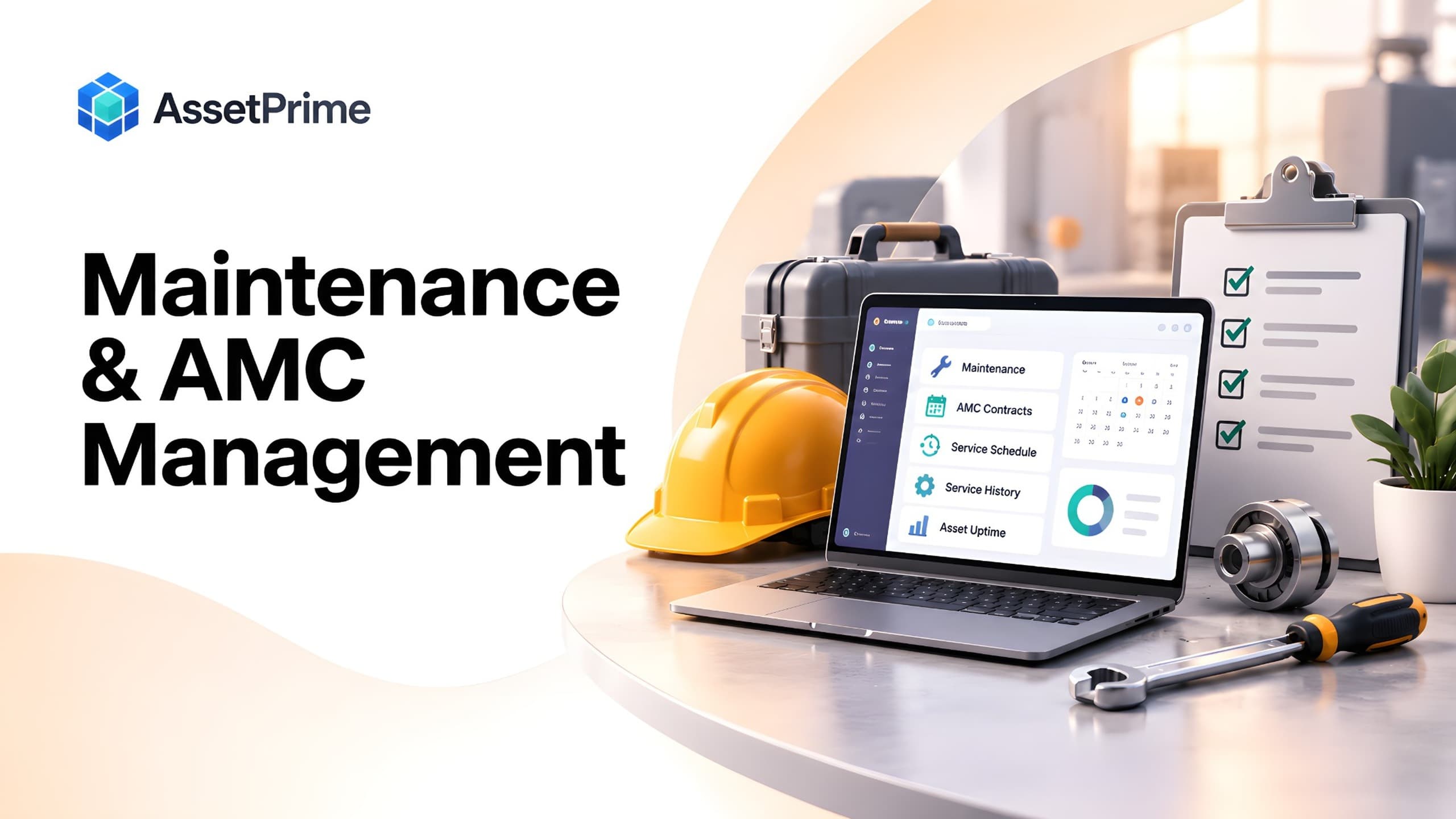
What is maintenance and AMC management?
Maintenance and AMC management is the structured process of planning, recording, monitoring, and reviewing the service activities and maintenance contracts associated with business assets. It connects each asset with its maintenance schedule, repair history, service provider, cost, downtime, contract coverage, renewal date, and supporting documents.
Maintenance management focuses on the work performed on an asset, including preventive servicing, inspections, breakdown repairs, parts replacement, calibration, and other service activities. AMC management focuses on the commercial agreement that may cover some or all of that work for a defined period.
Managing both together gives operations, facilities, IT, engineering, finance, and procurement teams a more complete view. Instead of keeping asset details in one file, service history in another, and AMC expiry dates in a calendar, the organization can connect these records to the same asset lifecycle.
This guide explains how maintenance and annual maintenance contracts should be structured, how to track schedules and renewals, what information to record, which reports matter, and how software can improve control across assets, branches, vendors, and teams.
“You cannot control assets clearly when ownership, location, maintenance, and audit history live in separate files.”
Why maintenance records become difficult to manage
Maintenance information often starts informally. A technician may keep notes, an administrator may maintain an Excel sheet, invoices may remain with finance, and service reminders may depend on email or someone's calendar. This can work for a small number of assets, but it becomes unreliable as asset volume and locations increase.
The first problem is fragmentation. Teams may know that an asset was repaired, but not the exact fault, vendor, service date, cost, replaced parts, downtime, or next scheduled activity. When the same asset fails again, the organization has no dependable history for deciding whether another repair is justified.
The second problem is timing. Preventive maintenance and contract renewals are date-driven. Missing a due date can lead to avoidable breakdowns, expired coverage, emergency service costs, operational disruption, or compliance gaps.
A structured maintenance system creates one traceable history for each asset and makes upcoming work visible before it becomes urgent.
What strong asset control should make visible
- ✓Where each asset is located today.
- ✓Who is responsible for the asset.
- ✓When it was purchased, moved, maintained, or disposed.
- ✓Which records are ready for audit, reporting, and decision-making.
What is an Annual Maintenance Contract (AMC)?
An Annual Maintenance Contract, commonly called an AMC, is an agreement under which a vendor or service provider maintains specified equipment or assets for an agreed period, commonly one year. The exact scope can vary significantly by asset type, industry, vendor, and contract.
An AMC may include scheduled preventive visits, breakdown support, labour, selected spare parts, inspections, calibration, response-time commitments, or other services. Some contracts cover only labour and routine service, while comprehensive contracts may include a broader set of repair costs and replacement components.
The contract should therefore never be treated as only an expiry date. Useful AMC records include the covered assets, provider, contract number, start and end dates, amount, coverage terms, service frequency, exclusions, contacts, documents, and renewal status.
Connecting the AMC record directly to the covered asset makes it easier to determine whether a repair should be handled under contract or charged separately.
Maintenance vs AMC: what is the difference?
Maintenance is the operational activity performed to keep an asset usable, safe, reliable, or compliant. An AMC is a contractual arrangement that defines how a vendor will provide some of those maintenance services during a specified period.
An asset can require maintenance without having an AMC. Internal technicians may perform preventive maintenance, or the organization may pay a vendor for each service call. Likewise, an active AMC does not mean that maintenance history can be ignored. Every visit, repair, finding, and cost should still be recorded against the asset.
The strongest model keeps the records related but distinct. Maintenance tells you what happened to the asset. AMC tells you what commercial coverage was available when it happened.
Corrective, preventive and planned maintenance
Corrective maintenance is performed after a fault or problem is identified. It may involve troubleshooting, repair, replacement of a failed component, or restoring the asset to working condition. Breakdown maintenance is a common form of corrective work triggered by an unexpected failure.
Preventive maintenance is performed at planned intervals to reduce the probability of failure or deterioration. The schedule may be based on calendar time, operating hours, usage, manufacturer recommendations, regulatory requirements, or internal policy.
Planned maintenance gives teams time to coordinate people, vendors, spare parts, shutdown windows, approvals, and replacement equipment. The objective is not to eliminate every failure, but to move maintenance from reactive firefighting toward controlled, measurable work.
A maintenance register should identify the maintenance type so reports can distinguish planned activity from recurring breakdowns.
What information should an asset maintenance record contain?
A useful maintenance record should identify the asset, branch and location, maintenance type, reported problem or planned task, service date, status, assigned technician or vendor, findings, work performed, replaced parts, service cost, downtime, next due date, and supporting documents where applicable.
The asset identity is critical. A generic entry such as 'AC serviced' is difficult to audit when a building contains dozens of similar units. The record should point to the exact asset code, serial number, barcode, or other unique identifier.
The system should also preserve historical records rather than overwriting the previous service information with the latest update. Over time, this history becomes valuable for reliability analysis, replacement planning, warranty claims, budgeting, and vendor evaluation.
How to build a preventive maintenance schedule
Start by identifying which assets require recurring maintenance and why. Manufacturer recommendations, warranty conditions, safety requirements, regulatory obligations, operational risk, asset criticality, historical failures, and internal engineering standards can all influence the interval.
For each asset or asset group, define the maintenance activity, frequency, responsible team or vendor, expected duration, checklist or instructions, and escalation process if the work becomes overdue. Avoid creating schedules that cannot realistically be executed with the available resources.
The schedule should generate a clear upcoming workload rather than relying on people to remember dates. Teams should be able to see what is due today, what is approaching, and what is overdue, then update the maintenance record when the work is completed.
Review intervals periodically. If an asset repeatedly fails between planned services, the frequency or maintenance scope may need adjustment. If a low-risk asset receives unnecessary service, the schedule may be consuming resources without corresponding value.
How to manage AMC coverage for multiple assets
An AMC may cover one asset, a group of similar assets, or equipment distributed across several locations. The organization needs a reliable way to identify exactly which assets are covered by each contract and which are excluded.
Linking asset records to the AMC prevents ambiguity during a breakdown. A user should be able to open the asset and confirm the provider, coverage period, contract reference, service contact, and relevant terms before raising an external service request.
For multi-branch organizations, coverage should also retain branch and location context. A national contract may cover equipment across many sites, while another vendor may support only a specific plant, office, hospital, or warehouse.
Centralized records allow head office to monitor overall exposure while branch teams work with the contracts relevant to their own assets.
AMC renewal tracking and expiry alerts
AMC renewal management should begin before the expiry date. Waiting until a contract expires can leave critical equipment without support and gives procurement less time to evaluate performance, negotiate terms, or consider alternative vendors.
A practical process tracks upcoming expiries in advance and assigns responsibility for review. The review should confirm whether the covered assets are still active, whether the service was satisfactory, how much the contract cost, how often it was used, whether exclusions caused additional spending, and whether the scope should change for the next period.
Expiry alerts are most useful when they are actionable. Instead of only showing that an AMC ends on a particular date, the system should help users identify the affected assets, provider, contract value, and current renewal status.
Maintaining renewal history also helps the organization understand how service costs and contract terms change over the life of an asset.
Track maintenance costs at the asset level
Maintenance cost is more useful when it can be connected to the individual asset rather than stored only as a vendor invoice total. Asset-level cost history helps reveal equipment that is becoming expensive to keep operational.
Relevant costs can include service charges, labour, spare parts, transport, inspection fees, calibration, emergency support, and other maintenance expenses. AMC cost should be tracked separately so decision-makers can compare contract spending with out-of-contract repairs where appropriate.
Cost history does not automatically determine whether an asset should be replaced. Age, criticality, downtime, utilization, safety, availability of parts, depreciation, replacement lead time, and business impact also matter. But reliable maintenance cost data makes the decision far more evidence-based.
Why downtime should be part of maintenance reporting
Two assets can have similar repair costs but very different operational impact. A low-cost repair that stops a production line, clinical workflow, warehouse process, or critical IT service may matter more than a more expensive repair on a non-critical asset.
Recording downtime helps organizations understand this impact. Useful measures include the date the asset became unavailable, service start, restoration date, total downtime, cause, and whether a temporary replacement was required.
Repeated downtime can expose reliability problems that are not obvious from service count alone. It can also support discussions about spare capacity, replacement planning, vendor response times, and preventive maintenance effectiveness.
Vendor and service provider management
Maintenance vendors should be connected to the work they actually perform. For each service provider, teams may need contact details, covered asset categories, contract references, service locations, response commitments, visit history, costs, and supporting documents.
Over time, maintenance records can help evaluate vendor performance using practical evidence: response time, completion time, repeat failures, contract utilization, service quality, and cost. This is more useful than relying only on informal feedback during renewal negotiations.
Vendor access should not weaken internal accountability. The organization should still maintain its own asset and maintenance history even when an external provider performs the work.
Maintenance management across multiple branches and locations
Multi-location operations add another layer of complexity. Different branches may use different vendors, service schedules, approval practices, and local spreadsheets. This makes it difficult for management to see the organization-wide maintenance position.
A centralized model should retain the exact branch and location of every asset while allowing authorized local teams to manage day-to-day maintenance. Head office can then review open work, overdue schedules, costs, AMC expiries, and vendor performance across the complete organization.
This is especially useful for manufacturers, hospitals, warehouses, schools, offices, retail networks, and other organizations where equipment is distributed across multiple operating sites.
Barcode and QR codes in maintenance workflows
Barcode or QR identification can make maintenance updates faster and more accurate. Instead of searching manually through a long asset list, a technician can identify the exact physical unit from its tag and open the relevant asset record.
This reduces the risk of recording work against the wrong asset, particularly when many identical models are installed in the same facility. The asset record can provide serial number, location, assignment, warranty, AMC, previous maintenance, and other context before work begins.
Scanning is most valuable when it is part of a controlled workflow. The barcode identifies the asset; the maintenance system still needs to record the work, responsibility, dates, costs, status, and history.
Warranty, AMC and insurance should not be mixed together
Warranty, AMC, and insurance can all provide forms of asset coverage, but they serve different purposes and should be recorded separately. A manufacturer warranty may cover eligible defects, an AMC may provide ongoing maintenance services, and insurance may cover defined financial risks or events.
Combining them into one generic expiry field makes it difficult to understand what protection actually applies. Each coverage type should retain its provider, reference, dates, amount where relevant, terms, documents, and renewal or extension history.
During a maintenance event, having these records connected to the asset helps teams decide whether the issue may be handled under warranty, AMC, insurance, or normal paid service.
Maintenance audit trail and compliance readiness
For important assets, it should be possible to demonstrate what maintenance occurred, when it occurred, who performed or recorded it, what the result was, and what happened next. This is particularly important in controlled environments where maintenance records support internal audits, customer requirements, safety processes, or regulatory reviews.
An audit-ready system should preserve historical records and important changes instead of allowing users to silently replace past information. Role-based permissions can also restrict who is allowed to create, edit, approve, or close maintenance activity.
Supporting files such as service reports, invoices, certificates, photographs, checklists, or AMC documents can strengthen the record when they are stored with clear asset and transaction context.
Important maintenance and AMC reports
Useful maintenance reporting should answer operational questions, not simply produce a long transaction list. Teams commonly need open maintenance, upcoming preventive maintenance, overdue maintenance, completed service history, asset-wise cost, vendor-wise cost, downtime, repeat failures, and branch-wise maintenance activity.
AMC reporting should show active contracts, upcoming expiries, expired coverage, covered assets, provider, contract value, branch or location, renewal status, and contract history. Management may also want to compare maintenance spending across asset categories, locations, vendors, or periods.
Dashboards are valuable for immediate attention items, while detailed reports are better for investigation, budgeting, audits, and management review. Both should use the same underlying asset records so figures remain consistent.
Common maintenance and AMC management mistakes
A common mistake is treating maintenance as a free-text note on the asset. This loses structure around dates, status, cost, responsibility, vendor, downtime, and future schedules. Another is storing AMC information only in contract files without linking the covered assets.
Teams also create problems when they overwrite previous service dates, depend on one employee's calendar for renewals, close maintenance without recording findings, or use inconsistent asset names instead of unique asset identifiers.
Another mistake is scheduling preventive maintenance without reviewing whether the schedule is effective. A large number of planned tasks does not automatically mean maintenance is well controlled. Organizations should examine failures, overdue work, downtime, cost, and asset condition to improve the program.
Finally, maintenance records should not become isolated from procurement, warranty, assignment, movement, depreciation, audit, and disposal information. Maintenance is one part of the wider asset lifecycle.
How to move from Excel to a maintenance and AMC management system
Start by cleaning the asset register. Maintenance software cannot create reliable history if the underlying asset identities, branches, locations, and statuses are inconsistent. Decide which assets require maintenance and which existing service and AMC records are worth migrating.
Next, standardize maintenance types, statuses, vendors, cost fields, due-date rules, and responsibility. Import active AMC contracts with their covered assets and validate expiry dates and documents. Then configure preventive schedules for the most important asset groups first rather than attempting to automate every possible task on day one.
Pilot the process with a manageable set of assets and users. Test a complete workflow from due maintenance through completion, cost recording, next schedule, and reporting. Also test an AMC expiry and renewal scenario so responsibilities are clear before wider rollout.
Once the workflow is stable, expand by branch, department, asset category, or operational priority and monitor data quality as usage grows.
What to look for in maintenance and AMC management software
Look for software that connects maintenance directly to a structured asset register. Important capabilities include unique asset identification, preventive schedules, corrective maintenance history, due and overdue visibility, vendors, costs, downtime, documents, AMC coverage, expiry tracking, renewals, branches, locations, role-based permissions, audit logs, dashboards, and exports.
If the organization already uses barcode or QR labels, verify that the software can use those identifiers during maintenance workflows. Multi-branch organizations should test whether users can be restricted to appropriate locations while management retains consolidated reporting.
During a demonstration, use real scenarios instead of only reviewing feature lists. Ask the vendor to show an asset with previous repairs, create a new maintenance activity, record cost and downtime, identify an active AMC, show an upcoming expiry, renew the contract, and produce the relevant reports.
The best system is not the one with the longest feature list. It is the one that fits the organization's asset structure, maintenance responsibilities, controls, reporting needs, and long-term operating model.
How AssetPrime supports maintenance and AMC management
AssetPrime brings maintenance and coverage information into the broader asset lifecycle. Organizations can maintain structured asset records and connect them with maintenance activity, warranty, AMC, insurance, assignments, movements, depreciation, documents, audit history, branches, locations, dashboards, and reports.
Maintenance records help teams preserve service history and operational context, while AMC records help track contract periods, providers, amounts, notes, covered assets, and upcoming expiries. This gives users a clearer view of both the physical asset and the commercial coverage surrounding it.
For organizations evaluating AssetPrime, a useful demonstration is to select a real equipment type and walk through registration, barcode identification, maintenance history, an upcoming AMC expiry, renewal, branch-level access, and reporting. This makes it easier to evaluate the system against the organization's actual workflow rather than a generic software checklist.
Final maintenance and AMC management checklist
Every maintainable asset should have a reliable identity, current branch and location, clear maintenance responsibility, and complete historical record. Preventive tasks should have defined frequencies and due dates, while corrective work should record the problem, action, provider, cost, downtime, and outcome.
Every AMC should identify the covered assets, provider, contract period, scope, amount where relevant, documents, renewal responsibility, and status. Upcoming expiries should be visible early enough for review and decision-making.
Finally, review the data rather than only collecting it. Use maintenance frequency, recurring failures, downtime, service cost, vendor performance, AMC renewals, asset age, and condition to support better repair, replacement, budgeting, and lifecycle decisions.
Related AssetPrime Pages
Continue with related pages
Explore connected features, guides, solutions, and industry pages that support this topic.
FAQ
Frequently asked questions
What is AMC management?
AMC management is the process of recording and controlling annual maintenance contracts, including covered assets, service provider, contract number, start and end dates, scope, value, documents, expiry alerts, and renewal history.
What is AMC management software?
AMC management software helps organizations centralize maintenance contract records, connect contracts to assets, track providers and coverage periods, monitor upcoming expiries, preserve renewals, and report on AMC status across locations.
What is the difference between maintenance and AMC?
Maintenance is the actual work performed to inspect, service, repair, or restore an asset. An AMC is a commercial agreement under which a provider delivers defined maintenance services for a specified period.
What should be tracked in an asset maintenance record?
Track the exact asset, maintenance type, problem or task, dates, status, technician or vendor, findings, work performed, parts, cost, downtime, next due date, and supporting documents where relevant.
How do I track AMC expiry dates?
Maintain each AMC with its start and end dates, covered assets, provider, responsible owner, and renewal status. Use upcoming-expiry views or alerts so the review starts before coverage ends.
Can one AMC cover multiple assets?
Yes. A contract may cover one asset or many assets across one or more locations. The system should clearly identify every covered asset so teams can confirm eligibility when service is required.
Why is preventive maintenance important?
Preventive maintenance helps organizations service assets at planned intervals to reduce avoidable failures, coordinate resources, support safety and compliance needs, and improve visibility into upcoming maintenance workload.
What maintenance reports should organizations use?
Useful reports include open, upcoming, overdue and completed maintenance; asset-wise and vendor-wise costs; downtime and repeat failures; active, expiring and expired AMCs; covered assets; renewals; and branch-wise maintenance activity.
Can barcode tracking be used for maintenance?
Yes. Barcode or QR scanning can identify the exact physical asset before a technician views or updates its maintenance record, reducing manual search and the risk of recording service against the wrong unit.
How does AssetPrime help manage maintenance and AMC records?
AssetPrime connects maintenance and AMC information with structured asset records, branches, locations, barcode identification, warranty, insurance, assignments, movements, depreciation, documents, audit history, dashboards, and reports.
Continue Reading
Related articles
Asset Management
What Is Asset Management Software? A Complete Guide for Modern Organizations
Read Article →
Asset Tracking
Asset Tracking vs Inventory Management: Key Differences for Modern Businesses
Read Article →
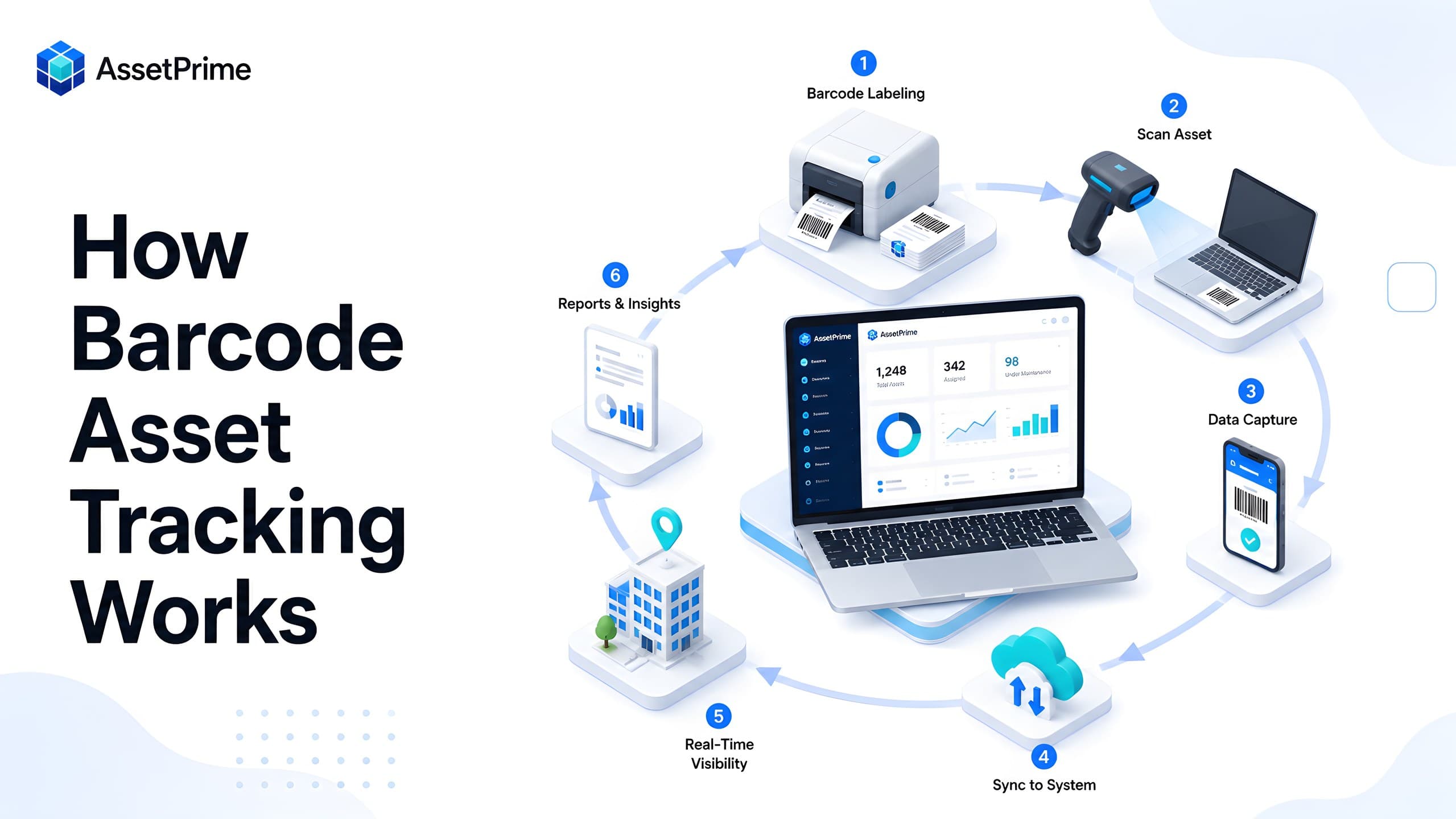
Barcode Tracking
How Barcode Asset Tracking Works: A Complete Guide for Modern Asset Operations
Read Article →