
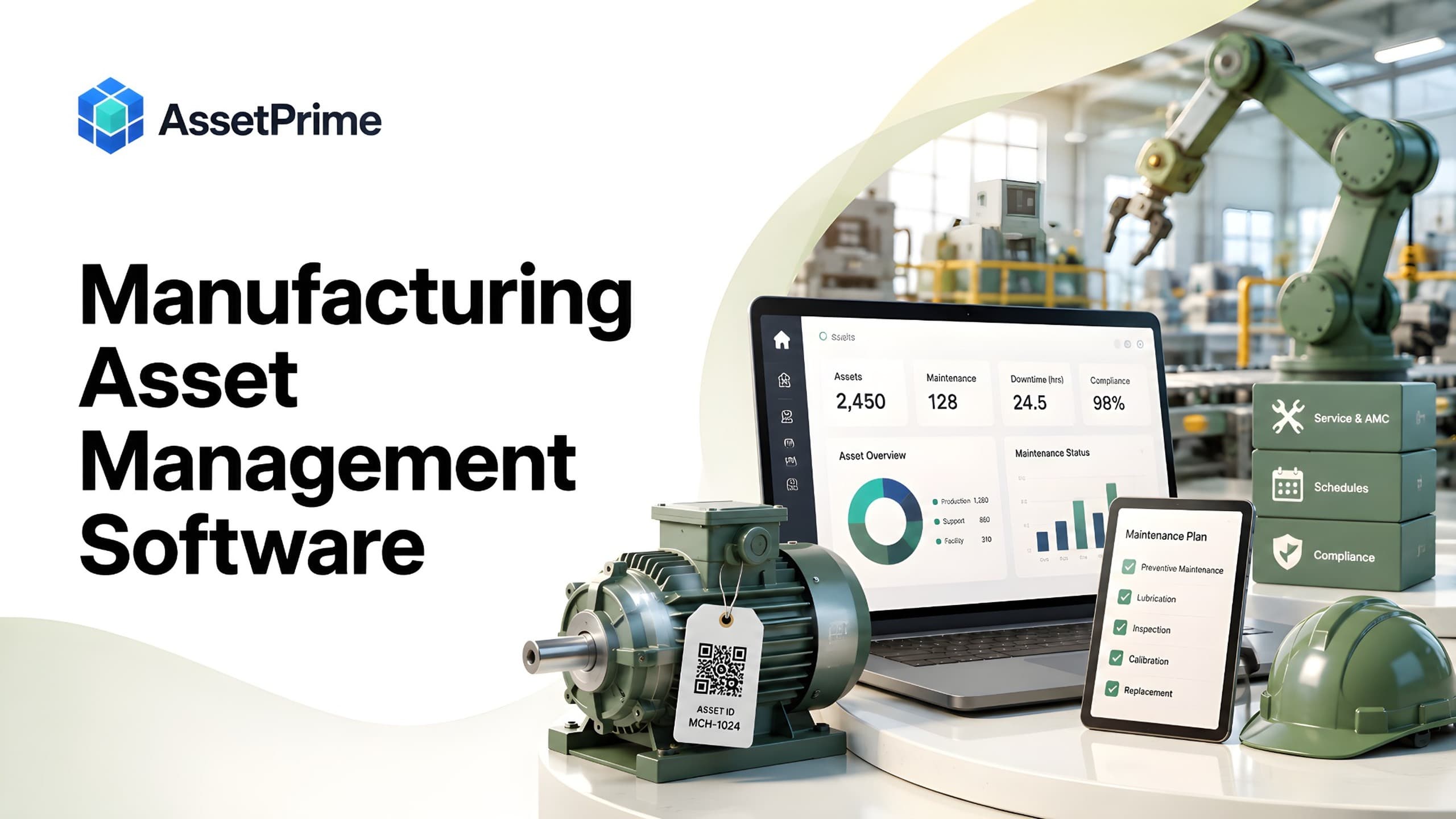
What is manufacturing asset management?
Manufacturing asset management is the structured process of identifying, tracking, maintaining, controlling, and reviewing the physical assets used across factories, plants, workshops, warehouses, utilities, and supporting operations. These assets can include production machinery, tools, material-handling equipment, test instruments, electrical equipment, IT devices, facility assets, safety equipment, and other items that support manufacturing activity.
The objective is broader than maintaining an equipment list. A manufacturing organization needs to know what each asset is, where it is located, whether it is available, who is responsible for it, how it has moved, when it was purchased, what it has cost to maintain, what coverage applies, and what should happen next in its lifecycle.
Manufacturing asset management software creates a central system of record for this information. It connects the asset register with branch and location hierarchy, barcode identification, assignment, movement, maintenance, warranty, AMC, insurance, depreciation, documents, audits, and disposal history.
This connected view is especially important in manufacturing because the operational value of an asset is often much greater than its purchase value alone. A missing tool, unavailable machine, overdue service activity, or poorly controlled transfer can affect production, quality, safety, maintenance workload, and audit readiness.
“You cannot control assets clearly when ownership, location, maintenance, and audit history live in separate files.”
Why manufacturing companies need stronger asset visibility
Factories contain assets across many physical and operational areas. Equipment may be installed on production lines, kept in maintenance rooms, issued to technicians, stored as standby units, transferred between plants, sent to vendors, or temporarily moved for repair and calibration. Without structured tracking, the recorded location can quickly stop matching reality.
Visibility problems become more serious when different departments maintain separate records. Finance may hold purchase values, maintenance may hold service history, stores may track equipment movement, production teams may know the current user or line, and administration may keep warranty or contract documents. The organization then has information, but not one dependable asset history.
A centralized asset management platform reduces this fragmentation by connecting operational and financial context to the same asset identity. Teams can review current location, lifecycle status, assignment, movement history, service activity, coverage, documents, and audit evidence without rebuilding the story from multiple spreadsheets.
Better visibility also supports faster decisions. When managers can see asset condition, age, service frequency, downtime, repair cost, and utilization context together, they can make more informed choices about repair, transfer, replacement, procurement, and retirement.
What strong asset control should make visible
- ✓Where each asset is located today.
- ✓Who is responsible for the asset.
- ✓When it was purchased, moved, maintained, or disposed.
- ✓Which records are ready for audit, reporting, and decision-making.
Common asset management challenges in factories and plants
One common challenge is location complexity. A single manufacturing site may contain buildings, floors, production lines, workshops, stores, laboratories, utility areas, offices, and yards. Multi-plant organizations add another layer of branches and geographically separated facilities.
Another challenge is movement. Portable tools, testing devices, laptops, measuring equipment, spare machines, and maintenance assets can move frequently. If transfers are not recorded, the asset register may show where an item was originally placed rather than where it is now.
Maintenance creates a third challenge. Service records may exist independently from the asset register, making it difficult to evaluate repeat failures, maintenance cost, downtime, vendor performance, or whether an asset is still under warranty or AMC coverage.
Manufacturers also face audit and accountability requirements. Physical verification becomes slow when labels are inconsistent, serial numbers are missing, location data is outdated, or asset history cannot explain transfers, repairs, assignments, and disposals.
Which manufacturing assets should be tracked?
The right scope depends on the organization, but manufacturers commonly track production machinery, CNC equipment, motors, pumps, compressors, generators, electrical panels, forklifts, material-handling equipment, tools, dies, molds, testing instruments, calibration equipment, safety devices, computers, printers, furniture, and facility equipment.
Not every item needs the same level of control. High-value or individually accountable assets usually benefit from serialized tracking with a unique asset code. Lower-value identical items may be better managed as bulk stock where quantity by location is more important than individual history.
A practical policy should define which assets require unique identification, which require maintenance history, which require assignment or movement control, and which can remain quantity-based. This prevents the system from becoming unnecessarily complex while preserving detail where it matters.
Manufacturers should also consider operational criticality. Some equipment may have a modest book value but a major production impact if unavailable. Asset-management scope should therefore consider business importance as well as purchase cost.
Build a reliable manufacturing asset register
A reliable asset register is the foundation of manufacturing asset management. Each serialized asset should have a unique code and enough information to distinguish the physical unit from similar equipment.
Useful fields include asset name, category, manufacturer, model, serial number, barcode or QR code, branch, plant, building, production area, location, department, custodian, purchase date, supplier, purchase value, condition, lifecycle status, warranty, AMC, insurance, depreciation details, and attached documents.
The register should use controlled categories and locations rather than inconsistent free-text values. For example, Production Line 1 and Line-01 should not accidentally become two different locations when they refer to the same physical area.
Data quality matters because every later workflow depends on it. Maintenance, movement, audits, depreciation, reporting, and disposal are more reliable when they reference a clean and uniquely identified asset record.
Track factories, plants, lines, departments, and locations
Manufacturing organizations need a location model that reflects how their facilities actually operate. A useful hierarchy may begin with company and branch, then continue through plant, building, floor, department, production line, room, store, workshop, or other physical location.
This hierarchy allows the organization to answer practical questions such as which assets are in a particular plant, which machines belong to a production line, what equipment is held in maintenance, and what assets are located in a specific store or utility area.
Multi-plant businesses also need location-based access control. A user responsible for one facility may not need operational access to every other plant. Software should therefore combine consolidated management visibility with appropriate location scope for day-to-day users.
Accurate location structure also improves audits and reporting because teams can verify assets area by area instead of searching through one flat company-wide list.
Use barcode and QR codes for factory asset tracking
Barcode and QR labels provide a practical bridge between the digital asset record and the physical equipment. Instead of searching by description or manually typing a long code, a user can scan the label to identify the exact asset.
Scanning is useful during physical audits, transfers, assignments, receiving, maintenance, verification, and other workflows where selecting the correct physical unit matters. It reduces typing errors and helps prevent activity from being recorded against the wrong asset.
Label design should consider the manufacturing environment. Heat, dust, oil, chemicals, moisture, abrasion, cleaning processes, outdoor exposure, and curved surfaces may require more durable label materials or placement methods than a normal office asset.
The barcode itself should identify the asset, while the asset management system remains the source of truth for current location, condition, history, maintenance, and lifecycle information.
Control asset movements between plants and production areas
Manufacturing assets frequently move for operational reasons. A tool may be issued to another department, a test instrument may be transferred to a different line, equipment may be sent to maintenance, or a standby machine may be moved between plants.
A controlled movement workflow should record the asset, source, destination, date, reason, responsible user, and any approval or supporting information required by the organization. The current location should update without losing the previous movement history.
Historical movement is valuable during audits and investigations. If an asset is not found where expected, teams can review where it came from, where it was moved, why it moved, and when the change occurred.
This is particularly important for multi-branch manufacturing companies because informal transfers can create discrepancies between physical assets, accounting records, and local responsibility.
Manage asset assignment and accountability
Some manufacturing assets are best controlled by location, while others need a named custodian. Laptops, instruments, tool kits, handheld devices, safety equipment, and specialized portable assets may be issued to employees or responsible users.
Assignment records should show who currently holds the asset, when it was assigned, its condition at handover, and when it was returned or reassigned. Historical assignment should remain available after the current assignment ends.
Clear accountability reduces uncertainty without treating every asset as personally owned by an employee. The organization can decide whether responsibility belongs to a person, department, plant, or location based on the nature of the equipment.
Assignment history also supports offboarding, internal transfers, audits, and investigations into missing or damaged equipment.
Connect maintenance history to each manufacturing asset
Maintenance information becomes much more useful when it is attached to the exact asset rather than stored in a separate generic service log. Each activity can then contribute to a continuous equipment history.
Useful maintenance records include the issue or task, maintenance type, opened date, scheduled date, completion date, technician or vendor, work performed, findings, replaced parts, cost, downtime, documents, status, and next required activity.
This history helps teams identify recurring failures and unusually expensive equipment. A machine that appears inexpensive to retain may actually be consuming significant repair cost and production time.
Connecting maintenance with the asset register also makes it easier to review warranty, AMC, age, purchase value, location, and lifecycle status before deciding whether to repair, overhaul, replace, or retire equipment.
Preventive maintenance and planned service schedules
Preventive maintenance aims to service equipment before avoidable failure occurs. Depending on the asset, schedules may be based on calendar intervals, operating conditions, manufacturer recommendations, regulatory requirements, or internal maintenance policy.
Asset management software should make upcoming and overdue activities visible so teams do not depend on individual calendars or memory. Clear responsibility and status are as important as the due date itself.
A preventive program should also be reviewed for effectiveness. Simply creating many scheduled tasks does not prove that reliability is improving. Teams should compare maintenance frequency with breakdowns, downtime, condition, cost, and operational impact.
For critical plant equipment, maintenance data can support broader reliability practices by providing a dependable history of work performed and issues observed.
Track warranty, AMC, and insurance coverage
Manufacturing equipment may be protected by warranty, Annual Maintenance Contracts, insurance, or a combination of coverage types. These records should be connected to the relevant assets so teams can understand what protection applies before paying for service or replacement.
Warranty records can include provider, start and end dates, terms, documents, and extension history. AMC records can include service provider, contract period, value, scope, covered assets, documents, renewal status, and service context.
Insurance records may include policy details, coverage dates, provider, insured value, documents, and renewal information. Keeping these records together reduces the risk of missed expiries and makes coverage easier to verify during an incident.
Expiry visibility is particularly useful when many machines and contracts are distributed across plants. Teams can review upcoming renewals centrally instead of relying on separate spreadsheets maintained by each location.
Monitor maintenance cost, downtime, and repeat failures
Purchase price is only one part of an asset's economic story. Over time, maintenance cost, spare parts, vendor charges, downtime, and repeat failures can materially affect whether equipment remains economical to operate.
Manufacturing asset management should therefore preserve cost history at the asset level where practical. Managers can compare similar equipment, identify high-cost units, review vendor spending, and examine whether older assets are consuming disproportionate maintenance resources.
Downtime adds operational context. Two machines may have similar repair cost, but one may repeatedly interrupt production. That difference matters when evaluating replacement priority.
The purpose is not to replace specialist production or reliability systems. It is to ensure that lifecycle decisions are supported by a consistent asset history rather than isolated invoices and anecdotal knowledge.
Manage procurement and receiving with lifecycle continuity
Asset control should begin before equipment reaches the production floor. Procurement and receiving records provide the origin of the asset lifecycle, including supplier, purchase reference, date, quantity, cost, and related documents.
When received equipment is converted into structured asset records, the organization avoids re-entering information later and can preserve a clearer link between purchase and operational history.
Serialized equipment should receive unique identities before deployment where possible. Bulk items should be recorded with appropriate quantity and location controls.
Connecting procurement, receiving, registration, and later maintenance gives managers a more complete view of what was purchased, where it went, how it performed, and when it was eventually retired or disposed.
Track depreciation without losing operational context
Manufacturing assets often have both financial and operational lives. Depreciation records help finance understand book value over time, while operational teams need condition, maintenance, availability, and lifecycle information.
These views should complement each other. A fully depreciated machine may still be operationally useful, while an asset with remaining book value may be unreliable or unsuitable for production.
Asset management software can connect depreciation information with the same asset identity used for location, maintenance, coverage, and audit history. This reduces reconciliation effort between physical and financial records.
Replacement decisions should therefore consider more than depreciation alone. Age, condition, repair frequency, downtime, maintenance cost, production importance, and replacement availability all provide useful context.
Prepare for physical asset audits in manufacturing
Physical audits verify that recorded assets exist and that important details such as location, custodian, condition, and status remain accurate. Manufacturing environments make this challenging because assets can be distributed across large sites and frequently moved.
Barcode-assisted verification can make audits faster by allowing teams to scan the physical unit and compare it with the expected record. Exceptions can then be investigated rather than manually checking every row in a spreadsheet.
Audit readiness also depends on history. If an asset has moved, been assigned, sent for maintenance, retired, or disposed, the system should provide enough traceability to explain the change.
Regular verification is preferable to discovering years of accumulated discrepancies during a major audit. Clean location structures and unique asset identities make recurring audits easier to organize.
Support multi-plant and multi-branch manufacturing operations
A manufacturing group may operate several factories, warehouses, offices, and service locations. Asset management should provide a consolidated company-wide view while preserving the operational boundaries required by each branch.
Management may need to compare asset counts, maintenance activity, stock, movements, coverage, and lifecycle status across plants. Local teams, however, may need access only to the assets and locations within their responsibility.
A hierarchical location model and role-based permissions help balance these needs. The organization can standardize asset categories and processes centrally while allowing each plant to maintain accurate local records.
This structure also supports controlled inter-plant transfers because both the source and destination remain part of the same traceable system.
Role-based access, audit logs, and manufacturing controls
Manufacturing asset data may be used by administration, finance, IT, maintenance, stores, production, procurement, auditors, and management. These users do not all need the same permissions.
Role-based access control should define who can view, create, edit, approve, export, or delete information. Location scope can further restrict users to the branches or facilities relevant to their work.
Audit logs strengthen accountability by recording important changes. When asset status, location, assignment, maintenance, or other controlled information changes, the organization benefits from knowing what changed and when.
Permissions should be designed around actual responsibilities rather than giving broad access for convenience. This becomes increasingly important as the number of plants, users, and asset records grows.
Manufacturing asset management reports that matter
Useful reporting should help managers identify exceptions and make decisions. A manufacturing asset register can show current assets by category, plant, location, condition, and lifecycle status.
Movement and assignment reports help explain where equipment has gone and who is responsible. Maintenance reports can highlight open, upcoming, overdue, and completed work together with service history and costs.
Coverage reports should show warranty, AMC, and insurance status and upcoming expiries. Procurement, receiving, depreciation, disposal, and audit reports provide additional lifecycle context.
Dashboards are most useful when they surface issues that require attention, such as overdue maintenance, expiring coverage, unusual stock positions, recent movements, or assets requiring follow-up.
Manufacturing asset management software vs spreadsheets
Spreadsheets are useful for initial asset lists, imports, exports, and ad hoc analysis. Their limitations become more visible when several people need to update the same operational data or when history and permissions matter.
A spreadsheet can show a current location, but preserving every movement requires additional manual records. It can show a maintenance date, but coordinating open work, history, cost, documents, and reminders becomes difficult as activity grows.
Dedicated software provides structured relationships between assets, locations, users, movements, maintenance, coverage, depreciation, documents, and audit activity. It also supports controlled workflows and role-based access.
Manufacturers do not need to eliminate spreadsheets completely. The stronger approach is to use asset management software as the system of record and use spreadsheet exports when analysis or offline sharing is appropriate.
How to choose manufacturing asset management software
Start with the operating model rather than a feature checklist. Document the plants, locations, asset categories, serialized and bulk assets, movement patterns, maintenance responsibilities, users, reporting needs, and current problems the software must solve.
Then test the complete lifecycle using realistic manufacturing examples. Register a machine, assign a barcode, place it on a production line, move it to maintenance, record service cost and downtime, verify warranty or AMC coverage, transfer it to another location, audit it, and review its history.
For multi-plant operations, test branch hierarchy and user access carefully. For high asset volumes, review search, filtering, reporting, exports, and performance. Also evaluate data migration, backups, deployment options, security, support, and long-term ownership cost.
The best manufacturing asset management software is not the product with the longest feature list. It is the platform that fits the organization's asset structure and can preserve reliable lifecycle information as operations grow.
How AssetPrime supports manufacturing asset management
AssetPrime is designed to manage physical assets across branches and locations while preserving lifecycle history. Manufacturing organizations can maintain structured asset records for serialized and bulk assets and connect them with barcode identification, assignments, movements, procurement, receiving, maintenance, warranty, AMC, insurance, depreciation, documents, audits, and reports.
Hierarchical branches and locations help represent factories, buildings, departments, production areas, stores, workshops, and other operational spaces. Movement history helps teams understand how assets change location over time, while assignment records provide accountability for equipment issued to users or employees.
Maintenance and coverage records provide service and renewal context alongside the asset itself. Reports and dashboards help teams review operational activity without rebuilding information from disconnected files.
Organizations evaluating AssetPrime for manufacturing should use their own equipment examples during a demonstration. Testing a real machine, tool, or instrument through registration, movement, maintenance, coverage, audit, and reporting provides a clearer view of how the platform fits actual factory operations.
Implementation roadmap for factories and plants
Begin by defining scope. Decide which plants, departments, asset categories, and workflows will be included in the first phase. Avoid importing years of inconsistent data before deciding what information is genuinely useful.
Clean the asset register and standardize categories, locations, status values, and identifiers. Define barcode rules and determine which assets need serialized tracking versus bulk quantity control.
Next, configure users, permissions, maintenance processes, coverage records, and reporting. Pilot the system in one manageable area and test complete workflows before expanding to additional plants.
After rollout, review data quality regularly. Asset management remains reliable only when movements, maintenance, assignments, acquisitions, retirements, and other lifecycle events are recorded as part of normal operations.
Final manufacturing asset management checklist
Every important manufacturing asset should have a reliable identity, category, current location, lifecycle status, and enough purchase information to support operational and financial review. Assets that move should have traceable movement history, and accountable equipment should have clear assignment records.
Maintainable assets should have structured service history, due-date visibility, cost and downtime context where relevant, and connected warranty or AMC information. Coverage expiries should be visible before renewal becomes urgent.
Multi-plant organizations should use consistent branch and location structures with appropriate user scope. Physical audits should verify the register regularly, ideally using barcode or QR identification where practical.
Finally, use the collected data to make decisions. The value of manufacturing asset management comes from turning reliable lifecycle history into better maintenance, accountability, utilization, procurement, replacement, and audit outcomes.
Related AssetPrime Pages
Continue with related pages
Explore connected features, guides, solutions, and industry pages that support this topic.
FAQ
Frequently asked questions
What is manufacturing asset management software?
Manufacturing asset management software is a system for recording and controlling factory and plant assets such as machinery, tools, equipment, instruments, IT devices, and facility assets. It can connect asset identity with locations, movements, assignments, maintenance, coverage, depreciation, documents, audits, and lifecycle history.
What assets should a manufacturing company track?
Manufacturers commonly track production machinery, motors, pumps, compressors, generators, forklifts, tools, dies, molds, testing and calibration equipment, safety devices, computers, facility equipment, and other assets that require location, accountability, maintenance, or lifecycle control.
How are barcodes used for manufacturing asset tracking?
A barcode or QR label identifies the exact physical asset. Teams can scan it during audits, transfers, assignments, receiving, maintenance, and verification to open or update the correct asset record and reduce manual entry errors.
Can manufacturing asset management software track maintenance?
Yes. A suitable system can connect preventive and corrective maintenance records to individual assets, including dates, status, vendor or technician, work performed, cost, downtime, documents, service history, and upcoming activity.
How does asset management help multi-plant manufacturers?
It provides a consolidated view across factories while preserving branch and location hierarchy. Organizations can track assets and movements between plants, compare activity across locations, and restrict users to appropriate operational scope.
What is the difference between manufacturing asset management and inventory management?
Asset management focuses on equipment and other long-lived items that need identity, location, accountability, maintenance, lifecycle, and audit history. Inventory management commonly focuses on quantities of stock, materials, consumables, or items that are received, stored, issued, or sold.
Can asset management software track warranty and AMC for factory equipment?
Yes. Warranty and AMC records can be connected to covered assets with provider, dates, terms, contract value, documents, expiry visibility, and renewal history, helping teams understand coverage before arranging service.
Why is movement history important in manufacturing?
Equipment may move between plants, production lines, stores, workshops, employees, and vendors. Movement history preserves where an asset came from, where it went, when it moved, and why, which improves accountability and audit traceability.
Can manufacturing asset management software replace Excel?
It can replace spreadsheets as the operational system of record when organizations need multi-user workflows, history, permissions, barcode tracking, maintenance, movements, audits, and reporting. Excel can still be useful for imports, exports, and ad hoc analysis.
How does AssetPrime support manufacturing companies?
AssetPrime supports structured asset registers, multi-branch and hierarchical locations, serialized and bulk assets, barcode identification, assignments, movements, procurement, receiving, maintenance, warranty, AMC, insurance, depreciation, documents, audit logs, and enterprise reporting from one platform.
Continue Reading
Related articles
Asset Management
What Is Asset Management Software? A Complete Guide for Modern Organizations
Read Article →
Asset Tracking
Asset Tracking vs Inventory Management: Key Differences for Modern Businesses
Read Article →
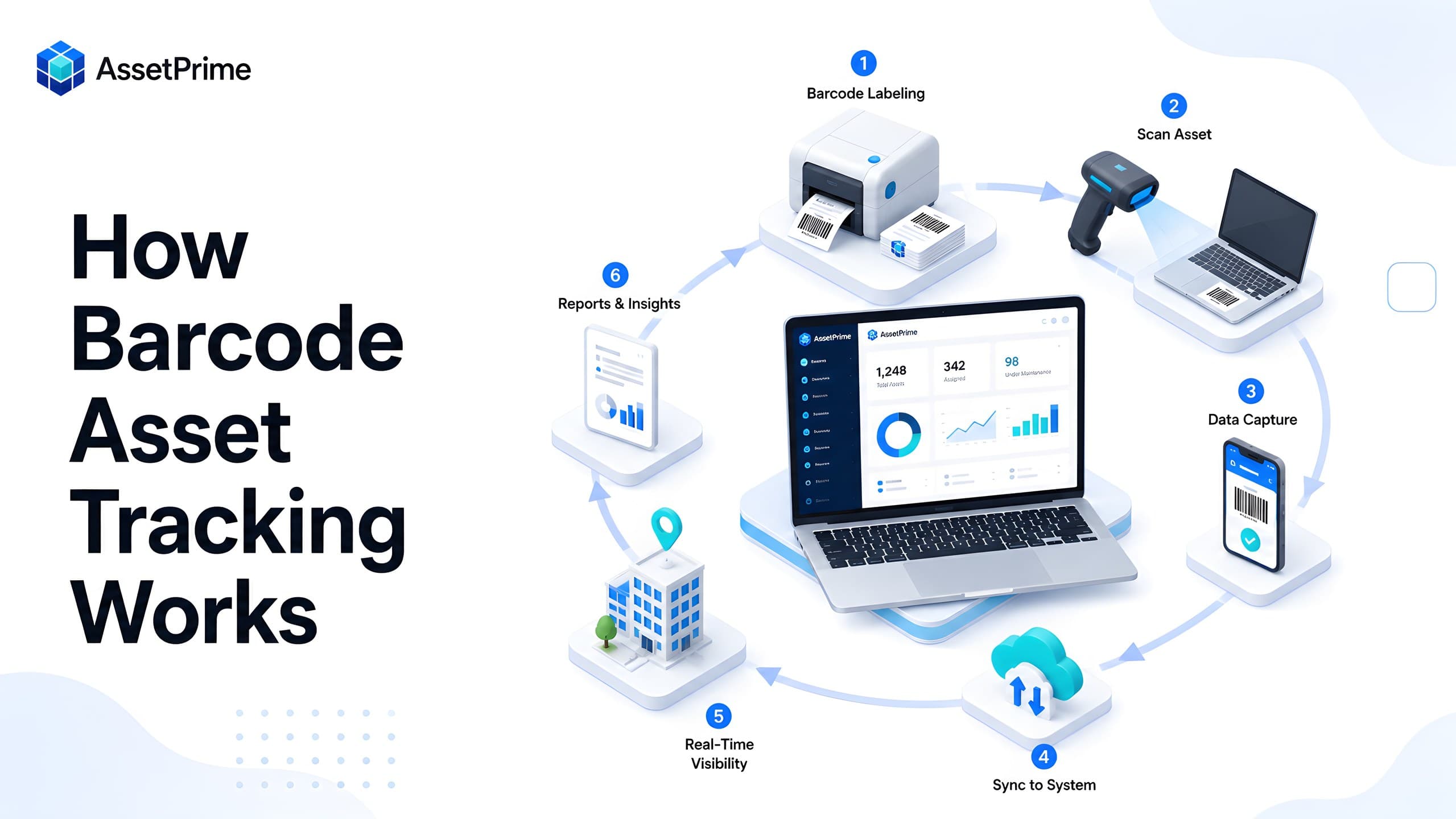
Barcode Tracking
How Barcode Asset Tracking Works: A Complete Guide for Modern Asset Operations
Read Article →