
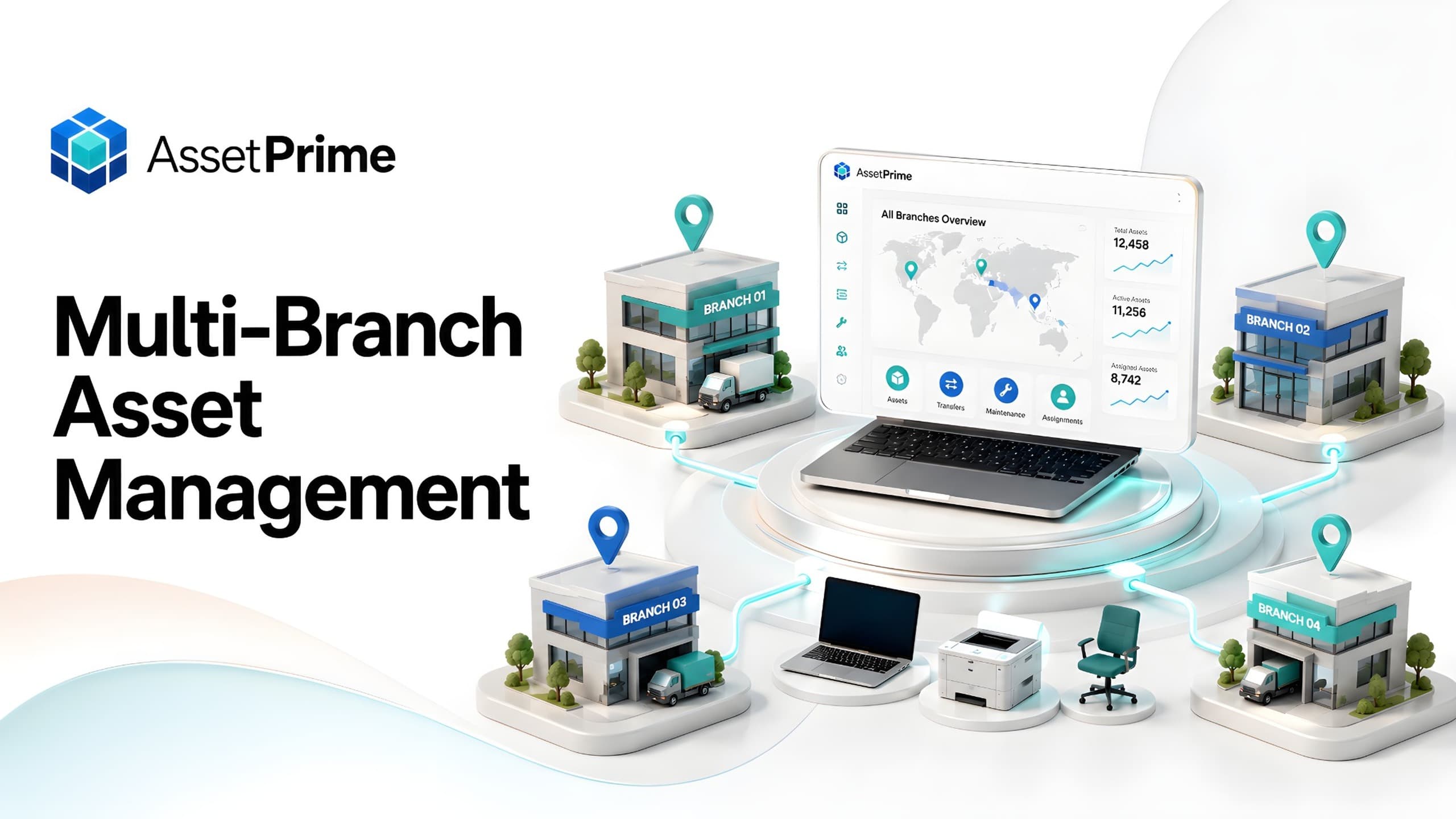
What is multi-branch asset management?
Multi-branch asset management is the process of controlling assets across multiple branches, offices, warehouses, plants, stores, hospitals, campuses, departments, or other operating locations from one structured system. It gives the organization a centralized view while preserving the exact branch and location responsibility of each asset.
The challenge is not simply knowing how many assets the organization owns. Teams need to know which branch holds each asset, its precise location, who is using it, whether it has moved, what condition it is in, when maintenance is due, what coverage applies, and whether the information has been physically verified.
A strong multi-branch model combines centralized governance with local operational control. Head office can maintain common standards and consolidated reporting, while authorized branch teams can manage the assets within their own scope.
This guide explains how to design that structure, manage inter-branch movements, control permissions, run audits, standardize data, and build reliable reports across a growing location network.
“You cannot control assets clearly when ownership, location, maintenance, and audit history live in separate files.”
Why multi-branch asset management becomes difficult as organizations grow
Asset control is relatively simple when one team manages a small number of assets in one location. Complexity rises quickly when the same organization operates across different cities, buildings, floors, departments, warehouses, project sites, or countries.
Different branches may use different spreadsheets, naming conventions, asset codes, approval practices, and maintenance records. Head office then receives delayed or inconsistent information and spends significant time reconciling records before audits, budgeting, insurance renewals, or management reviews.
Assets also move. Laptops may be transferred between offices, tools may move between sites, medical equipment may be reassigned between departments, and machinery may be relocated as operations change. If teams only edit the current location, the organization loses the history behind those movements.
The solution is a common asset data model with clear branch ownership, location hierarchy, controlled movement workflows, role-based access, and consolidated reporting.
What strong asset control should make visible
- ✓Where each asset is located today.
- ✓Who is responsible for the asset.
- ✓When it was purchased, moved, maintained, or disposed.
- ✓Which records are ready for audit, reporting, and decision-making.
Centralized control without losing branch-level accountability
Multi-branch asset management should not mean that every user can see or edit every asset. The goal is centralized visibility with controlled responsibility.
Head-office administrators may need organization-wide access for policy, finance, procurement, compliance, and reporting. Branch managers may need access only to their own branch. Department or location users may require an even narrower scope. Auditors may need read-only visibility without operational editing rights.
This structure improves accountability because every asset remains connected to a responsible branch and location while management can still view the complete organization from one system.
A centralized platform also makes it easier to standardize categories, statuses, asset coding, required fields, lifecycle rules, and reports so branches do not create incompatible local processes.
Design the right branch and location hierarchy
A reliable multi-branch system begins with location architecture. The hierarchy should reflect how the organization actually operates rather than forcing every asset into a flat branch list.
A practical structure may begin with company or region, followed by branch, building, floor, department, room, store, warehouse zone, production area, or other physical location. The required depth varies by industry and organization size.
For example, a hospital group may use Hospital → Building → Floor → Department → Room. A manufacturer may use Plant → Building → Production Area → Line. A corporate network may use Branch → Floor → Department → Room.
The hierarchy should be detailed enough to locate and audit assets but simple enough for users to maintain consistently. Avoid unnecessary levels that add data-entry effort without improving control.
Create one standardized asset register across all branches
Every branch should work from the same core asset register structure. Standard fields typically include asset code, asset name, category, serial number, branch, location, department, custodian, purchase date, purchase value, vendor, condition, lifecycle status, warranty, maintenance information, and supporting documents.
Common standards prevent one branch from recording a device as Laptop while another uses Notebook Computer or IT Device for the same category. Consistent categories and statuses are essential for reliable consolidated reporting.
The organization should define which fields are mandatory, who owns data quality, how duplicate records are prevented, and how new branches are onboarded into the same structure.
Standardization is especially important before migration from branch spreadsheets. Importing inconsistent data without cleansing it simply moves the existing problem into a new system.
Use unique asset identification across the organization
Every serialized asset should have a unique identity that remains stable even when the asset changes branch, location, department, or custodian. The identifier should represent the asset itself rather than its current physical position.
Barcode or QR labels make this identity practical during receiving, movement, maintenance, assignment, and physical verification. A user can scan the label and retrieve the correct asset record instead of relying on manual searches or local naming conventions.
Avoid creating a new asset record every time an item moves to another branch. The same record should continue through the lifecycle so its purchase details, maintenance, assignments, movements, documents, and audit history remain connected.
For bulk items where individual serialization is unnecessary, the system should still maintain controlled quantities by branch and location so stock changes remain traceable.
Track current location and complete movement history
Knowing the current branch is necessary, but it is not enough. Organizations also need the history of how an asset reached that location.
A proper movement record should capture the source, destination, date, asset, quantity or serialized unit, reason, responsible users, and relevant approval or reference information. The current location can then be updated without destroying the previous trail.
This history is valuable during audits, investigations, handovers, insurance reviews, and disputes about responsibility. It also helps management understand how frequently assets move and whether some locations repeatedly request transfers.
Treat movement as a business transaction rather than a simple edit to the asset master record.
Build a controlled inter-branch asset transfer process
Inter-branch transfers require more control than movement within the same room or department because responsibility passes from one operating unit to another.
A practical workflow can include transfer initiation, source verification, approval where required, dispatch, receipt confirmation, and final location update. High-value or regulated assets may require additional documents or authorization.
The receiving branch should confirm what actually arrived. This prevents records from showing an asset at the destination while the physical item is still in transit, rejected, damaged, or missing.
The organization should also define how transfers affect custodians, cost centers, maintenance responsibility, insurance records, and branch-level reports.
Manage employee assignments across branches
Assets such as laptops, phones, tools, instruments, and portable equipment may be assigned to employees rather than simply placed at a location. Multi-branch organizations need to connect assignment responsibility with branch and location context.
When an employee transfers to another branch, the organization should decide whether assigned assets move with the employee, are returned to the original branch, or require a formal inter-branch transfer. The system should preserve both assignment and movement history.
Return workflows are equally important. When an employee leaves, changes role, or returns an item, the active assignment should close and the asset should move to the correct available, store, repair, retired, or other lifecycle state.
Clear assignment records reduce disputes and make branch-level accountability much stronger.
Control access with branch and location-based permissions
Role-based access control is essential when many teams share one asset management platform. Users should receive only the permissions and data scope required for their responsibilities.
A branch administrator may create and update assets only within one branch. A regional manager may view several branches. Finance may need organization-wide purchase and depreciation reports. Maintenance teams may need service access without permission to change financial data.
Location-scoped access reduces accidental changes and protects operational or financial information while still allowing central teams to produce consolidated reports.
Permission design should be tested using real job roles before rollout. Overly broad access weakens control, while overly restrictive access can push users back to spreadsheets and offline workarounds.
Standardize procurement and receiving across locations
Multi-branch asset control starts before an asset is placed into service. Procurement and receiving practices determine the quality of the asset record created later.
Organizations should decide whether purchases are centralized, branch-led, or mixed. Regardless of the model, receiving should capture consistent vendor, purchase, invoice, quantity, serial number, value, branch, and location information.
If head office purchases equipment for several branches, receiving and allocation should clearly show which units were sent to each destination. Serialized items should retain their individual identity throughout this process.
Connecting procurement and receiving with the asset register reduces duplicate entry and gives management a clearer view from purchase to operational use.
Coordinate maintenance across branches and sites
Maintenance becomes harder when equipment is distributed across many sites. Service teams need to know where the asset is, its history, what work is due, which vendor supports it, and who is responsible at the branch.
A centralized maintenance record helps organizations plan preventive work, track breakdowns, record service costs, identify repeated failures, and compare maintenance performance between locations.
Branch teams can report issues locally while central operations or maintenance managers monitor open and overdue work across the organization.
For mobile or transferred assets, maintenance history should remain attached to the asset record rather than being lost when the branch changes.
Track warranty, AMC, and insurance by branch
Coverage information is often fragmented across invoices, emails, local files, and vendor records. In a multi-branch environment, this makes renewal and claim management difficult.
Warranty, annual maintenance contracts, and insurance should be connected to the relevant assets with provider, start date, expiry date, amount, document, and status information where applicable.
Central teams can then monitor upcoming expiries across all branches while local teams see the coverage relevant to their assets. This helps prevent missed renewals and unnecessary repair expenditure.
Coverage reports should support both organization-wide review and branch-level filtering so management can identify gaps in protection.
Run physical asset audits branch by branch
Physical verification is one of the strongest tests of asset data quality. A multi-branch organization should be able to audit one location without disrupting the entire network.
Before an audit, define the branch, location scope, expected assets, responsible team, verification method, and treatment of exceptions. Barcode or QR scanning can speed up identification and reduce manual transcription.
The audit should identify assets that are verified, missing, found in the wrong location, damaged, unlabelled, duplicated, or otherwise inconsistent with the system record.
After reconciliation, approved corrections should update the operational records while preserving an audit trail. Management can then compare audit accuracy across branches and focus on locations with recurring control problems.
Create consolidated and branch-level reports
Multi-branch reporting must answer two different questions: what is happening across the entire organization, and what is happening inside each branch.
Useful reports include asset register, stock position, assignments, movements, maintenance, warranty, AMC, insurance, procurement, depreciation, disposal, documents, and audit activity. Each should support appropriate branch and location filters.
Consolidated dashboards help leadership compare asset value, counts, utilization, maintenance exposure, expiring coverage, and lifecycle status across locations. Branch reports help local managers act on the assets they directly control.
Consistent definitions are critical. If branches calculate status or value differently, a consolidated dashboard can look precise while still being misleading.
Handle depreciation and financial reporting consistently
Finance teams need consistent asset values and depreciation rules across branches, especially when assets are transferred between cost centers or operating locations.
The operational branch location and the accounting treatment of an asset are related but should not be confused. A physical transfer does not necessarily create a new asset or reset its depreciation history.
Asset records should preserve purchase value, capitalization information, depreciation method where managed, accumulated depreciation, and relevant history while allowing reports to be filtered by branch or other financial dimensions.
Organizations should align the asset management process with their accounting policies and statutory requirements rather than allowing each branch to improvise its own treatment.
Plan for lost, retired, and disposed assets across branches
Lifecycle controls must remain consistent at every location. Branches should not be able to remove assets from reports simply because an item is lost, retired, destroyed, or disposed.
A lifecycle transaction should record what happened, when it happened, who performed or approved the action, and any supporting reason or documentation. Disposal may also require buyer, proceeds, certificate, or method information depending on policy.
Historical records should remain available after the asset leaves active use. This protects auditability and allows management to analyze replacement patterns, losses, and disposal activity across branches.
Clear lifecycle rules also prevent inactive assets from remaining indefinitely in operational stock reports.
Common multi-branch asset management mistakes
One common mistake is giving every branch its own spreadsheet and attempting to consolidate the files periodically. This creates version conflicts, inconsistent categories, duplicate asset codes, delayed reporting, and weak movement history.
Another mistake is using branch names as part of an asset identity in a way that requires the code to change after every transfer. The asset identity should remain stable while location information changes separately.
Organizations also struggle when permissions are too broad, transfer processes are informal, audits are irregular, or branches are allowed to create their own statuses and categories without governance.
Finally, technology cannot compensate for unclear ownership. Each branch should know who is responsible for asset data, physical custody, approvals, maintenance updates, and audit exceptions.
A practical multi-branch implementation plan
Start by documenting the organization structure, branches, location hierarchy, asset categories, current data sources, user roles, movement processes, maintenance responsibilities, and reporting requirements.
Next, clean and standardize the asset data. Resolve duplicate codes, inconsistent categories, obsolete locations, missing serial numbers, and unclear ownership before migration wherever possible.
Configure one representative branch first and test receiving, registration, barcode identification, assignment, movement, inter-branch transfer, maintenance, audit, lifecycle actions, permissions, and reports. Use the lessons from this pilot to refine the template.
Then roll out the standardized model branch by branch with training, data validation, ownership, and post-launch checks. A phased rollout is often easier to control than migrating every location at once.
What to look for in multi-branch asset management software
Software should support a true branch and hierarchical location model rather than a single free-text location field. It should also maintain unique asset identities, movement history, assignments, barcode or QR workflows, lifecycle states, and branch-aware reports.
Look for role-based permissions that can restrict users by branch or location, along with audit logs showing who changed important records. For larger organizations, bulk imports, exports, scalable reporting, and structured master data are also important.
Operational modules such as procurement, receiving, maintenance, warranty, AMC, insurance, depreciation, documents, and disposal should remain connected to the same asset record across transfers.
During a demonstration, test an actual inter-branch scenario from source to destination. Do not rely only on a dashboard screenshot or a vendor statement that the product supports multiple locations.
How AssetPrime supports multi-branch asset management
AssetPrime is designed to manage assets across branches and hierarchical locations from a centralized platform. Organizations can structure assets by branch and location while maintaining detailed operational records for individual serialized assets and quantity-based stock.
The platform supports asset registration, assignments, movements, procurement, receiving, maintenance, warranty, AMC, insurance, depreciation, documents, audits, lifecycle actions, role-based access, dashboards, and reports.
Movement and assignment history help preserve accountability when assets change location or custodian, while permissions can support controlled access for different operational roles. Central reporting provides visibility across the organization without removing branch-level context.
For organizations evaluating multi-branch asset management, the most useful approach is to demonstrate the real hierarchy and workflows used by the business, including an inter-branch transfer and branch-specific reporting.
Build one reliable asset view across every branch
Multi-branch asset management works best when the organization treats asset information as a shared operational system rather than a collection of local files. Central standards, branch accountability, unique identification, controlled movements, and consistent lifecycle rules create that foundation.
The objective is not merely to centralize data. It is to make asset information dependable enough for daily operations, maintenance, audits, financial review, procurement planning, and management decisions.
As the branch network grows, a structured platform can reduce reconciliation work and provide faster answers to basic questions: what assets do we own, where are they, who is responsible, what changed, and what requires attention next.
Organizations that establish these controls early can expand locations without allowing asset visibility and accountability to become progressively harder to manage.
Related AssetPrime Pages
Continue with related pages
Explore connected features, guides, solutions, and industry pages that support this topic.
FAQ
Frequently asked questions
What is multi-branch asset management?
Multi-branch asset management is the centralized control of assets across multiple branches, offices, warehouses, plants, hospitals, campuses, or other locations while preserving branch-level ownership, location, movement, assignment, maintenance, and audit information.
How do you track assets across multiple locations?
Use a centralized asset register with unique asset IDs, a structured branch and location hierarchy, barcode or QR identification, movement history, assignments, role-based permissions, and regular physical verification.
Should an asset code change when an asset moves to another branch?
Usually no. The asset should keep a stable unique identity while its branch and location are updated through a controlled movement or transfer transaction. This preserves complete lifecycle history.
What is the difference between a branch and a location in asset management?
A branch is normally a higher-level operating unit such as an office, plant, hospital, or warehouse. Locations are the more detailed physical areas within or under that branch, such as buildings, floors, departments, rooms, stores, or production areas.
How should inter-branch asset transfers be managed?
Use a structured workflow that records the source, destination, asset, date, reason, responsible users, approval where required, dispatch, and receiving confirmation before finalizing the new location.
Can branch users be restricted to their own assets?
Yes. Multi-branch asset management software should provide role-based and location-scoped permissions so users can access only the branches, locations, modules, and actions relevant to their responsibilities.
How do physical audits work across multiple branches?
Audits can be planned by branch or location, with an expected asset list and barcode or QR verification. Exceptions such as missing, misplaced, damaged, or unlabelled assets are reconciled while preserving an audit trail.
What reports are important for multi-branch asset management?
Important reports include branch-wise asset register, stock, assignments, movements, maintenance, warranty, AMC, insurance, procurement, depreciation, disposal, audit activity, and consolidated organization-wide dashboards.
What are common multi-branch asset management problems?
Common problems include separate spreadsheets, inconsistent categories, duplicate asset codes, weak transfer history, excessive permissions, missed maintenance or renewals, irregular audits, and unclear responsibility for branch data.
How does AssetPrime help with multi-branch asset management?
AssetPrime supports branches and hierarchical locations together with asset registration, barcode tracking, assignments, movements, maintenance, coverage, depreciation, audits, documents, permissions, dashboards, and reports in one platform.
Continue Reading
Related articles
Asset Management
What Is Asset Management Software? A Complete Guide for Modern Organizations
Read Article →
Asset Tracking
Asset Tracking vs Inventory Management: Key Differences for Modern Businesses
Read Article →
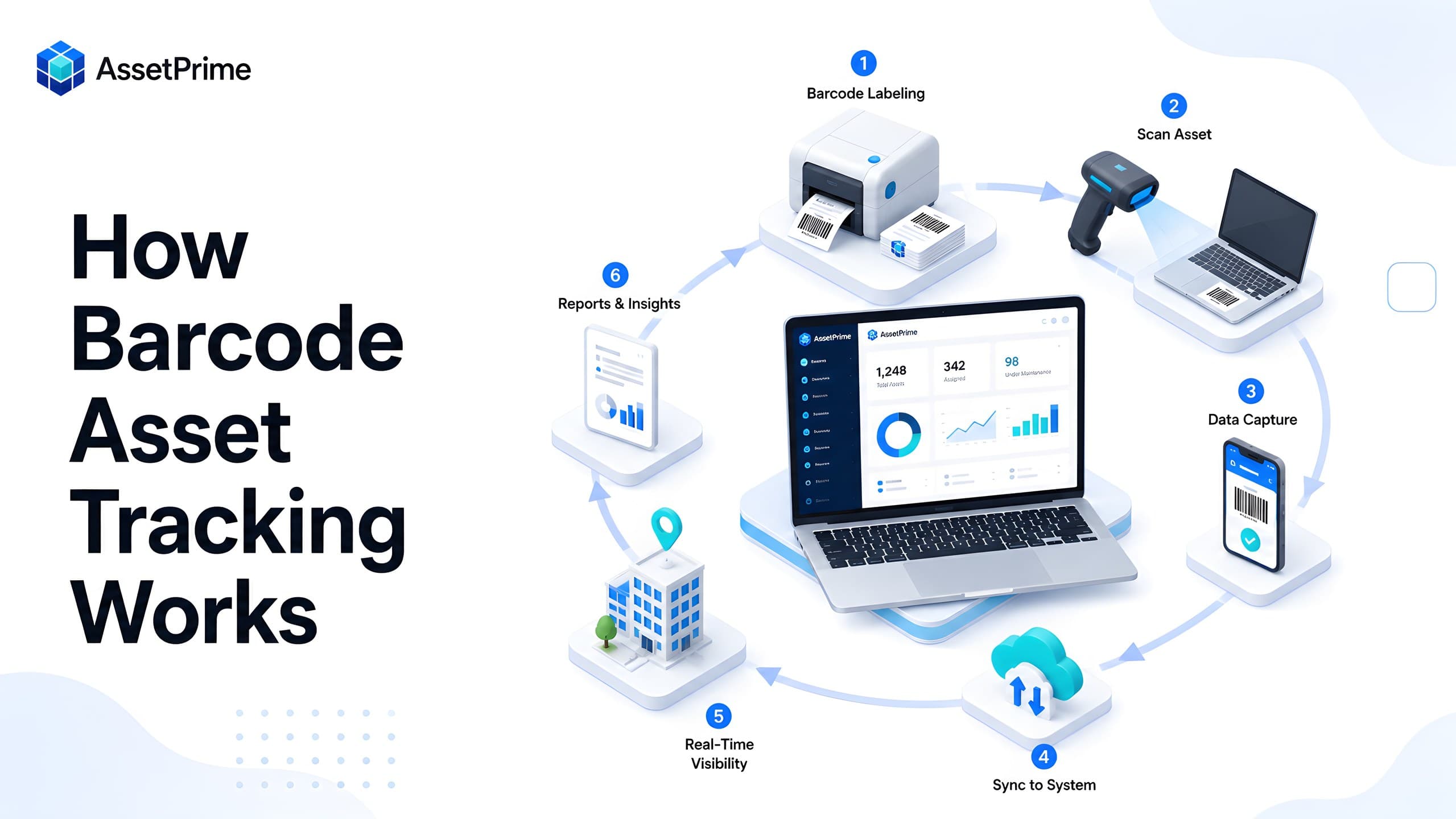
Barcode Tracking
How Barcode Asset Tracking Works: A Complete Guide for Modern Asset Operations
Read Article →