
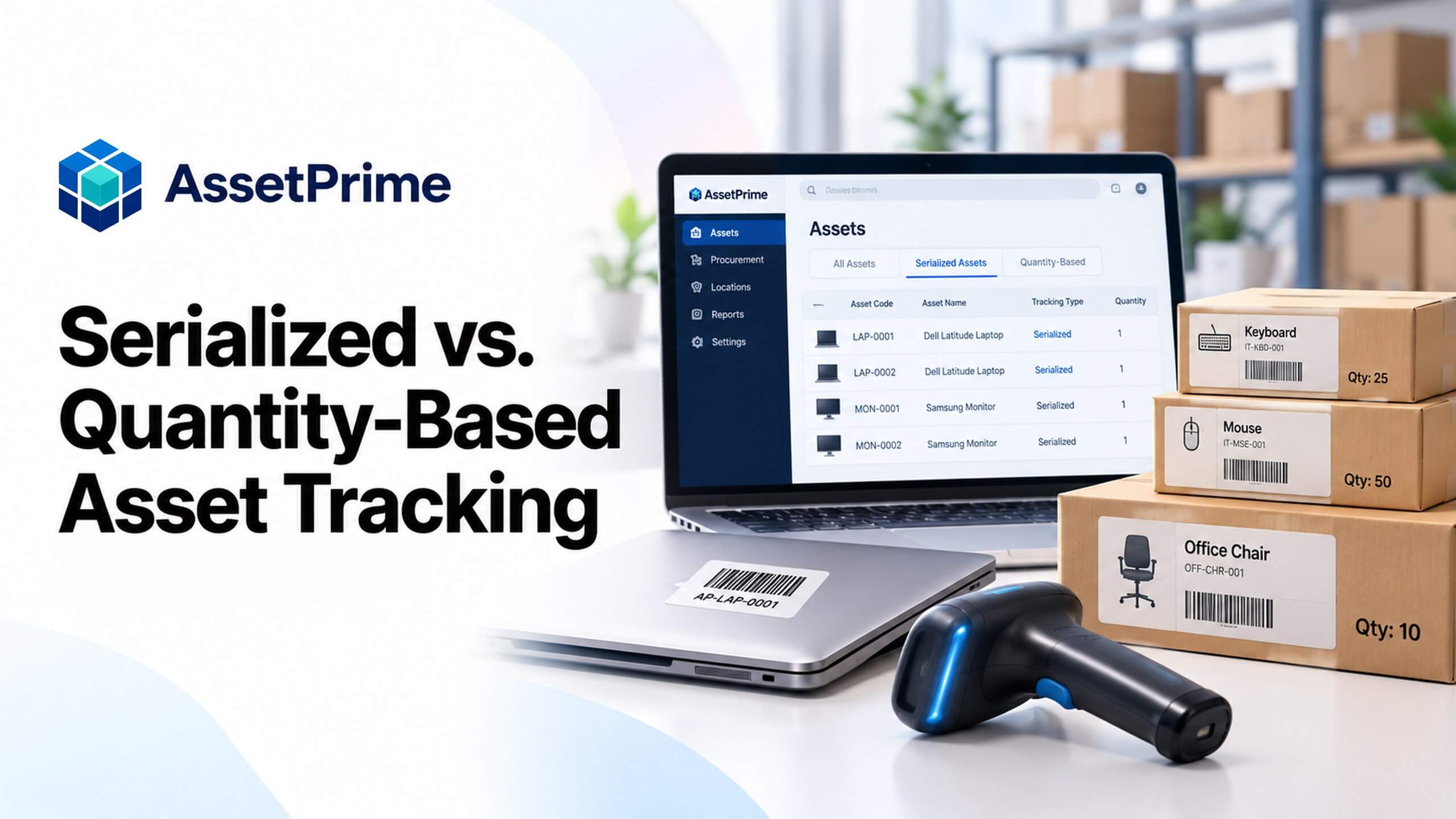
What is the difference between serialized and quantity-based asset tracking?
Serialized asset tracking records each physical unit as a distinct item. Quantity-based tracking, also called bulk tracking, manages interchangeable units as a count associated with an asset type and location. Both can be useful; the right choice depends on what an organization must identify, move, assign, maintain and audit.
Consider ten identical laptops and ten identical office chairs. A laptop typically needs its own serial number, custodian and lifecycle record. If a business only needs to know how many matching chairs are held in each room or store, a quantity balance may be more practical. The product category alone does not decide the method: control requirements do.
“You cannot control assets clearly when ownership, location, maintenance, and audit history live in separate files.”
How serialized asset tracking works
In a serialized model, each unit receives its own identity or instance code. Its manufacturer serial number and barcode value can be recorded separately. Two laptops of the same model can share an asset category or master record while retaining different unit identities.
An individual record can carry branch and location, condition, employee assignment, lifecycle status and event history. That makes it easier to answer questions such as: Which laptop is assigned to this employee? Which unit was moved? Which specific device is missing or retired?
Serialized tracking is useful where individual accountability, maintenance, warranty, security, high value or audit requirements justify the extra recordkeeping. It does not mean that every asset must have a manufacturer serial number; a business-assigned unique instance ID can be important too.
What strong asset control should make visible
- ✓Where each asset is located today.
- ✓Who is responsible for the asset.
- ✓When it was purchased, moved, maintained, or disposed.
- ✓Which records are ready for audit, reporting, and decision-making.
How quantity-based or bulk tracking works
Quantity-based tracking maintains a quantity for an interchangeable asset type in each relevant branch or location. For example, one store could hold 35 matching office chairs while a second store holds 12. Receiving adds accepted quantities; transfers and other stock operations change the appropriate location balances.
A quantity-based record can still have an asset code, category, purchase context, unit of measure and movement history. The difference is that the system does not need a separate lifecycle profile for every chair. It is therefore inaccurate to describe bulk tracking as having no identity, no controls or no traceability.
Bulk tracking works best when users need reliable counts rather than a named custodian, maintenance log or history for each physical unit.
Serialized vs. quantity-based tracking: key differences
The most important distinction is the unit of accountability. A serialized workflow answers what happened to this exact item. A quantity-based workflow answers how many units of this type are at this location and how that balance changed.
Use the comparison below as a practical guide rather than a rigid classification. An organization may decide to serialize relatively low-cost assets when loss prevention, regulation or assignments make item-level records valuable.
At-a-glance comparison
The level of tracking detail changes, but both methods still need accurate records.
| Aspect | Serialized | Quantity-based |
|---|---|---|
| Core record | One unique instance for each unit | Count of interchangeable units by location |
| Identification | Individual instance ID; serial/barcode where applicable | Asset type/code, quantity and unit of measure |
| Location | Location of the specific item | Location-wise quantity balance |
| Receiving | Create or register accepted unit identities | Add accepted units to stock quantity |
| Movement | Move selected individual instances | Move a specified quantity between locations |
| Assignment | Can identify the custodian of a unit | Primarily controls the pooled count |
| Audit | Verify individual instances | Count and reconcile stock quantities |
| Typical fit | Laptops, specialized devices, high-accountability equipment | Identical chairs or pooled operational equipment |
On smaller screens, scroll horizontally to view the full comparison.
Example: laptops versus office chairs
An IT department receives eight identical laptops. It accepts all eight, verifies each device, creates eight distinct unit records and assigns six to employees. The remaining two laptops stay available in the IT store. The organization can then locate each laptop and investigate a missing device by its unique identity.
A facilities team receives 40 matching office chairs and stores 25 in the main store and 15 in an administrative block. If chairs are managed as interchangeable stock, those balances can be controlled through quantity-based receiving and transfers. A later transfer of five chairs changes the two location balances without requiring five separate serial identities.
If a particular chair later needs individual maintenance or assignment history, the organization should reassess its tracking policy and the available record-creation workflow. Do not assume that changing a tracking setting automatically converts existing stock into serialized units.
When should you choose serialized tracking?
Choose serialized tracking when an individual asset must be assigned to a person, located precisely, distinguished from identical units, scanned for item-specific audits or followed through repairs, loss, replacement and retirement.
Common candidates include laptops, servers, specialist tools, high-value medical equipment and machinery. The decision should also reflect local policies: a low-cost device carrying sensitive data may need stricter individual control than its purchase price suggests.
When does quantity-based tracking make more sense?
Quantity-based tracking fits groups of interchangeable items when the operational questions are about count, unit and location rather than each item’s personal history. Examples might include standard chairs, matching storage containers or other reusable equipment managed as pooled stock.
Avoid assuming that all consumables belong in a fixed-asset register, or that all furniture should be bulk-tracked. Whether an item is inventory, an expense, a fixed asset or a trackable operational resource depends on the organization’s accounting and asset policies.
What changes during procurement and receiving?
The tracking decision should be made before entering a receipt. For serialized assets, the receiving team verifies the accepted quantity and captures a unique record for every accepted unit, including serial and barcode details where applicable. For quantity-based assets, it records the accepted amount and correct unit of measure at the receiving location.
In either model, shortages, damage, partial deliveries and rejected units must be separated from accepted stock. The asset receiving process should describe what physically arrived rather than merely copy the ordered quantity.
How do transfers, locations and assignments differ?
For serialized assets, a transfer identifies the particular unit leaving one location and arriving at another. Item-level assignment can show the current custodian and later return or reassignment. Location and assignment history matter because two identical devices may take different paths.
For quantity-based stock, a transfer identifies an asset type, quantity, source and destination. The receiving and dispatching balances must reconcile. Bulk tracking should not be presented as one total number across the whole company; location-specific stock control is essential.
Do barcodes work with both tracking methods?
Yes, but barcodes serve different identification purposes. A serialized barcode commonly identifies one unique unit or instance. For quantity-based assets, a label or code can identify the asset type or stock record, while the operation also needs the quantity and location.
An encoded barcode does not need to contain the complete asset history. A scan can identify the record, while software holds the serial information, branch, condition, maintenance and other details. This is why a generic label generator is not the same as a complete asset management workflow.
How should physical audits and maintenance be handled?
Serialized verification checks which individual units are present, missing, in service, assigned or at the wrong location. An item-specific issue can be attached to the identified device, subject to the software’s implemented workflows.
Quantity-based verification compares counted units at a location with the recorded balance. Differences require investigation, approval and appropriate adjustment. Bulk maintenance or disposal also needs a clearly recorded affected quantity rather than an invented per-item serial history.
A practical tracking-method decision checklist
Choose the model based on how staff actually receive, store, move, assign and verify assets. Apply the policy consistently within each class of equipment, but allow justified exceptions for items that need more control.
Before importing historic spreadsheet data, also verify which rows represent one physical item and which represent several interchangeable units. Treating a quantity of 20 as one serialized instance—or as 20 duplicate bulk records—can create avoidable register and reporting errors.
Six questions to choose your tracking method
- ✓Must each physical unit have its own identity?
- ✓Does an employee or department need to be accountable for a particular unit?
- ✓Will each unit need its own maintenance, condition or lifecycle history?
- ✓Would a count by location answer the operational question?
- ✓Can the receiving team consistently capture the required identifiers or quantities?
- ✓Will the tracking records support the organization’s planned audit and reporting process?
How AssetPrime supports both asset tracking models
AssetPrime provides separate quantity-based and serialized tracking workflows in the same asset management application. The serialized model includes distinct asset instances with identifying details, location, assignment, condition and lifecycle records. The bulk model supports quantity and stock visibility across branches and locations, with receiving and movement context.
Both models connect to the broader asset lifecycle, but they are not identical screens or interchangeable databases. AssetPrime’s Serialized Asset Tracking and Quantity-Based Asset Tracking feature pages explain each capability in more detail. For a real operational fit assessment, request a demonstration using your own asset categories, branch structure and movement requirements.
This article is an educational comparison of the supported tracking approaches. It does not imply that every item can be switched between modes automatically or that every tracking policy, approval or accounting rule is predefined in the software.
Common mistakes when using mixed tracking methods
One mistake is to serialize every low-value interchangeable item and create more records than teams can maintain. The opposite is to manage laptops or important medical devices only as aggregate quantities, leaving no reliable way to identify the unit held by a particular person.
Other problems include confusing the asset code with the manufacturer serial number, entering quantities without a unit of measure, combining balances from different locations, and changing tracking policies without reconciling existing data. A clear naming convention and a receiving checklist help reduce these errors.
Final recommendation: use the right level of detail
The best method is not serialized everywhere or quantity-based everywhere. Use individual records where accountability, condition, assignment and lifecycle history matter. Use quantity balances where interchangeable stock is best controlled by count and location.
For organizations that manage both, define the tracking method when the asset type is set up, train receiving and movement teams on the difference, and verify the resulting records in audits and reports. AssetPrime supports both operating models without forcing every asset into one type of record.
Related AssetPrime Pages
Continue with related pages
Explore connected features, guides, solutions, and industry pages that support this topic.
FAQ
Frequently asked questions
What is the main difference between serialized and quantity-based asset tracking?
Serialized tracking identifies each physical unit individually. Quantity-based tracking manages interchangeable units by asset type, count and location.
Is bulk asset tracking the same as having no asset code?
No. A bulk asset type can have an asset code and movement or location records. What it generally lacks is a unique instance record for each physical unit.
Should every asset have a serial number?
No. Use unique instance records when individual accountability matters. Quantity-based stock often does not need a manufacturer serial number for every unit.
Can barcodes be used for quantity-based assets?
Yes. A barcode can identify an asset type or relevant stock record. A transfer or count still needs a quantity and location; a serialized barcode usually identifies one individual unit.
Are office chairs always quantity-based assets?
Not necessarily. Chairs can be tracked as quantities when interchangeable, or serialized when individual assignment, maintenance or audit policy requires it.
Can AssetPrime manage serialized and bulk assets together?
Yes. AssetPrime supports individually identified serialized instances and quantity-based stock with branch, location, receiving and movement context.
Can bulk stock automatically be converted into serialized assets?
Do not assume so. Conversion or reclassification depends on the software workflow, data preparation and policy. Verify the required process during implementation or demonstration.
How should an organization choose between the two methods?
Consider whether it must track each unit’s identity, custodian, maintenance and lifecycle, or mainly the count held at each location. Use those operational requirements to define a tracking policy.
Continue Reading
Related articles

Asset Management
Asset Receiving Process and Checklist: From Delivery to Asset Register
Read Article →
Asset Management
What Is Asset Management Software? A Complete Guide for Modern Organizations
Read Article →
Asset Tracking
Asset Tracking vs Inventory Management: Key Differences for Modern Businesses
Read Article →