
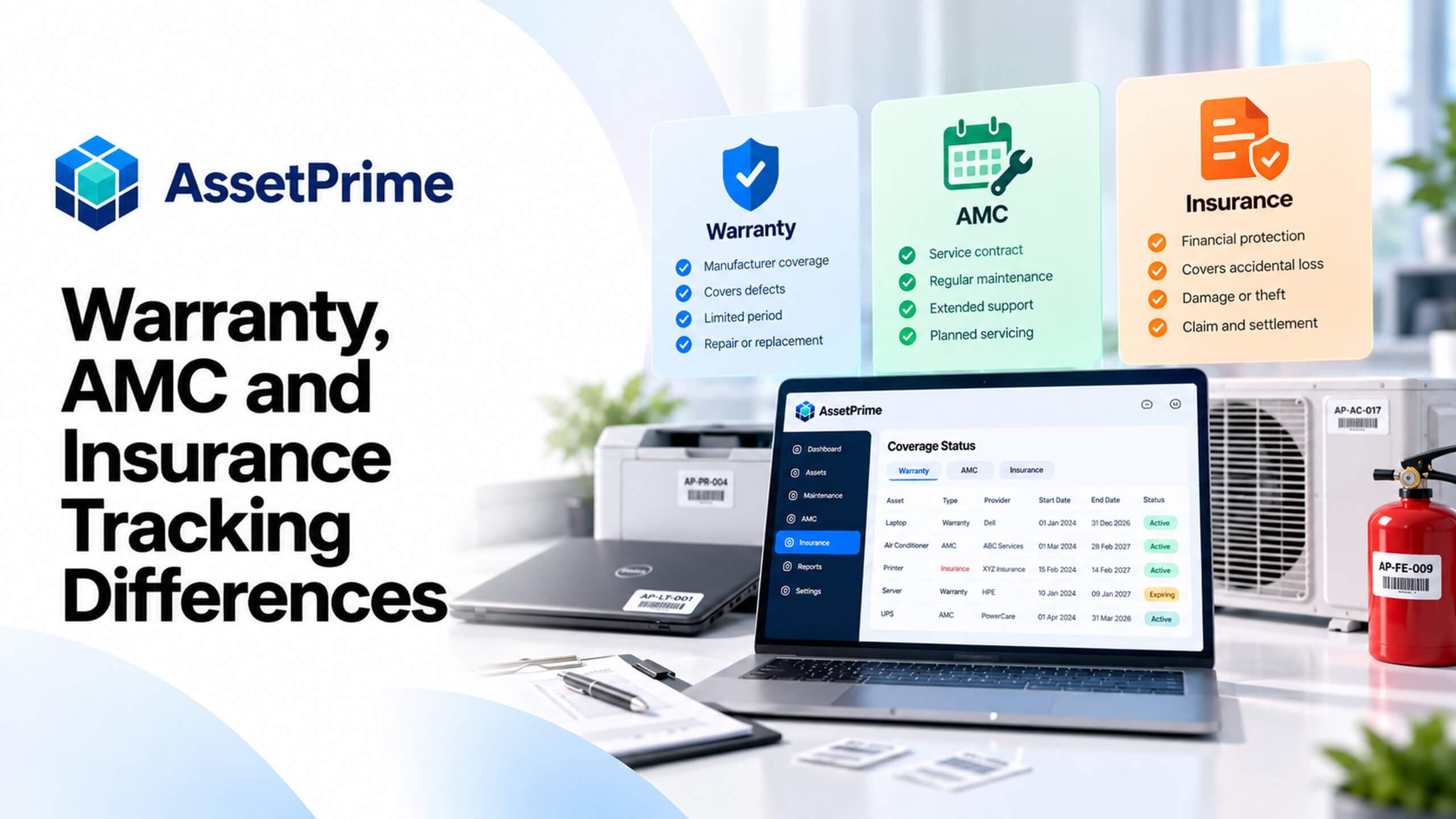
Warranty, AMC and insurance: what is the difference?
Warranty, Annual Maintenance Contract (AMC) and insurance all relate to asset protection, but they answer different questions. A warranty sets out a manufacturer or seller’s obligations for qualifying defects. An AMC describes agreed servicing and repair support. Insurance addresses specified insured events and financial losses under a policy.
They are not interchangeable. A damaged laptop may be outside warranty because the damage was accidental, outside an AMC because the contract excludes physical damage, and potentially within an insurance policy—but only if the insured peril, conditions and excess allow it. The documents and circumstances determine the outcome.
This guide compares their usual purposes, explains the information worth tracking and shows how to review coverage when equipment needs attention. For detailed administration of each arrangement, see the separate Warranty Management and Maintenance & AMC Management guides.
“You cannot control assets clearly when ownership, location, maintenance, and audit history live in separate files.”
What is an asset warranty?
A warranty is a commitment by the manufacturer, seller or another warrantor to remedy certain qualifying defects or failures within specified terms and dates. Depending on the product, it may provide repair, replacement, parts or another remedy.
Warranty coverage should not be assumed to include every failure. Accident damage, misuse, consumables, unauthorized repair and other exclusions may apply. Keep the actual warranty document, the provider, the purchase evidence and any registration or serial-number requirements.
A useful warranty record identifies the equipment, start and end dates, provider, terms and supporting evidence. A serialized unit may have a different warranty expiry from another unit of the same model.
What strong asset control should make visible
- ✓Where each asset is located today.
- ✓Who is responsible for the asset.
- ✓When it was purchased, moved, maintained, or disposed.
- ✓Which records are ready for audit, reporting, and decision-making.
What is an Annual Maintenance Contract (AMC)?
An AMC is a negotiated service agreement for an asset or group of assets, commonly covering a defined period. It may include scheduled inspection, preventive servicing, breakdown attendance, labour, parts, calibration or defined response times according to the contract.
An AMC is not automatically comprehensive: the service frequency, parts coverage, exclusions, charges, site access and vendor obligations must be checked. An asset can have an AMC and still incur separately billed repair work.
Record the contracted provider, scope, covered asset identities, effective dates, contract amount, renewal owner and service documents. Keep AMC contract status separate from individual maintenance jobs: the contract says what was agreed; the job history says what was done.
What does asset insurance cover?
Asset insurance is a financial risk-transfer arrangement subject to a policy. Depending on the cover purchased, specified events may include fire, theft, accidental damage, machinery breakdown or other insured risks. Coverage cannot be inferred from a simple “insured” checkbox.
Policies can have insured values, limits, excesses or deductibles, geographic conditions, exclusions, endorsements, reporting deadlines and claim-evidence requirements. Different equipment may require different policy terms, and not every incident is claimable.
Track the insurer, policy reference, covered asset or schedule, effective and expiry dates, insured amount where available, supporting documents and a responsible reviewer. Consult the insurer and applicable policy terms before presenting a loss as covered.
Warranty vs. AMC vs. insurance: comparison at a glance
The table compares common characteristics, not guaranteed coverage. Always read the applicable warranty, service contract and insurance policy before approving a repair or making a financial decision.
A single asset may be covered by all three arrangements at the same time, each for a different purpose. Record each one separately so that teams can check the right provider and deadline.
| Consideration | Warranty | AMC | Insurance |
|---|---|---|---|
| Primary purpose | Remedy eligible product defects | Provide contracted servicing or support | Financial protection against specified insured events |
| Typical trigger | Qualifying defect or failure | Scheduled visit or service request | Loss or damage event within policy terms |
| Provider | Manufacturer, seller or warrantor | Service contractor or vendor | Insurer |
| Key proof | Purchase evidence, unit identity, terms | Signed agreement, covered-asset schedule, service log | Policy wording, insured schedule, incident evidence |
| Main dates | Start and expiry of warranty | Contract start, end and service dates | Policy inception, expiry and notification deadlines |
| Typical exclusions | Misuse, accidents or unauthorized repairs may be excluded | Parts, labour or visits may be excluded | Specific perils, locations or conditions may be excluded |
| Action before expiry | Review support or replacement options | Evaluate renewal and service performance | Review insured values, risks and renewal terms |
Illustrative comparison only. Actual entitlements depend on the signed warranty, service agreement and insurance policy.
Can one asset have warranty, AMC and insurance together?
Yes. Consider a hospital device purchased with a manufacturer warranty, a separate service agreement for planned inspections, and an insurance policy covering specified loss events. The three records may overlap in dates but apply to different circumstances.
If the device develops a defect, first verify whether the warranty applies. If it needs scheduled service or out-of-warranty support, check the AMC. If it suffers an insured loss event, review the insurance wording and claims procedure. More than one arrangement may be relevant, but avoid assuming expenses can be recovered twice.
The correct order depends on the incident, contractual conditions and local obligations. Keep the decision trail with the asset rather than treating a generic coverage status as authorization.
What fields should a coverage-tracking record contain?
Start with the asset code, relevant serial or instance number, category, branch and location. Then distinguish coverage type, provider, reference number, start and expiry dates, contact or renewal owner, document location and operational notes.
For warranties, keep proof of purchase and eligibility terms. For AMCs, keep the asset schedule, contract scope, service frequency and renewal amount. For insurance, keep policy wording, insured limits or values, excess, endorsements and claim contacts.
Do not overwrite historical dates without retaining enough evidence to understand what was valid when a repair or incident occurred. Coverage records should be easy to locate when staff change or assets move between branches.
How to review coverage before approving a repair or claim
First confirm which physical unit or quantity-based asset group is affected and what happened. A reported fault, routine maintenance request, accidental damage and theft report require different decisions.
Next compare the event date and incident details with the recorded coverage dates and the underlying terms. Check the applicable provider, exclusions, documentation, notice periods and whether prior authorization is required.
Finally record the decision, responsible person, reference number, related maintenance activity or claim and any costs. Do not classify a vendor response or payment as guaranteed simply because the policy or AMC has not expired.
How to track expiry dates and renewals without confusion
Keep separate expiry fields and renewal ownership for warranty, AMC and insurance. Warranty expiry may prompt an extended-service or replacement review, AMC expiry may require a service-contract decision, and insurance expiry may expose a different type of financial risk.
Choose lead times that reflect the effort needed to obtain quotations, confirm a vendor, review policy wording, secure internal approval and arrange coverage continuity. A reminder should begin a review process; it should not automatically renew a contract or confirm cover.
Regularly reconcile recorded dates against signed documents and endorsement updates. When an item is retired, transferred or disposed of, review whether the corresponding contracts or schedules need changes.
Serialized assets vs. quantity-based stock: coverage considerations
For a serialized laptop, medical device or machine, verify the exact instance identity and relevant purchase or warranty date. If the equipment moves, keep the same unit associated with its history and coverage context.
For quantity-based office equipment or interchangeable stock, confirm whether one purchase batch or contract genuinely covers the group. Track the applicable location and quantity, but do not assume every unit has identical coverage or a unique serial number.
A physical asset count or location transfer should not silently change the contractual entitlement. Changes to claims, insured schedules and service contracts need their own organizational review.
Nine checks for warranty, AMC and insurance tracking
Use the checklist below during an initial register cleanup or a quarterly coverage review. It is an internal review aid, not a substitute for professional advice or the original signed documents.
Make exceptions visible: missing policy references, uncertain coverage, expired dates and assets without evidence are follow-up tasks—not proof that a claim will fail or succeed.
Nine checks before relying on coverage records
- ✓Confirm the exact asset or affected quantity and current branch or location.
- ✓Identify separately whether warranty, AMC and insurance are relevant.
- ✓Check each provider, agreement or policy number and the original supporting document.
- ✓Validate start dates, expiry dates and any notification or renewal deadlines.
- ✓Read applicable coverage terms, exclusions, limits and required evidence.
- ✓Verify whether a service visit, repair or claim requires advance authorization.
- ✓Name the owner responsible for vendor follow-up, contract renewal or insurer notification.
- ✓Record the incident, related maintenance activity and the actual response or decision.
- ✓Review coverage schedules after moves, replacement, retirement or disposal.
Common mistakes when comparing the three
Assuming “under warranty” means every repair is free; treating an AMC as a maintenance history; interpreting an active insurance policy as proof that any loss is covered; and relying on an expiry date without checking the asset schedule are recurring control mistakes.
Another mistake is mixing operational ownership with contract responsibility. The employee using a laptop may not be the person authorized to contact the vendor, approve an AMC renewal or notify an insurer.
The most reliable approach is to keep distinct records but link them to a shared asset identity, maintenance evidence and controlled follow-up.
How AssetPrime helps organize coverage records
AssetPrime’s documented asset-management features include warranty management, AMC tracking, insurance tracking, maintenance workflows and reports. They connect coverage context to asset records, including serialized assets, bulk stock and multi-location operations.
The existing feature pages describe warranty expiry visibility, AMC contract dates and service context, insurance policy records and renewals, plus reporting across these areas. These capabilities help teams find dates and records and identify items needing attention.
AssetPrime does not determine whether a repair qualifies under a warranty, whether a particular service is included in an AMC, or whether an insurer must settle a claim. Those decisions depend on agreements, evidence and authorized parties. Explore the Warranty Management, Maintenance & AMC Management and Insurance Tracking feature pages for the product-specific scope.
Example: a laptop with three different records
Consider an illustrative company laptop with a manufacturer warranty expiring in June, a support AMC running through September, and insurance that renews in December. The three dates should appear as distinct records, not a single “coverage expiry.”
A manufacturer defect reported in May might involve warranty review; a scheduled support visit in August might involve the AMC; and a theft report in November might require an insurance assessment. None of those outcomes can be guaranteed from the dates alone.
A reviewable record captures the laptop identity, the incident or maintenance task, evidence checked, provider contacted and the decision or response received.
Conclusion: track each coverage type separately
Warranty, AMC and insurance protect different interests. Warranty addresses eligible defects, an AMC defines service obligations, and insurance responds to specified insured events. A company may need one, two or all three, depending on the asset and its risks.
For reliable asset management, separate the agreements, keep their evidence available and connect them to the same asset history. That makes repair decisions, renewals and reporting clearer without mistaking a status field for a promise of coverage.
Related AssetPrime Pages
Continue with related pages
Explore connected features, guides, solutions, and industry pages that support this topic.
FAQ
Frequently asked questions
Is an AMC the same as a warranty?
No. A warranty concerns qualifying defects or other obligations described by a warrantor. An AMC is a negotiated service contract. Scope, dates, providers and exclusions can differ.
Does an AMC include spare parts and breakdown repair?
Only if the signed contract includes them. Some AMCs are labour-only or limited to specified services; others may cover more extensive repair work.
Does asset insurance cover all accidental damage?
Not necessarily. Coverage depends on the policy, insured risks, exclusions, limits, excess and claim conditions. Review the policy wording and the circumstances of the event.
Can warranty, AMC and insurance cover the same asset?
Yes. The same asset may have separate warranties, service contracts and insurance policies, each addressing different needs. Their dates should be recorded independently.
Which expiry date should an asset register display?
Use separate warranty, AMC and insurance expiry dates where applicable. One overall expiry date cannot accurately describe all three types of coverage.
Does an active warranty guarantee a free repair?
No. The defect, timing, product identity, exclusions, proof of purchase and warrantor’s terms determine whether the repair is eligible.
How should serialized and bulk assets be handled?
Verify the individual unit and its coverage when serialized. For quantity-based items, check the batch, contract asset schedule or other documented scope before assuming all quantities share one arrangement.
Can AssetPrime approve insurance claims or warranty eligibility automatically?
The documented AssetPrime features organize asset, warranty, AMC, insurance and maintenance records and their dates. They do not guarantee a claim outcome or decide contractual eligibility on behalf of a provider.
Is insurance tracking a replacement for a maintenance log?
No. Insurance records describe a financial protection arrangement. Maintenance records document inspections, faults, repairs, costs and service outcomes; the two records serve different purposes.
Continue Reading
Related articles
Asset Management
Preventive vs. Corrective Asset Maintenance: Differences, Examples and Checklist
Read Article →

Asset Management
On-Premise vs. Cloud Asset Management Software: Which Fits Your Team?
Read Article →
Asset Management
Asset Register vs. Inventory List: Differences, Examples and When to Use Each
Read Article →